
A dentist with a great reputation can still have a weak referral engine. So can a medspa owner, a family law attorney, or a small business that gets compliments all the time but can't predict where the next qualified introduction will come from. That gap is usually the problem, not a lack of goodwill. It's a lack of structure.
Referral partnerships work when they're treated like a measurable growth channel, not a polite networking habit. The businesses that get real traction define who fits, what happens after the introduction, how rewards work, and how results get tracked. That's the difference between random names in a spreadsheet and a partner system that produces revenue.
Table of Contents
- Why Most Referral Partnerships Stall Out
- Defining Your Ideal Partner and Building a Target List
- Crafting Outreach That Earns a Reply
- Designing an Offer Both Sides Want to Share
- Writing the One-Page Partner Playbook and Agreement
- Handling Asymmetry and the Reciprocity Problem
- Tracking Attribution and Running Monthly Partner Reviews
Why Most Referral Partnerships Stall Out
Maya runs a medspa with a steady stream of happy clients, a well-reviewed practice, and a long list of contacts she calls her referral network. The problem is that most of those contacts never send anyone. A few mean well, some forget, and others only reach out when they need something back.

That's what a lot of referral systems look like in the wild. They're built on goodwill, but goodwill alone doesn't tell a chiropractor, attorney, dentist, or medspa owner who to send, when to send, or what happens after the handoff. Referral partnerships become reliable only when both sides know the rules and the reward is clear enough to matter.
Practical rule: if you can't explain the handoff, the qualification criteria, and the follow-up in one sentence each, the partnership is still informal.
The reason this matters is simple. Recent benchmark reporting found that referrals convert at 3–5x higher rates than non-referred leads, and top programs can reach 8%+ conversion rates. The same benchmark set also found that dual-sided rewards increase participation by 29% and tiered reward structures generate 27% more referrals than flat rewards, which is a strong signal that structure changes behavior (referral program statistics).
For service businesses, that kind of predictability matters more than volume. A law firm, medspa, dentist, or eye doctor usually doesn't need more introductions. It needs better-fit introductions that protect reputation and close at a healthy rate. That's why the playbook here focuses on measurable economics, not vague relationship advice.
From Favor Economy to Channel Mindset
The old model is, “Let's stay in touch and refer each other when it makes sense.” The stronger model is, “Let's define fit, agree on the exchange, and review the numbers together.” That shift turns a referral partnership into something you can manage.
A few firms already work this way. Pipedrive's partner guidance emphasizes clear referral workflows, lead-ownership rules, simple enablement materials, and a shared resource hub so introductions don't get lost between parties (Pipedrive referral partner guidance). That approach lines up with what works in practice, especially for businesses that need reliable lead quality instead of random goodwill.
If your referral system feels fuzzy, that's not a sign to network harder. It's a sign to build the channel properly. For readers who want to see what structured partnerships look like outside their own niche, it helps to browse real-world business partnerships and compare the shape of those relationships to your own. For an example of an agency that presents itself as a long-term strategic partner, see Leaping Lemur Media's approach.
Defining Your Ideal Partner and Building a Target List
A referral partner should serve the same customer base, but not sell the same thing. That's the starting line, not the finish. The strongest matches tend to have a shared audience, a complementary offer, a similar enough price point, and a reputation that won't embarrass you when a client asks who sent them.
What to look for and what to ignore
Start with overlap, then prune for fit. A family law attorney and a mortgage broker may serve the same life stage. A dentist and an orthodontist may share patients, but they're usually competing inside the same lane, which makes the relationship harder to sustain. A medspa and a dermatologist can work well together if they serve adjacent needs and their standards feel aligned.
Good partners make introductions feel obvious. Bad partners make you explain why the referral makes sense.
The easiest way to avoid a bloated list is to use the 30/15/8–10 framework. Build a starting list of 30 candidates from your community, referrals, client overlaps, and existing contacts. Qualify that down to 15 after checking audience fit, service overlap, credibility, and responsiveness. Then activate 8–10 high-fit partners who are worth onboarding (step-by-step referral network guide).
Disqualifiers save time fast:
- Competing offers: if the partner is trying to win the exact same customer for the exact same service, the relationship will get awkward quickly.
- Mismatched price points: if one side serves premium clients and the other serves bargain hunters, the handoffs feel forced.
- Vague audience descriptions: “everyone,” “local people,” and “small businesses” are not partner profiles.
- Reputation risk: if the partner's reviews, communication style, or follow-through feel sloppy, they'll eventually affect your brand too.
A more tactical way to narrow the list is to ask, “Would I be comfortable having this person introduced to my best client?” If the answer is no, don't add them to the active set.
The one-page target list should live somewhere your team can use it. If your business already has a public positioning statement, your own site should reinforce the same clarity, which is why firms like Leaping Lemur Media make their service positioning easy to find on their services page. That kind of clarity helps referral partners understand what kind of client is a fit.
Crafting Outreach That Earns a Reply
The cold email that works doesn't sound like a sales pitch. It sounds like a well-informed introduction from one professional to another. If you're a dentist reaching out to a local family-law attorney, the message should center the overlap, the client benefit, and a small next step, not your wish list.
A message people can answer
Here's a practical version:
Hi Jordan,
I run a dental practice nearby, and I keep meeting patients who are stressed about major life transitions and let their care slide. I thought there might be a useful overlap between your work and ours, since both of us support people who need steady care during a difficult season.
If it's relevant, I'd love to compare notes for 20 minutes on who we each serve best and what a clean referral handoff would look like. I'm happy to share what kinds of patients are the best fit for us and hear whether any of your clients ever need that kind of support.
If there's no current fit, no problem. I still think there may be value in knowing each other.
Best,
[Name]
The ask is a 20-minute exploratory call with a clear agenda. That matters more than “let's grab coffee sometime,” because the specificity makes the next move easy. Mail Tracker for Gmail has useful outreach email templates if you want a structure to customize instead of building every first draft from scratch.
Follow-up without sounding desperate
Use a five-touch rhythm. The goal isn't to pressure someone into replying. It's to give them a few clear chances to act on a message that was easy to forget.
- Initial outreach. Keep it short and fit-first.
- First follow-up. Restate the overlap and the 20-minute ask.
- Second follow-up. Add a brief example of the type of client you'd refer.
- Third follow-up. Offer a no-pressure “not now” exit.
- Final follow-up. Close the loop politely and leave the door open.
If there's no current fit, say so directly and keep the relationship warm. On LinkedIn, connection requests can work when the relationship is already close to the surface, but email usually gives you more room to explain the overlap and the ask. If you'd rather have a team help with the outreach and positioning side, the contact path at Leaping Lemur Media is a reasonable place to start.
Designing an Offer Both Sides Want to Share
Goodwill can start a referral relationship. It rarely sustains one. People keep sharing when the exchange is obvious, fair, and simple enough to remember without a meeting reminder.
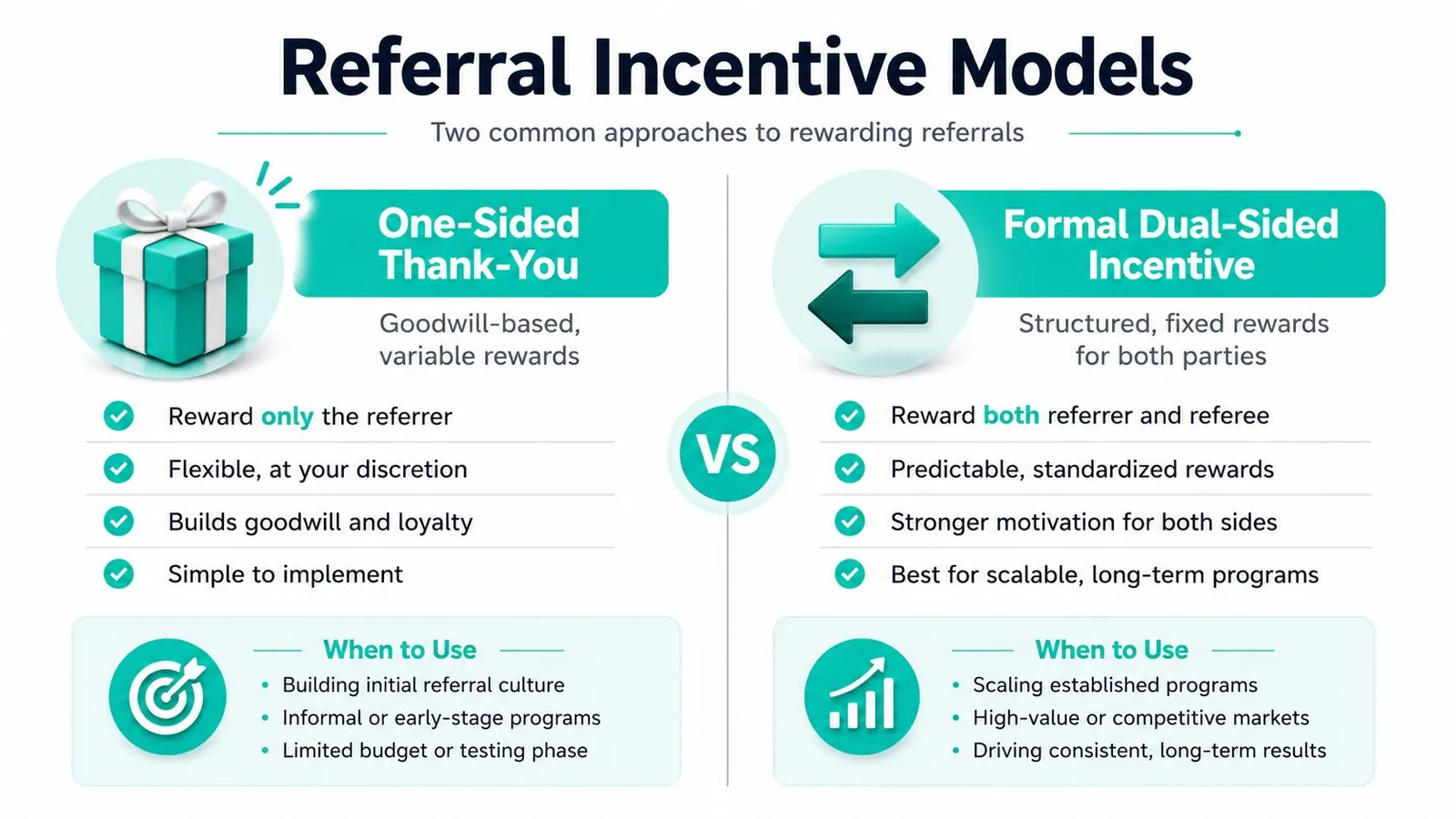
The benchmark data points in one direction. Dual-sided rewards increase participation by 29%, and tiered reward structures generate 27% more referrals than flat rewards (referral program statistics). That doesn't mean every partnership needs a cash payment. It means both sides need a visible reason to care.
Choosing the right reward model
One-sided thank-you gestures work when the relationship is already strong and the volume is low. A handwritten note, a donation in someone's name, or a gift card can be enough for occasional introductions. Formal dual-sided incentives make more sense when you want repeat behavior and a cleaner operating system.
For service businesses, the reward menu usually looks like this:
- Referral fees. Useful when the partner is comfortable with financial compensation and the relationship is tightly defined.
- Revenue share. Better when the referral flow is ongoing and the value is easy to attribute.
- Reciprocal referrals. Best when both businesses have comparable ability to send business.
- Co-branded offers. Helpful when both sides want a visible public asset, such as a joint webinar or shared guide.
- Intro credits. Good for practices that prefer service-based value over cash, like a spa credit or consultation credit.
A medspa might offer a $150 spa credit for a qualified referral, while a consultant or agency could frame a recurring finder's fee in percentage terms if that's standard in the relationship. The specific number or rate should be based on your economics, but the structure matters more than the label. Recepta.ai's scripts for referral calls are useful if you want wording that helps the conversation stay clean when compensation comes up.
Practical rule: choose the reward that matches your sales cycle, not the one that sounds most generous in the moment.
Tiered rewards work because they create a reason to keep participating after the first easy win. That can mean a small reward for the first introduction, a larger reward after a qualified conversion, or a deeper benefit for partners who consistently send fit leads. The point is to make the behavior repeatable, not accidental.
Writing the One-Page Partner Playbook and Agreement
If a referral process lives only in someone's head, it will drift. A one-page partner playbook keeps the relationship legible when new staff join, a client asks questions, or a handoff gets messy. It also gives both sides a document they can point to when something needs clarification.
What goes on the page
A good partner playbook should include five items:
- Ideal referral criteria. Spell out who is a fit and who isn't.
- Introduction steps. State exactly how the first handoff should happen.
- Response-time expectations. Define how quickly the receiving side should acknowledge the lead.
- Ownership after handoff. Make it clear who follows up and when.
- Attribution and reward confirmation. Explain how the referral gets tracked and when the incentive is approved.
The same one-pager can become the basis for a short agreement. That agreement should cover compensation terms, exclusivity or the lack of it, the trial period, and how either side can exit without drama. Jennifer Bourn recommends a trial period before formal compensation, which is a smart way to verify fit before you lock in a payment structure (referral relationship trial period guidance).
A simple trial clause protects both parties from overcommitting too early. If the leads are good and the communication is clean, formalizing the relationship later feels natural. If the fit is weak, you've limited the damage.
Core KPIs to Track for Every Referral Partner
| KPI | What to Measure | Cadence | Action Trigger |
|---|---|---|---|
| Qualified referrals sent | Introductions that meet agreed criteria | Monthly | Review if volume is low |
| Conversion rate | Percent of referrals that become clients | Monthly | Fix if referrals don't close |
| Revenue generated | Revenue tied to each partner | Monthly | Grow if value is consistent |
| Reciprocity balance | Referrals given versus received | Monthly | Pause if the relationship is one-sided |
That structure also pairs well with a CRM or PRM workflow. If you need a practical service page to anchor how your own business frames partnerships and fulfillment, the services overview at Leaping Lemur Media shows the kind of clarity referral partners can work from.
Handling Asymmetry and the Reciprocity Problem
Not every referral relationship will be balanced. One partner may have a faster sales cycle. Another may serve clients with higher lifetime value. A third may have more opportunity to refer than you do. That's normal, and it's exactly why structure matters more than polite optimism.
Three ways referral relationships get lopsided
The first asymmetry is timing. One business can refer quickly, while the other needs weeks or months before a lead becomes a client. The second is value. Two businesses might send the same number of referrals, but the economics behind those referrals can look very different. The third is intent. A partner can be enthusiastic in conversation and still fail to introduce anyone.
A partnership doesn't become unfair just because the volume is uneven. It becomes fragile when nobody talks about the unevenness.
The fix is a give-confirm-request loop. Every introduction gets acknowledged within 24–48 hours, the person receiving the lead confirms what happened, and the side that's underproducing commits to a specific action within a time frame everyone understands (attribution and qualification guidance). That keeps the relationship honest without turning it into a scoreboard war.
When the imbalance persists, don't let it linger forever. A polite exit is better than a dead relationship occupying one of your active slots. Say that the fit is still respected, but the cadence or client pattern isn't working for your business right now. That protects the bridge and frees both sides to focus on partners who are more active.
Smaller, tighter networks can outperform large, inactive ones. A short list of partners who move leads is more useful than a long list of names who never respond. That's the kind of asymmetry management a lot of “how to build referral partnerships” advice skips entirely.
Tracking Attribution and Running Monthly Partner Reviews
You can't improve what you can't attribute. Referral partnerships stop being guesswork the moment each lead is tied to a source, a status, and an outcome. The simplest setup is usually enough, as long as the team uses it consistently.
Set attribution up before volume grows
Track each partner with one or more of these tools:
- Unique partner links for online forms or campaigns.
- Intake-form questions asking how the person heard about you.
- CRM partner tags so referrals can be filtered by source.
- A shared spreadsheet if the CRM isn't ready yet.
The key is confirmation speed. Attribution should be verified within 24–48 hours, which keeps partners confident that their introductions aren't disappearing into a black hole (referral network guidance). If the lead is unqualified, note that too. Otherwise, you can't tell the difference between a weak partner and a weak-fit lead.
The monthly review rhythm that keeps partners active
A monthly review doesn't need to be long. Thirty minutes is enough if the data is clean. For each active partner, review these four KPIs: qualified referrals sent, conversion rate, revenue generated, and reciprocity balance. If one of those numbers is off, decide whether to grow, fix, or pause the relationship.
A simple review template looks like this:
- What changed this month? Ask whether the volume or quality shifted.
- What did we learn about fit? Identify which client types converted best.
- What needs adjusting? Clarify if the playbook, incentive, or timing needs work.
- What happens next? Assign one follow-up action before the next review.
That cadence turns the partnership into an operating system. It also makes the relationship easier to defend internally, because the data shows what each partner contributes. In benchmark guidance, teams are encouraged to document average sales cycle length, close rate, and average price before scaling, since those inputs help estimate ROI and spot unqualified introductions that waste time (benchmark attribution guidance).
A 90-day launch rhythm
Weeks 1 to 2, build the 30-name target list and score it for fit. Weeks 3 to 5, send outreach, book exploratory calls, and narrow to the active set. Weeks 6 to 7, sign agreements and send the first introductions. Weeks 8 to 10, run the first monthly review and double down on the top three partners.
That's the shift from hoping for referrals to engineering them. The businesses that do this well treat partnerships as measurable channels, not as lucky breaks. They define fit, document the handoff, review the numbers, and keep only the relationships that keep producing.
If you want a partner system built for a service business, Leaping Lemur Media helps practices shape referral channels, earned visibility, and digital PR in a way that supports real lead quality, not just more noise. Visit Leaping Lemur Media if you want help turning introductions into a repeatable growth channel and putting a cleaner structure around the relationships that matter most.