

Most advice on how to market a private practice starts with the wrong question. It asks how to get visible everywhere, when the core question is which one or two channels will bring in the right patients without wasting the owner's time, energy, or cash. If you run a solo clinic or a small medspa, broad awareness is a luxury. Predictable patient flow is the job.
The practices that grow in a controlled way don't treat marketing like a side hustle. They tie spend to patient-revenue targets, choose channels that fit capacity, and measure whether inquiries turn into kept appointments. That is why a budget model like the 40/30/20/10 split for search, referrals, reputation, and experiments is more useful than random posting and hope, especially for independent practices that need measurable acquisition economics (Tebra benchmark guide).
If you want a quick reality check on whether your current spend is even in the right neighborhood, it helps to see how small businesses are told to start advertising on a budget before they scale what works. A practical primer like start online advertising on a budget is useful only if you already know your niche and your conversion path. Otherwise, you just buy clicks for the wrong audience.
Table of Contents
- Why Most Private Practice Marketing Fails Before It Starts
- Defining Your Ideal Patient and Building an Authentic Brand
- Building a High-Converting Website and Dominating Local Search
- Creating Referral Pipelines and Community Visibility
- Paid Ads, Social Media, and Content Systems That Actually Work
- Your 3-Month, 6-Month, and 12-Month Marketing Roadmap
Why Most Private Practice Marketing Fails Before It Starts
Most private practice marketing fails because owners try to buy attention before they have a conversion system. They launch ads, post on social media, and spend on directory listings, but the practice still has a fuzzy offer, weak intake tracking, and a website that does not make booking easy. That is not marketing, it is scattered activity.
Capacity beats activity
The first mistake is acting like every channel deserves a turn. A small practice does not need to be everywhere, it needs to be findable where the right patients already look, then ready to convert them fast. That is why a budget framework tied to revenue targets, then split across search, referrals, reputation, and testing, is useful for independents. See the Tebra benchmark guide for a practical reference point.
The second mistake is measuring the wrong thing. Traffic can rise while the schedule stays empty. Followers can climb while inquiries stay low quality. Owners should care more about inquiry quality, conversion rate, and patient source attribution than vanity metrics.
Practical rule: if a channel brings leads your front desk cannot convert into booked visits, it is not a growth channel. It is a distraction.
Pick one discovery engine and build around it
Independent practices usually win by going deep on one primary discovery path first, then adding a second when the first is working. That path can be local search, referrals, or paid ads, but it has to be chosen deliberately. If your intake team cannot tell you where each new patient came from, you are flying blind.
A strong operator asks three blunt questions. Who is the ideal patient. What problem are they trying to solve. What makes them book here instead of calling the next practice.
If you need outside help after the offer, site, and measurement loop are clear, use a partner like Leaping Lemur Media for SEO, ads, and website design for service businesses, including healthcare-facing practices. If you need a lower-cost starting point for paid acquisition, you can start online advertising on a budget without pretending every channel deserves equal spend.
Defining Your Ideal Patient and Building an Authentic Brand
Generic branding is poison for a private practice. If your homepage sounds like every other clinic in town, you've already lost the people who need a specialist, not a slogan. The right move is to define one ideal patient segment and build every message around the way that person thinks, searches, and decides.
Start with the patient, not the service menu
A dentist who serves anxious patients should sound calmer and more precise than a general office trying to please everyone. A medspa targeting confidence-seeking clients should speak to outcomes and comfort, not clinical jargon that makes the experience feel cold. A therapy practice focused on life transitions should use language that reflects the client's emotional state, not a list of credentials that no one outside the field cares about.
The fastest way to sharpen positioning is to answer five questions in plain English.
- Who do you help most often? Name the exact person, not a broad category.
- What pain are they trying to reduce? Use the words they'd search.
- What makes them hesitate? Fear, cost, shame, uncertainty, or time.
- Why should they trust you? Explain your process, tone, and specialty fit.
- What should they do next? Give them one obvious next step.
Once you have those answers, strip your copy of filler. Replace “care” and “solutions” with specifics about the patient experience, the type of support, and the condition or service you handle best.
Make the brand sound like a real practice
Brand voice matters because it tells people whether they belong. A practice that serves teens, busy parents, or nervous first-timers should sound human, grounded, and clear. That doesn't mean casual for the sake of being casual. It means writing in a way that reduces uncertainty.
Your homepage, service pages, and intake forms should feel like they came from the same practice. The details matter here, because inconsistency makes people doubt whether you're organized enough to handle their care.
For a closer look at how a practice can present itself with intention, the team page at Leaping Lemur Media is a clean example of a brand that ties identity to audience. That's the standard to aim for, not loud marketing copy that sounds pasted from a template.
Good positioning reduces friction. When the right patient reads your site, they should think, “This is for me,” without having to decode your language.
Building a High-Converting Website and Dominating Local Search
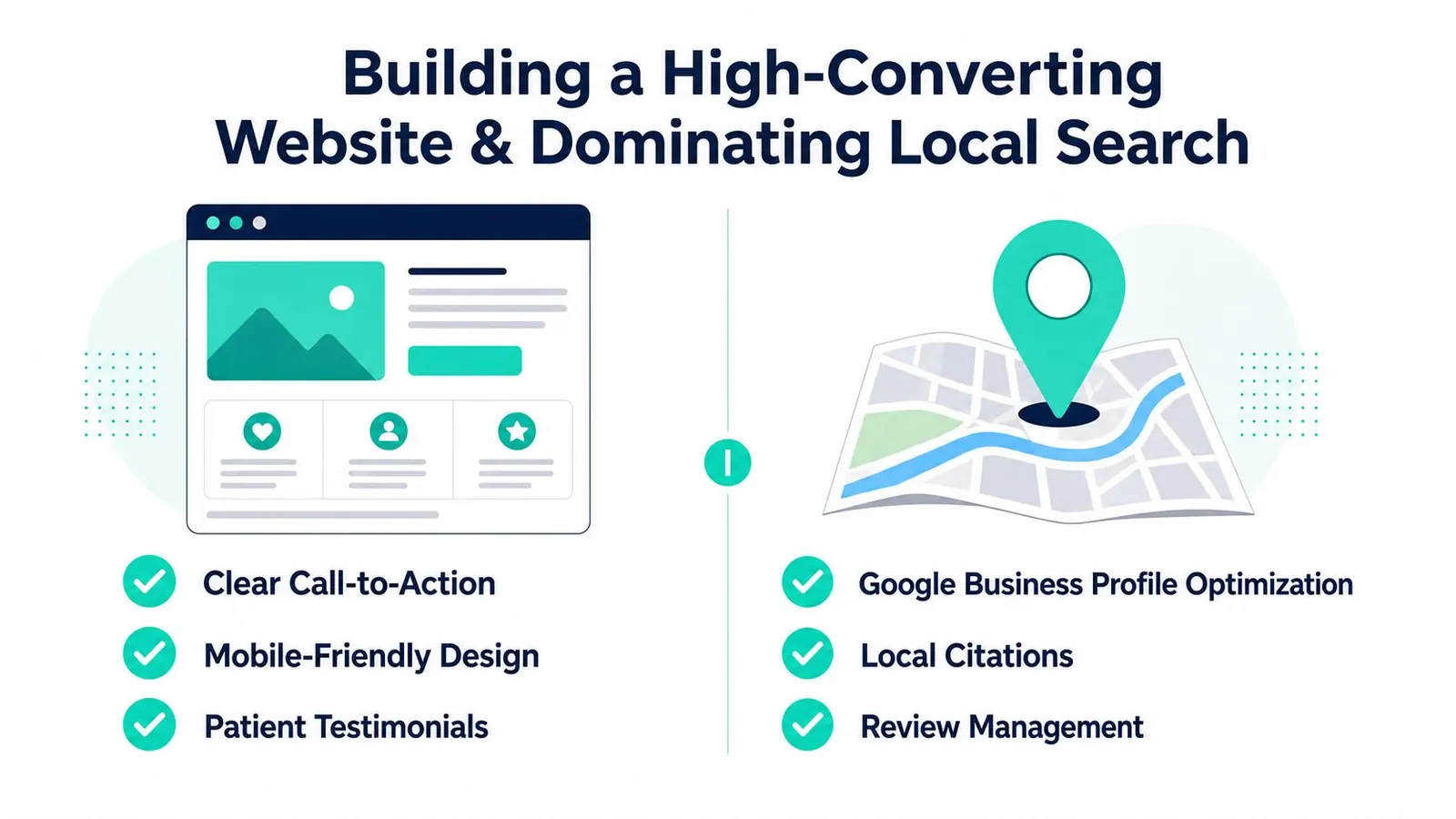
A private practice website has two jobs, and both matter. It should make the right visitor feel understood, and it should make booking easy. If it only does one, you are leaking revenue. If it does neither, you are paying for digital space that acts like a brochure.
Put the specialty above the fold
The homepage has one job in the first screenful, tell people what you do, where you do it, and who you serve. One industry guide recommends putting the niche in the above-the-fold section and creating separate services pages for each specialty or treatment (private-practice website guidance). That is the right move because generic homepages confuse both patients and search engines.
Your service pages should answer the questions people are already asking. What is the treatment. Who is it for. What happens in the first visit. What does it cost or what insurance do you take. What should they do if they want to move forward. If the visitor has to hunt for that information, they will leave.
Make contact frictionless. Display fees, insurance, hours, and contact options clearly. The peer-reviewed review on digital marketing for private practice advises making the phone number visible on every page and posting at least one new article per week, with each article at least 400 words and containing one to three relevant keywords (PMC review). Those are not decoration points. They are conversion points.
Treat local search like infrastructure
Local search works when your practice data is consistent. That means the practice name, address, and phone number need to match exactly across profiles, listings, and the website. Inconsistency is not a branding quirk, it weakens local visibility and hurts trust.
A Google Business Profile should be handled like a live storefront. Keep the categories accurate, the description clear, the hours current, the photos recent, and the reviews managed. If your profile still looks abandoned, patients read that as a signal that the practice is inactive or disorganized.
Speed matters too. If your site is slow, the user experience suffers before your message even gets a chance to work. For a practical breakdown of site speed fixes, how to improve Core Web Vitals is worth reviewing once the content structure is in place. Fast pages do not replace good positioning, but they stop friction from ruining otherwise solid traffic.
The other hidden variable is consistency across every profile, from directories to maps to social bios. That consistency is a core local-search mechanism, not just a housekeeping chore. If your site says one thing and your listings say another, search engines and patients both notice.
The journal at Leaping Lemur Media is useful for owners who want to keep their marketing knowledge close without getting buried in generic advice.
Creating Referral Pipelines and Community Visibility
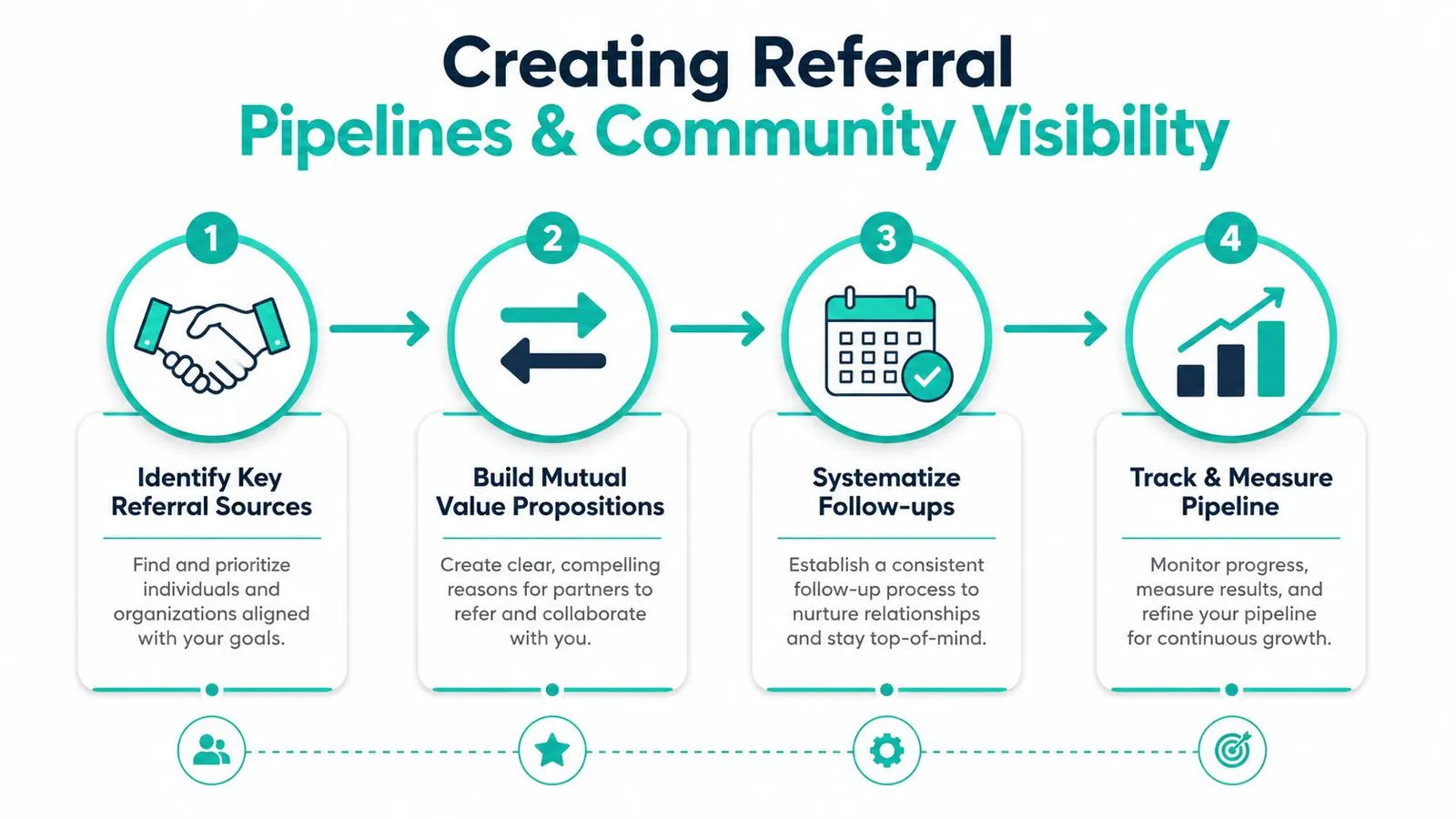
Referrals do not happen by luck. They come from a deliberate pipeline built through steady contact, clear positioning, and a practice that people can describe in one sentence. Owners call this networking because it sounds lighter than sales, but the matter is simple. This is a revenue channel with relationships attached.
Turn introductions into a repeatable process
You need a rhythm, not random outreach. For a small practice that depends on predictable growth, set a weekly target for contacting potential referrers and make that activity visible inside the business. The AAAI practice management guide supports consistent outreach to MD referrers, and that mindset fits any clinic that cannot afford to wait around for goodwill.
The right referral sources depend on the patient you want. A therapist serving women through divorce may focus on couples counselors, attorneys, and primary care providers who hear those concerns first. A dental practice may work best with local physicians, orthodontic offices, and family-focused community groups. A medspa usually gets stronger referrals from complementary wellness businesses, estheticians, and event planners than from generic mixers where everyone is trying to sell everyone else.
Keep the message short. Say who you serve, what you do best, and when you are a fit. That is enough. Long explanations blur the point and make it harder for a busy referrer to remember you.
Referrals grow when you become easy to remember and easy to trust.
Track the source at intake
If your front desk does not ask how the patient heard about you, you are guessing. One intake question changes the economics of the whole channel because it shows which sources bring in inquiries that book. It also tells you which partners send people who show up, not just people who ask questions.
Use that information to protect your time. Keep the sources that produce scheduled patients, and stop pretending that every handshake is valuable. A small practice cannot afford to fund vague visibility.
Community visibility works the same way. Consistency beats random attention, so use a steady public rhythm that the local market can recognize. That may mean periodic press outreach, local partnerships, or a few well-chosen appearances that match the practice's position. If you want help turning that into a usable system, Leaping Lemur Media services can be part of the mix, but only if it supports a clear referral plan instead of adding noise.
The B2B newsletter for accountants is another example of how specific channels win when they speak to a defined audience instead of chasing broad attention.
A solo practice does not need a giant community relations program. It needs a short list of referral sources, a regular contact cadence, and a staff habit of recording attribution correctly. Get those three things right and the channel starts producing schedulable patients, not just polite conversations.
Paid Ads, Social Media, and Content Systems That Actually Work
Private practices waste money when they treat paid ads, social media, and content as if they all do the same job. They do different jobs, and your budget should reflect that. Use ads for immediate demand, short-form video for trust, and content for durable search visibility. If you only have room for one or two channels, pick the ones that match your real bottleneck.
Paid search is for intent, not awareness
Search ads work when the patient is already looking for the service you provide. Build campaigns around high-intent keywords, send traffic to tightly matched landing pages, and give visitors one clear action to take. If you push ad traffic to a generic homepage, you pay for curiosity instead of booked inquiries.
The mistake I see most often is weak measurement. Conversion tracking has to be set up properly, not just analytics installed, because you need to know which clicks become calls, forms, and bookings, as noted in the 2025 marketing tips guide. If you cannot connect spend to scheduling, you are guessing.
Social media works when it builds trust fast
Static posting rarely moves the needle for local practices. Short-form video does better when it answers common questions, shows behind-the-scenes care, and makes your approach feel familiar. Patients do not need polished performance. They need reassurance that you are competent, safe, and easy to approach.
That matters even more in crowded markets, where people compare providers before they book. Video lets them hear your voice and see your manner before they commit. If you are going to spend staff time here, use it to clarify who you are and how you help, not to chase whatever trend is popular this week.
Content marketing earns search visibility
The peer-reviewed review on private-practice digital marketing recommends one new article per week, with each article at least 400 words and using one to three relevant keywords (PMC review). That is a clean standard because it connects publishing with search visibility and patient education.
A good content system should not feel like a marketing machine. It should sound like answers to real questions from local patients. Why does this treatment matter. How does insurance work. What should someone expect at the first visit. Those are the pages and posts that move people toward booking.
If you want a vendor example for paid media or search support, Leaping Lemur Media's services cover website design, SEO, and ads. That mix only helps when you already know which channel deserves your limited budget and which one does not.
Budget and effort should follow the channel
| Channel | Best use | Main weakness | What to watch |
|---|---|---|---|
| Paid ads | Fast demand capture | Burns cash if targeting is loose | Booked inquiries |
| Social media | Trust and familiarity | Easy to overproduce, hard to convert | Replies and clicks |
| Content | Long-term discoverability | Slow to mature | Search-driven inquiries |
A newsletter-style content system can work for other service businesses too, which is why models like a B2B newsletter for accountants are worth studying as a format, even if the audience is different. The lesson carries over cleanly. Consistent, useful information builds authority, and in healthcare that authority should feed back into bookings.
Your 3-Month, 6-Month, and 12-Month Marketing Roadmap
Private practice marketing works only when the plan matches the practice's real capacity. The first three months should go to positioning and infrastructure, not chasing every shiny channel. By month six, the practice should be putting more money and attention into the sources that produce qualified inquiries. By month twelve, the goal is to make the practice less dependent on any single source of new patients.
Phase by phase priorities
| Phase | Key Priorities | Budget Focus | Primary KPIs |
|---|---|---|---|
| First 3 months | Define the niche, fix the website, complete local listings, start referral outreach | Search, referral development, reputation setup | Inquiry volume, lead source, booking rate |
| By month 6 | Publish content, improve conversion paths, test paid search if the basics are working | Shift more toward the channels showing schedulable patients | Conversion rate, show rate, source quality |
| By month 12 | Strengthen reputation, formalize community visibility, diversify acquisition carefully | Balance the budget across core channels and a small test pool | Repeat inquiries, source mix, patient retention |
Budget should follow the channels that drive acquisition. A useful benchmark is the 40/30/20/10 split for search, physician referrals and partnerships, reputation management, and experiments, as outlined in the Tebra benchmark guide. That split works because it keeps spend tied to real patient acquisition work instead of hopeful spending. It also keeps a small practice from putting too much money into channels that have not earned more budget.
Cash reserve matters too. A private-practice success guide recommends keeping 3 to 6 months of income in reserve and pairing that with 5-year, 1-year, 3-month, and weekly goals (private-practice success guide). That buffer gives marketing time to work without forcing panic decisions when the schedule gets soft.
Operating rule: build the marketing machine at a pace your cash flow can handle, then let the results decide what gets more money.
Track the numbers that matter. Inquiry source, booked appointments, show rates, and the quality of each lead belong on the same dashboard. Cut channels that bring noise. Put more budget behind the ones that attract the patients you want to treat.