How to Grow a Small Business with a Practical Playbook
LLSeptember 6, 202613 min read
You've had a good month, then a quiet one. Your team is busy, but the bank balance doesn't reflect the effort. New inquiries arrive from several places, yet nobody can explain which channel produces profitable customers. Meanwhile, hiring feels risky, advertising feels expensive, and the work of serving existing patients or clients keeps pushing marketing to the bottom of the list.
That's the reality behind the question, how to grow a small business. Sustainable growth isn't a matter of attracting more attention. It comes from improving the economics of each customer, making delivery more consistent, and building enough visibility that the right people can find and trust you.
Why Growing a Small Business Feels Harder Than It Should
A dental practice may have excellent clinical care but an unclear reason for a new patient to choose it. An eye doctor may rely on word of mouth while nearby competitors appear everywhere in local search. A medspa owner may run promotions that fill the calendar with low-margin appointments. A law firm may receive plenty of inquiries but lose qualified prospects because follow-up is slow or the next step is confusing.
In each case, the owner is working hard. The problem is that effort is spread across too many activities without a dependable system connecting positioning, lead generation, conversion, retention, and capacity.
The early years make this especially unforgiving. About 79.6% of new U.S. businesses survive their first year, 50.6% survive five years, and 34.7% survive ten years, according to reporting based on Bureau of Labor Statistics data from the Commerce Institute's business failure analysis. Roughly one in five closes within the first year, about half are gone by the fifth year, and around two-thirds have exited by the tenth.
Those figures don't mean owners should chase reckless expansion. They point to a more useful conclusion: the first 12 to 60 months demand operating discipline. Cash flow, customer acquisition, scheduling, staffing, and service quality have to work together before a larger marketing budget can help.
Practical rule: Don't scale demand until you know how much profitable demand your business can deliver well.
A practical playbook starts with diagnosis. If inquiries are weak, clarify who you serve and why you're different. If inquiries are strong but bookings are poor, repair the conversion experience. If bookings are healthy but margins are thin, improve pricing and delivery before buying more traffic. If customers leave after one interaction, retention deserves attention before acquisition expands.
The promise is not instant growth. It's a business that becomes easier to choose, easier to operate, and more valuable with every customer relationship. That's a far stronger foundation for a local practice than a campaign that creates temporary activity without improving the underlying model.
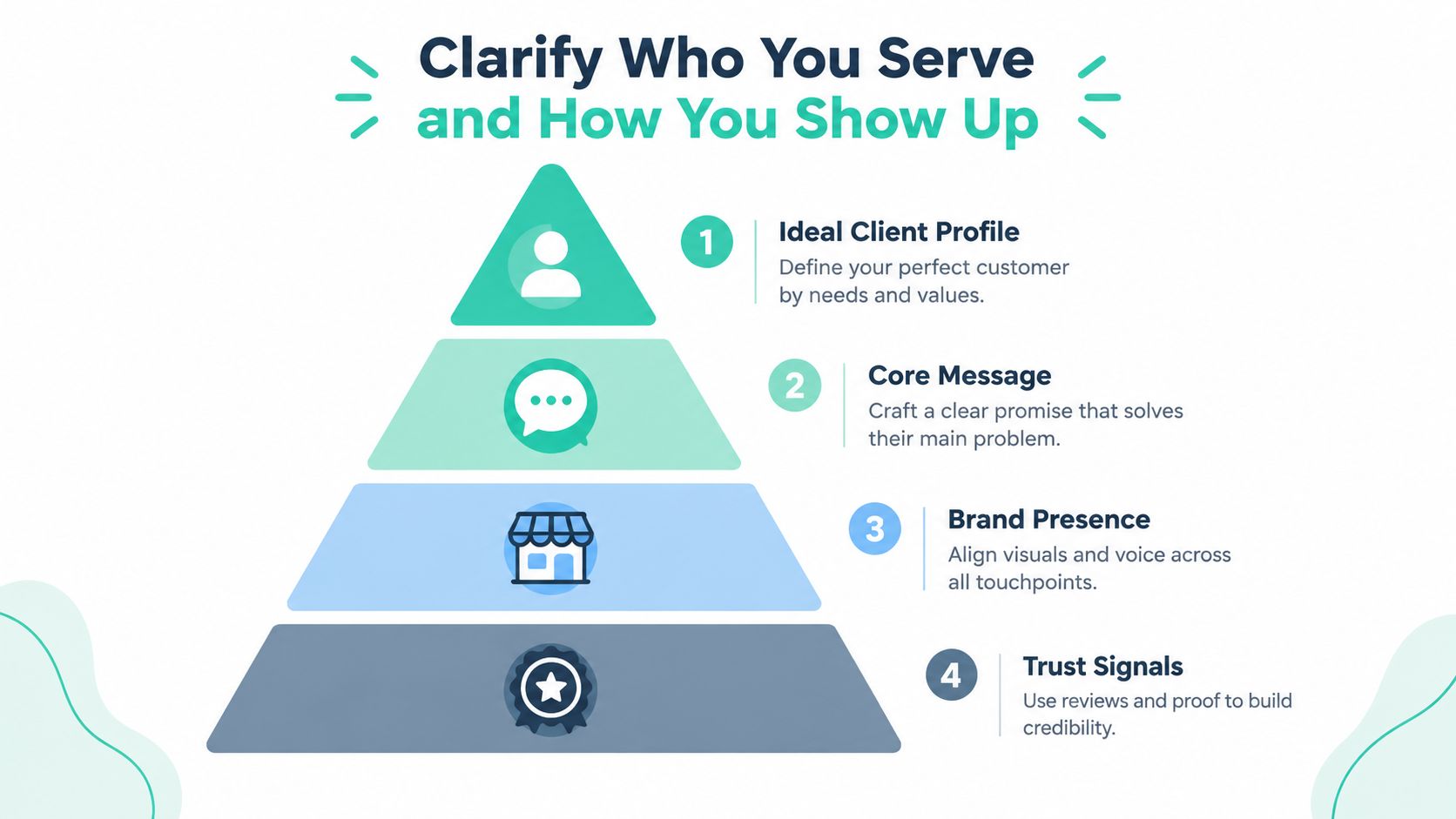
Clarify Who You Serve and How You Show Up
Broad positioning sounds safe, but it usually makes marketing forgettable. “Full-service dental care,” “quality legal representation,” and “advanced aesthetics” tell prospective customers what category you're in. They don't explain why your practice fits their situation better than the alternatives.
Start with one clearly defined customer group. A dentist might focus on anxious adults who want calm, judgment-free care. An eye doctor might serve busy families who need efficient exams and children's eyewear guidance. A medspa could specialize in clients seeking conservative, education-led treatment plans. A law firm might concentrate on local business owners facing a specific type of legal problem.
Build a sharper positioning statement
Write one sentence using this structure:
We help [specific customer] achieve [meaningful outcome] through [distinctive approach].
Keep the language close to how patients or clients describe their problem. “We help nervous adults feel comfortable returning to regular dental care through unrushed appointments and clear explanations” is more useful than “We deliver exceptional patient-centered dentistry.”
Then test the statement against three questions:
Recognition: Would the right person immediately see themselves in it?
Relevance: Does it address a problem they're actively trying to solve?
Proof: Can your team demonstrate the promise through experience, process, reviews, or results?
Your answer should shape your website, Google Business Profile, social content, sales conversations, and appointment experience. A positioning statement isn't a slogan you place on a homepage and forget. It's a filter for deciding which services to emphasize and which opportunities to decline.
Make the brand feel consistent
A strong position loses power when every touchpoint sounds different. The receptionist shouldn't describe the practice one way while the website makes a different promise. Ads shouldn't attract bargain seekers if the business depends on premium, relationship-based service.
Review the customer journey from first search to follow-up. Look for mismatched language, unclear calls to action, outdated photos, and services that receive attention but don't fit your profitable customer profile. A consistent voice builds familiarity, especially in trust-based sectors where people often compare several providers before contacting one.
Small firms also matter beyond their own owners and teams. Businesses with fewer than 250 employees accounted for 52.8% of total net job creation between the first quarter of 2021 and the second quarter of 2024, and 51% from the third quarter of 2020 to the third quarter of 2025, according to the U.S. Bureau of Labor Statistics. Clear positioning helps a small firm become more visible, more employable, and more capable of building capacity without trying to look like a national chain.
For examples of how a strategy partner can approach brand clarity and community-rooted marketing, explore Leaping Lemur Media's about page. The important point isn't the agency. It's the discipline of making your message sound like your practice on purpose.
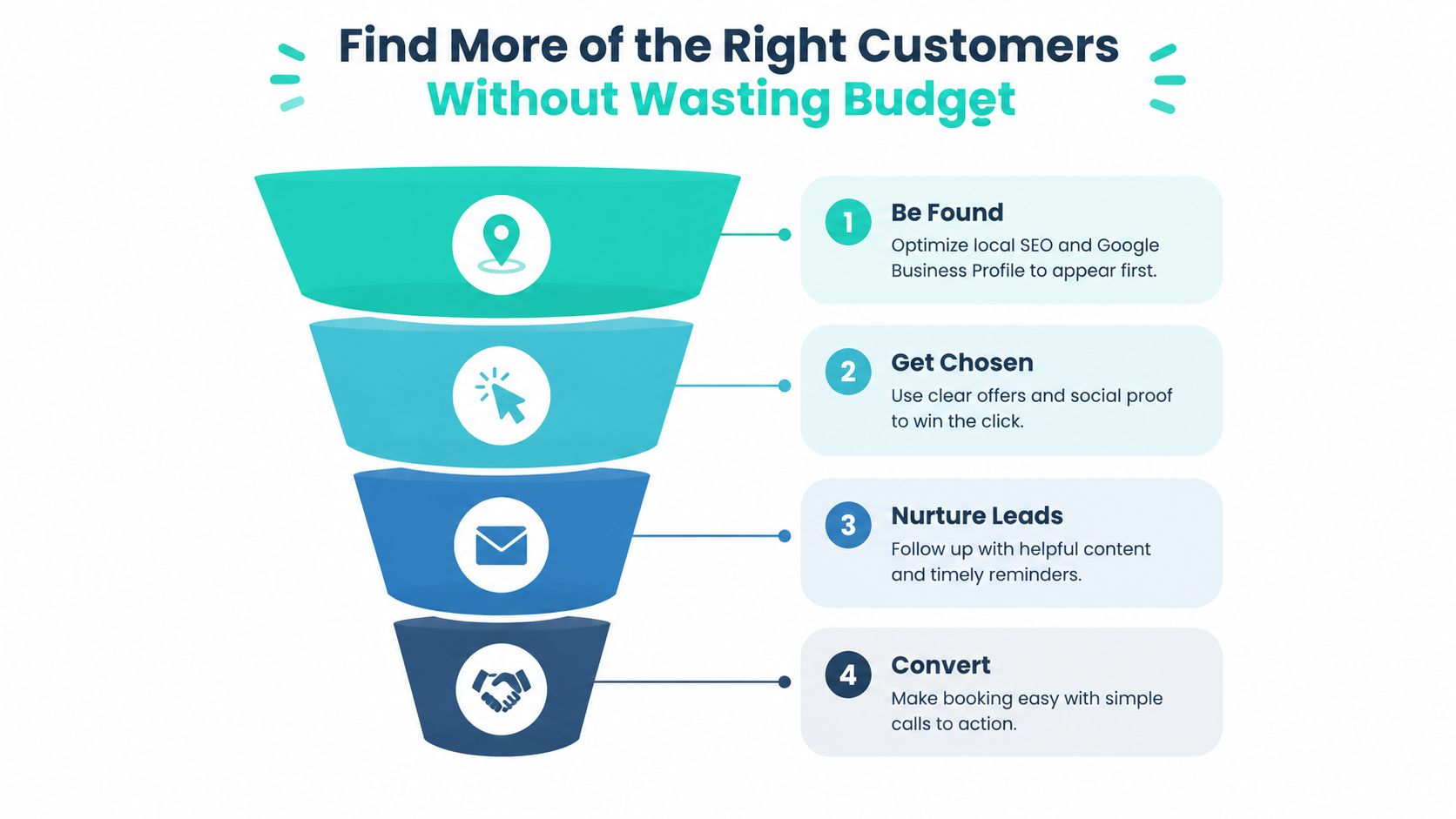
Find More of the Right Customers Without Wasting Budget
Acquisition works best when each channel has a defined job. Local search helps people discover you when intent is already high. Referrals transfer trust from an existing customer. Paid advertising can create controlled demand, but only when the offer, landing page, and follow-up process are ready.
Start with local visibility. Make sure your Google Business Profile accurately reflects your services, service area, hours, contact details, photos, and appointment options. Build individual website pages for meaningful services and locations rather than placing every offer on one generic page. Publish useful answers to questions your ideal patients or clients ask before they book.
Match the channel to the constraint
Referrals need a process, not just hope. Ask satisfied customers at an appropriate moment, make sharing easy, and give the team a natural way to mention who you're best equipped to help. A law firm might provide a short explanation clients can forward to another business owner. A medspa might follow up after a successful appointment with education that encourages a future conversation rather than an aggressive offer.
Paid campaigns should come after the basics are measurable. Use Google Ads for clear, high-intent searches, Meta for audience education and retargeting, and TikTok only when the format fits the practice and the team can produce credible creative. Don't judge a campaign by impressions or clicks alone. Track the path from source to inquiry, booked appointment, completed service, and collected revenue.
Inflation makes this discipline essential. Forty-five percent of small businesses marked inflation as one of their biggest issues in late 2025, while 50% named inflation or rising costs their top concern; 33% said rising costs blocked expansion into new markets, according to the U.S. Chamber of Commerce's small business survey.
Budget test: If you can't explain how a channel produces profitable customers, reduce the spend until you can measure the path.
Use short feedback loops. Review search terms, call quality, booked consultations, no-shows, and revenue by source. If an ad produces inquiries that your team can't serve profitably, the campaign isn't a growth asset. It's a capacity problem wearing a marketing label.
For support with websites, SEO, content, and paid growth campaigns across channels such as Google, Meta, and TikTok, review Leaping Lemur Media's services. The right choice depends on your margin, message, and ability to follow through, not on which channel sounds most fashionable.
Keep Customers Longer and Turn Experience Into Growth
New customers are expensive in attention, time, and trust. Retention lets you earn more from relationships you've already started, while also creating the conditions for referrals and stronger reviews.
Bain's widely cited research finds that increasing customer retention rates by 5% raises profits by 25% to 95%, depending on industry and cost structure, as documented in the archived Bain research source. The range matters. Retention doesn't create an identical financial effect for every company, but it shows why keeping customers deserves the same strategic attention as acquiring them.
For an appointment-based practice, retention often improves through small operational details:
Schedule the next step: Offer rebooking before the patient or client leaves, when the value of continuity is easiest to explain.
Follow up with purpose: Send care guidance, preparation details, reminders, or answers to common questions instead of generic promotional messages.
Recover quickly: When a customer has a poor experience, acknowledge the issue, provide a clear resolution, and document what the team should change.
Make progress visible: Summarize what happened, what comes next, and when the customer should contact you again.
Invite useful feedback: Ask about friction in booking, communication, wait times, and service delivery, then act on recurring themes.
Turn communication into a service asset
Email can support recall, education, rebooking, and referrals without requiring the owner to manually contact every person. A dental office might create separate reminders for preventive care and treatment follow-up. An eye doctor can send preparation notes and eyewear updates. A law firm can offer plain-language updates that reduce uncertainty between meetings.
For healthcare practices managing high volumes of routine questions, conversational AI for patient communication can be evaluated as one way to extend responsiveness while keeping the human team focused on issues that require judgment and care. Any tool should support privacy, accurate escalation, and a warm patient experience. Automation shouldn't make communication feel automated.
Reputation is part of retention, too. A customer who feels remembered is more likely to return and recommend the practice. Review requests should follow a genuine service moment, and negative feedback should reach a person who can respond rather than disappear into an inbox.
A useful retention review asks three questions: Where do customers commonly stop? What information would make the next step easier? Which parts of the experience can be made more personal without adding administrative strain? Resources and ideas about sustained practice growth are available through the Leaping Lemur Media journal.
Price Smart Operate Lean and Build Capacity Before You Hire
Growth can damage a small business when revenue rises faster than margins, systems, or service quality. The owner sees more bookings and assumes the next move is hiring. Then payroll, training, scheduling gaps, and inconsistent delivery consume the additional revenue.
Capital constraints make that sequence even more dangerous. In 2025, 81% of small business owners who applied for financing said affordable capital was difficult to access, 49% had to halt expansions, and 89% of those hiring said finding qualified workers was difficult, according to Goldman Sachs' small business survey.
Improve the economics before increasing volume
Begin with a service-level margin review. Identify which offers create healthy contribution after labor, supplies, fees, discounts, and delivery time. A medspa may discover that a popular promotion produces little room for follow-up care. A law firm may find that certain matters generate revenue but consume disproportionate administrative time. A dental practice may need to distinguish profitable treatment plans from appointments that repeatedly create scheduling strain.
Pricing should reflect value, complexity, urgency, and capacity. Don't use discounts to solve a positioning problem. If customers don't understand the difference between your service and a cheaper alternative, clarify the offer before cutting the price.
Then map capacity in practical terms:
Calendar capacity: Which appointment types fill the schedule, and which create gaps?
People capacity: Which tasks require licensed expertise, and which can be documented or delegated?
Process capacity: Where do handoffs, approvals, callbacks, or billing delays slow delivery?
Quality capacity: What level of demand can the team handle without longer waits or weaker communication?
Use leverage selectively
Document recurring work with checklists, templates, intake forms, scheduling rules, and training materials. A partner can handle specialized marketing, a scheduling tool can reduce manual coordination, and carefully selected automation can answer routine questions or route requests. These choices extend the team without pretending that software can replace clinical, legal, or relationship-based judgment.
Growth is healthy only when the customer experience remains worth paying for.
Hire when the bottleneck is persistent, measurable, and economically justified. Before adding a full-time role, test whether the work can be narrowed, standardized, outsourced, or shifted to a better process. Capacity planning won't eliminate staffing challenges, but it prevents the business from hiring in response to temporary chaos.
Measure What Matters and Grow With Confidence
A growth plan becomes practical when the owner can see what changed and why. You don't need a dashboard filled with every available metric. Start with four operating signals: lead volume, conversion rate, average order value, and headcount capacity.
Lead volume tells you whether enough potential customers are entering the system. Conversion rate shows whether the message, offer, trust signals, and follow-up are working. Average order value reveals whether the business is attracting valuable work and pricing it appropriately. Capacity tells you whether the team can fulfill additional demand without lowering standards.
Build a simple weekly review
Use one sheet or dashboard. Record the source of each inquiry, whether it became a qualified opportunity, whether it booked, what service it purchased, and whether delivery was completed successfully. For professional services, include the time spent before and after the sale. A lead that looks valuable on paper may be unprofitable when it requires extensive unpaid consultation.
Review the numbers weekly, but make major decisions with enough context to avoid reacting to a single unusual day. Ask:
Which source produced customers, not just inquiries?
Where did qualified prospects stop moving?
Which offer generated strong value without overwhelming delivery?
What capacity constraint would appear first if demand increased?
What customer feedback should change the message or process?
Avoid the common traps. Traffic can rise while revenue stays flat. Followers can increase while bookings remain weak. A full calendar can hide underpricing. More leads can create longer response times, poorer service, and higher churn when the team has no operating room.
The growth benchmark should also be realistic. Only about 7% to 17% of firms with at least 10 employees achieved average annualized employment growth above 10% over three years between 2016 and 2018, and half of SMEs grew at 1% per year or less in employment from 2011 to 2020, according to OECD SME indicators. The lesson isn't to settle for stagnation. It's to build repeatable systems instead of assuming rapid scaling is normal.
Use a focused 90-day rhythm
In the first phase, tighten your ideal customer, core offer, and proof. In the next phase, improve one acquisition channel and connect it to source-level conversion tracking. In the final phase, strengthen follow-up, rebooking, pricing, and delivery capacity before increasing spend.
Choose one owner for each action and review progress at the same time every week. Consistency will outperform a burst of activity followed by neglect. A small business grows with confidence when every new customer strengthens the economics and the system, not just the top-line activity.
Leaping Lemur Media helps local practices and small businesses clarify positioning, build fast, conversion-focused websites, improve SEO and content, and run paid growth campaigns tied to revenue and profit. Visit Leaping Lemur Media to explore a practical marketing partnership built around visibility, trust, and sustainable capacity.