Local marketing is the work of being visible, credible, and easy to choose in the exact places nearby customers are already looking. For practices, that matters because 69% of people say at least half of their searches have local intent, and 37% say more than two-thirds are local.
A dentist can have a polished website, experienced clinicians, and a welcoming office, yet still notice that new patient calls have gone quiet. An eye doctor may rank well for a broad service but disappear when someone searches from the next town. A medspa might be known by existing clients but overlooked by people comparing providers on Google Maps. A law firm may have a strong reputation offline while its online presence gives prospective clients little reason to call.
That gap is where local marketing works. It connects the quality of your practice with the people who live, work, commute, or regularly travel within realistic reach of it.
Table of Contents
- What Local Marketing Really Means for a Practice
- Why Local Search Behavior Changed the Game
- How to Define Your Real Local Market
- The Five Core Channels Every Practice Should Know
- Where to Focus When the Budget Is Tight
- How Dentists, Eye Doctors, Medspas, and Law Firms Put It to Work
- The Numbers That Prove It Is Working
- Your First 30 Days and the Questions Owners Ask Most
What Local Marketing Really Means for a Practice
A practice owner often starts with the same question: “Why aren't more people finding us?” The answer usually isn't that the practice needs louder advertising. It may need clearer local signals, stronger proof, or a simpler path from search result to appointment.
Local marketing is the work of being visible, credible, and easy to choose in the exact places nearby customers are already looking. Those places include Google Search, Google Maps, review platforms, local directories, community spaces, and the practice website itself.
General marketing may aim to build awareness with a broad audience. Local marketing narrows the focus to people who could realistically become patients or clients. A family dentist doesn't need every internet user to know the brand. The practice needs nearby families searching for cleanings, emergency care, implants, or orthodontic treatment to see a trustworthy option and know what to do next.
That makes proximity, trust, and action central. A complete local presence answers practical questions quickly:
- Is this provider close enough?
- Does the practice offer the service I need?
- Do patients or clients describe good experiences?
- Is the office open?
- Can I call, request an appointment, or get directions now?
Clinical excellence remains the foundation. Local marketing isn't a replacement for patient care, professional ethics, or a good experience. It's the connective tissue that helps the right people discover those qualities.
Practical rule: Your marketing should make it easier for a nearby searcher to understand, trust, and contact the practice without extra effort.
The work can include a clear view of how a marketing partner approaches practice growth, but the strategy should always begin with the practice itself. Define who you serve, where those people come from, which services matter most, and what evidence helps them feel comfortable choosing you. From there, channels, priorities, examples, metrics, and a first-month plan become much easier to manage.
Why Local Search Behavior Changed the Game
A prospective patient may find a practice before ever entering its office. Someone searching for an emergency dentist could compare map listings, return later to check insurance information, and read reviews before calling. A medspa prospect may review treatment pages and photos from several providers without making an initial visit.
Local discovery has become a regular habit. BrightLocal's 2026 consumer research found that 84% of consumers searched for a local business in the past 3 months (BrightLocal local SEO statistics). SOCi data summarized by Taylor Scher SEO reports that 80% of U.S. consumers search for local businesses online at least weekly, while 32% search daily (local search behavior data).
That repeated exposure changes the practice's job. Each appearance should answer a different concern, such as whether the service is available, whether the location is convenient, and whether other patients had a good experience. A profile that is accurate but lacks current reviews may answer only part of the decision.
The first contact often happens on a phone screen. Moz cites research showing that 33% of searches return a Google local pack (Moz's local SEO industry history). That map display can serve as the first waiting-room impression, showing the practice name, category, location, hours, reviews, photos, and contact options before a prospective patient speaks with the team.
Search also shortens the distance between interest and action. 76% of people who search for something nearby visit a business within 24 hours, and 28% of local searches result in a purchase, according to Biziq's summary of local search statistics (Biziq local search data). For a dentist, eye doctor, medspa, or law firm, the comparable action may be a call, consultation request, or appointment booking.
| Local Behavior Statistic | What It Means for Your Practice |
|---|---|
| 69% say at least half of their searches have local intent (Moz) | Local visibility belongs in the core growth plan, not as a side project. |
| 80% of U.S. consumers search locally weekly, and 32% daily (Taylor Scher SEO) | Profiles and reviews need ongoing attention because people return to them often. |
| 76% visit a nearby business within 24 hours (Biziq) | Accurate hours, click-to-call access, and clear appointment paths can affect near-term decisions. |
| 33% of searches return a local pack (Moz) | The map listing may shape the first impression before the website does. |
The important shift is strategic. Local marketing is not a checklist of profiles and posts. It connects the practice's real service area and audience with trust signals that help nearby searchers choose, contact, and book.
How to Define Your Real Local Market
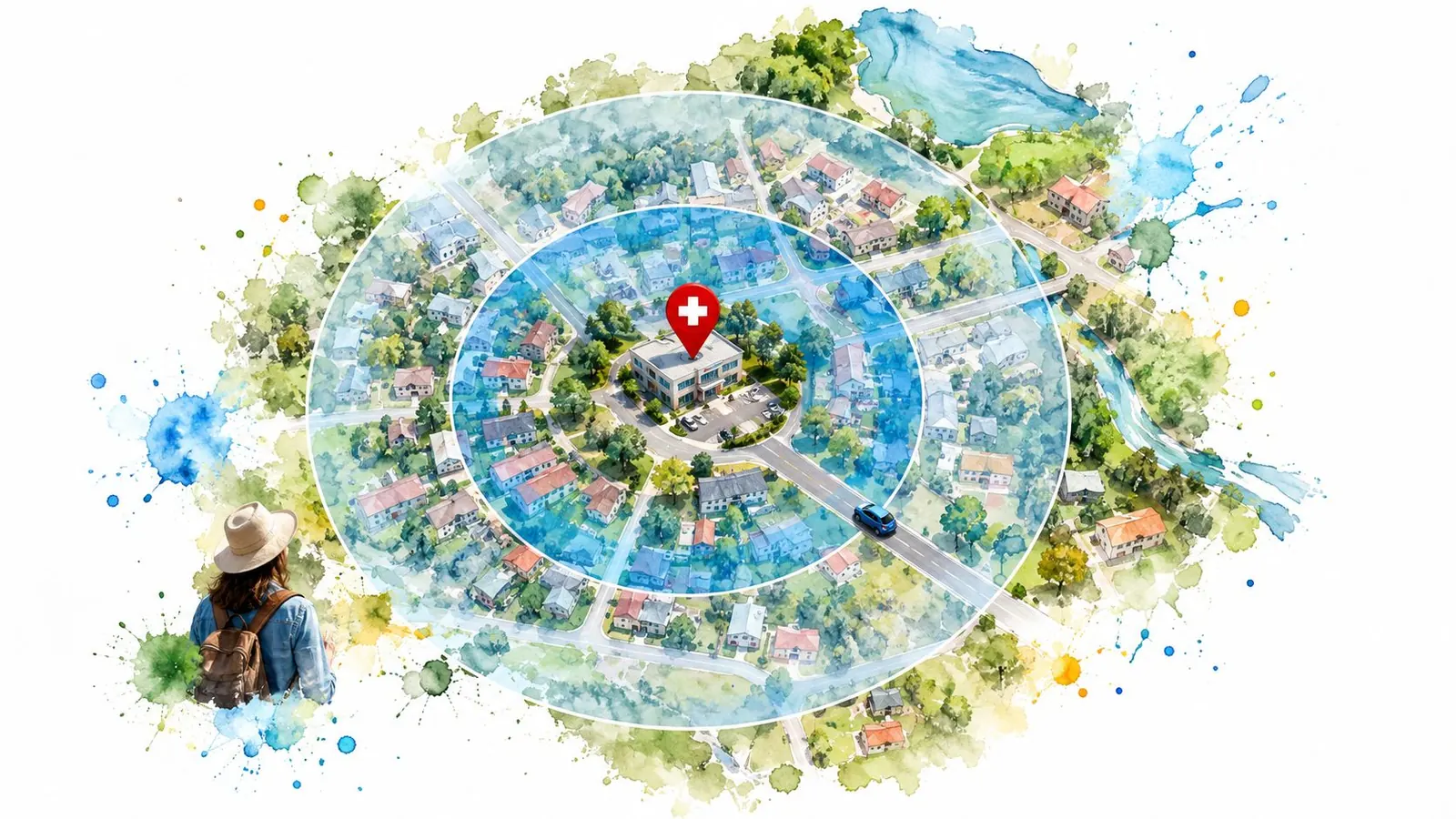
“Local” doesn't always mean the city printed on your office address. It means the area from which people will realistically travel, commute, receive a referral, or consider your service valuable enough to justify the trip.
A general dentist may draw most routine appointments from a nearby radius. An ophthalmologist with specialized expertise may attract patients from a much wider region. A medspa may serve a particular neighborhood whose residents match its treatment focus and positioning. A personal injury firm may receive matters from across a metropolitan area or from specific counties rather than from adjacent streets.
The right service area depends on the practice, the service, and the reason someone is searching. One neutral overview of local marketing and service-area definitions notes that “local” can be subjective and may extend much farther for specialists than for everyday services.
Use evidence instead of assumptions
Start by mapping where real patients and clients come from. Useful inputs include:
- Drive-time areas: Mark the roads and travel routes people can reasonably use, not just a circle around the office.
- Patient origin data: Review zip codes in your PMS or EHR to identify where completed appointments originate.
- Referral patterns: Note which physicians, organizations, employers, or communities send people to you.
- Insurance coverage: A provider network can expand or narrow the practical market for certain services.
- Competitor density: A crowded area may require sharper specialization, while a wider service area may support a broader reach.
- Service value: Someone may travel farther for surgery, cosmetic treatment, complex legal representation, or specialist care than for a routine appointment.
Multi-location practices should repeat this exercise for each location. Don't assume every branch needs the same city pages, ad radius, or neighborhood message.
Your final output should be a practical map with priority areas, secondary areas, and places that aren't worth targeting. That map becomes the foundation for location pages, Google Business Profile content, paid ad settings, referral outreach, and reporting. Without it, a practice can spend money reaching people who are too far away while missing the communities most likely to book.
The Five Core Channels Every Practice Should Know
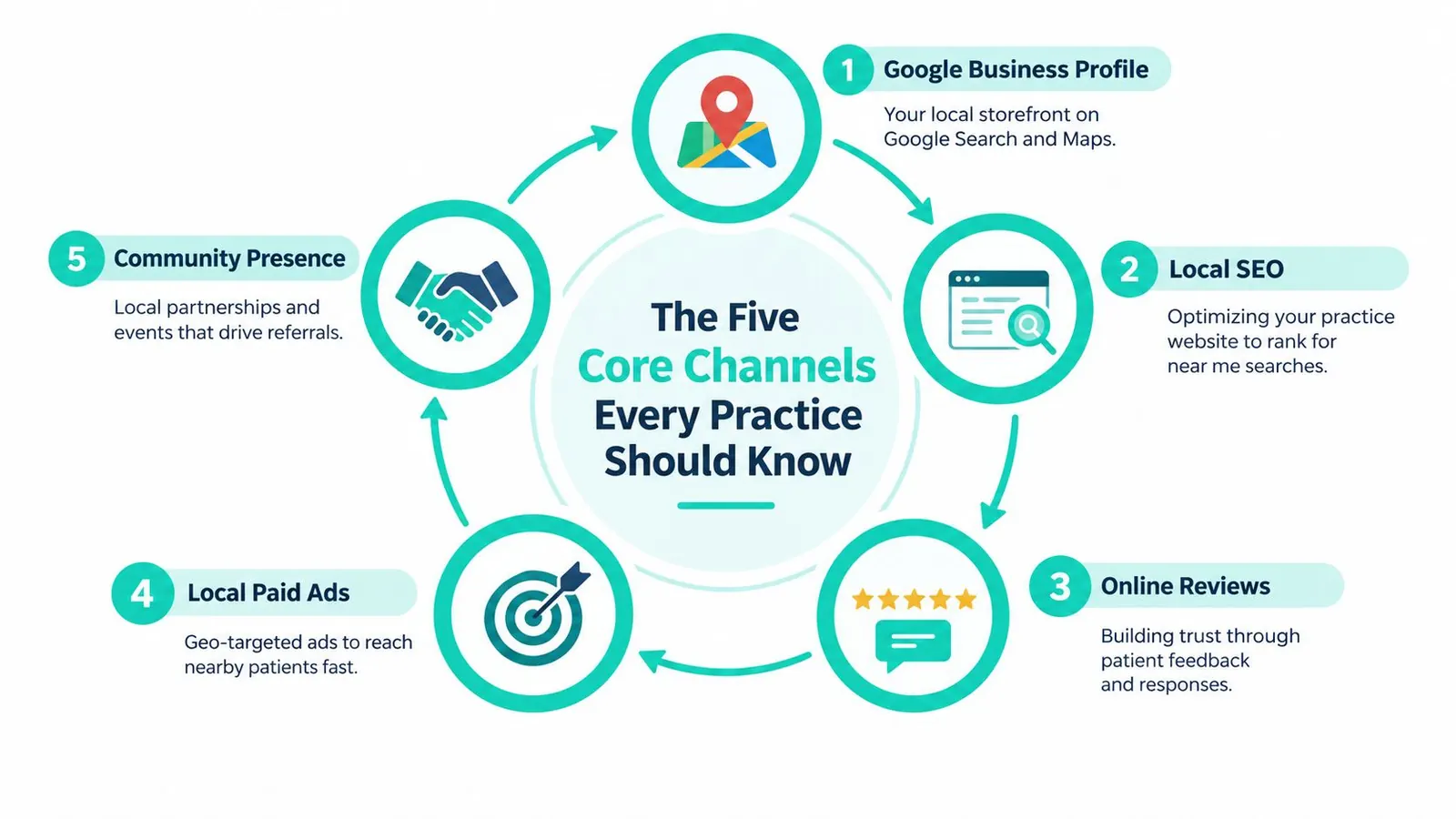
Local marketing works best as a connected trust system. Each channel handles a different question, and the strongest results come when the answers agree.
Google Business Profile
Your Google Business Profile acts like the practice's digital storefront on Search and Maps. It should show the correct name, address, phone number, categories, hours, services, photos, and appointment options. A complete profile answers the immediate question, “Is this a real, nearby practice that can help me?”
Local SEO on the website
Your website gives Google and prospective patients more context. Service pages should explain what you offer, while location pages can clarify the communities you serve. A dentist may need separate pages for emergency care and implants. An attorney may need pages for relevant practice areas in the counties where the firm accepts cases.
Online reviews
Reviews provide social proof at the moment someone is comparing options. Ask satisfied patients or clients for feedback through an ethical, consistent process, then respond to reviews in a professional way. A response can demonstrate attentiveness even when the reviewer never becomes a patient.
Local paid ads
Paid search and social campaigns can place a high-value service in front of people who are actively looking. Keep targeting tight, send each ad to a relevant landing page, and track calls or forms rather than clicks alone. Ads shouldn't compensate for an incomplete profile or a confusing website.
Community outreach
Partnerships, sponsorships, educational events, and local participation create relationships that online tactics can't manufacture. A primary care partnership can help an optometrist build referrals. A law firm may gain recognition by supporting a local event. A dental practice can become more familiar through useful community education.
These channels reinforce one another. A community event can produce real photos and mentions. Those mentions can support awareness, while reviews and a well-built website help convert the people who search after hearing about the practice.
For additional ideas on planning content around growth goals, Omega Lasers growth resources can provide useful context. Practices can also review Leaping Lemur Media's services when they need help coordinating strategy, content, search, or advertising instead of managing each channel in isolation.
Where to Focus When the Budget Is Tight
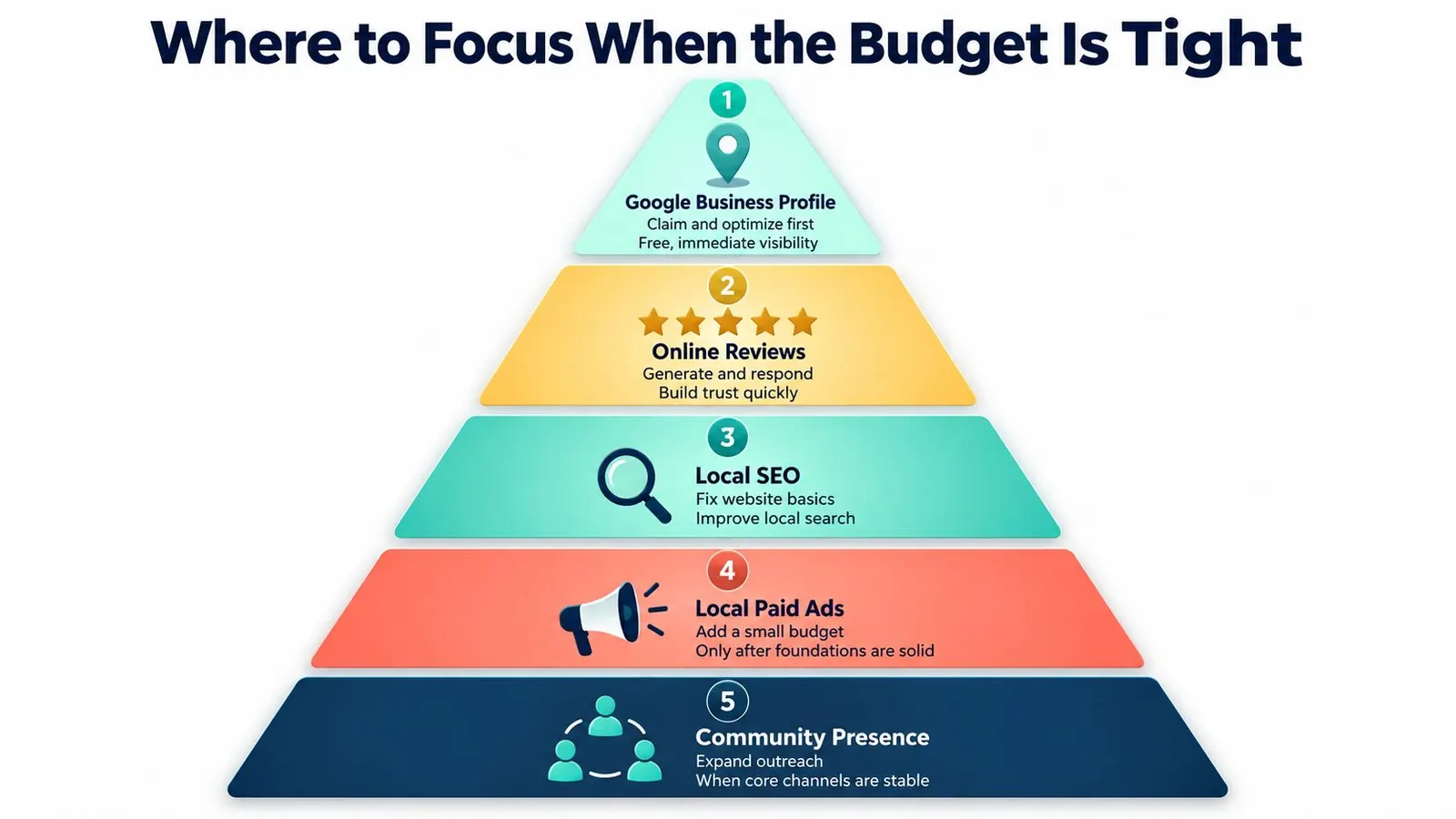
Most practices can't give every channel equal attention at the start. A sensible order follows the way trust forms: first make the practice easy to find, then make it easier to believe, then make it easier to act.
Do these first
Start with Google Business Profile. Claim the profile, correct the core information, choose accurate categories, add current photos, list services, and verify that hours match the practice's real schedule. This work improves the information people see during nearby searches and costs time rather than an advertising budget.
Build a review process next. Ask at an appropriate point after care, make the request simple, and respond consistently. Don't pressure people to leave only positive feedback or offer incentives that violate platform policies. The goal is a reliable picture of patient experience.
Fix the website's local foundations. Make the address, phone number, service area, provider information, and appointment pathway easy to find. Create useful pages for priority services and locations, but don't publish thin pages that merely swap one city name for another.
Add these when the foundation is stable
Use paid ads for selected services. Choose the services with clear demand, strong capacity, and meaningful value to the practice. Send traffic to a page that matches the search, and measure calls and booked consultations.
Invest in community presence over time. Outreach may take longer to show up in reports, but it builds familiarity and referral relationships. Choose activities that fit the practice's values and audience instead of sponsoring every available opportunity.
This ladder prevents a common mistake: paying for more traffic before fixing the experience people encounter. A focused profile, credible reviews, and a conversion-ready website should carry the first phase. Ads and outreach can then extend a system that already gives nearby searchers a clear reason to choose the practice.
How Dentists, Eye Doctors, Medspas, and Law Firms Put It to Work
A family dentist in a mid-sized suburb might begin with the office's actual first impression. The Google Business Profile would use current photos of the reception area, treatment rooms, team, and exterior. After routine cleanings, the team could invite patients to share honest feedback. The website could give emergency care, implants, and Invisalign their own useful pages, with service-area language for nearby communities. A modest Google Ads test could focus on emergency and cosmetic searches only when the practice has appointment capacity.
An optometrist needs a different emphasis. The practice could target eye exams, contact lens care, and dry-eye services in the places its patients travel from. A relationship with nearby primary care practices could support referrals, while the website answers practical questions about insurance, appointments, and treatment pathways. The profile should make hours, location, accessibility, and booking options obvious.
A medspa competes in a trust-sensitive category where people often want to understand the provider and the expected experience before contacting the office. Treatment-specific pages for Botox and microneedling can explain candidacy, consultation steps, and aftercare. With appropriate consent and privacy practices, before-and-after proof can give visitors something more useful than polished general branding. Geo-targeted offers may focus on suitable upscale neighborhoods, but the landing page still needs to explain why the treatment and practice are credible.
A solo law firm may define local service by counties or a broader metropolitan area rather than a short drive from the office. Pages for car accidents and wills should describe the jurisdictions and circumstances the firm handles. Sponsoring or participating in local events can create authentic community connections and mentions, but the firm shouldn't claim local expertise in places where it doesn't serve clients.
Owners developing a legal acquisition plan may also find this high-quality legal leads guide useful for thinking through lead quality, qualification, and follow-up. The same principle applies across practices: local marketing isn't complete when someone clicks. It must help the right person take the next step.
The Numbers That Prove It Is Working
A practice doesn't need a dashboard full of impressive-looking activity. It needs evidence that the right people are finding the practice, trusting it, and contacting the team.
Google Business Profile reporting can show views, searches, calls, direction requests, and photo views. Website analytics can reveal organic visits from geographic service queries, contact-form submissions, and phone interactions. Call tracking adds useful context, especially call duration and whether the caller asked about a service the practice wants to grow.
Reputation metrics belong beside acquisition metrics. Track the pace of new reviews, average rating, and response rate. Don't treat these as isolated goals. A review may influence a click, a click may lead to a call, and a call may become a booked appointment only after staff follow-up.
| Metric | What It Tells You | Where to Find It | Realistic Monthly Benchmark |
|---|---|---|---|
| Profile views and searches | Whether nearby demand is discovering the listing | Google Business Profile | Look for a positive month-over-month trend |
| Calls and direction requests | Whether visibility is creating practical intent | Google Business Profile and call tracking | Compare with booked appointments and qualified inquiries |
| Website local traffic | Whether service and location pages attract relevant visitors | Google Analytics and Search Console | Focus on relevant queries, not raw traffic |
| Forms and call duration | Whether visitors are taking meaningful action | Website analytics and call tracking | Review quality and outcome, not volume alone |
| Review velocity and response rate | Whether trust signals are being maintained | Google and other review platforms | Keep the process consistent and responses timely |
For a single-location service practice in a mid-sized market, the planning notes often used by agencies may describe 50 or more Google Business Profile actions per month as a practical reference point, but that isn't a universal standard. Review activity also varies by specialty, patient volume, and platform behavior, so don't adopt a double-digit weekly review target without checking whether it fits ethical and operational realities.
Use the Leaping Lemur Media journal for ideas on interpreting marketing activity in context. The most useful comparison is your own month-over-month trend, tied to qualified calls, consultations, appointments, and revenue.
Your First 30 Days and the Questions Owners Ask Most
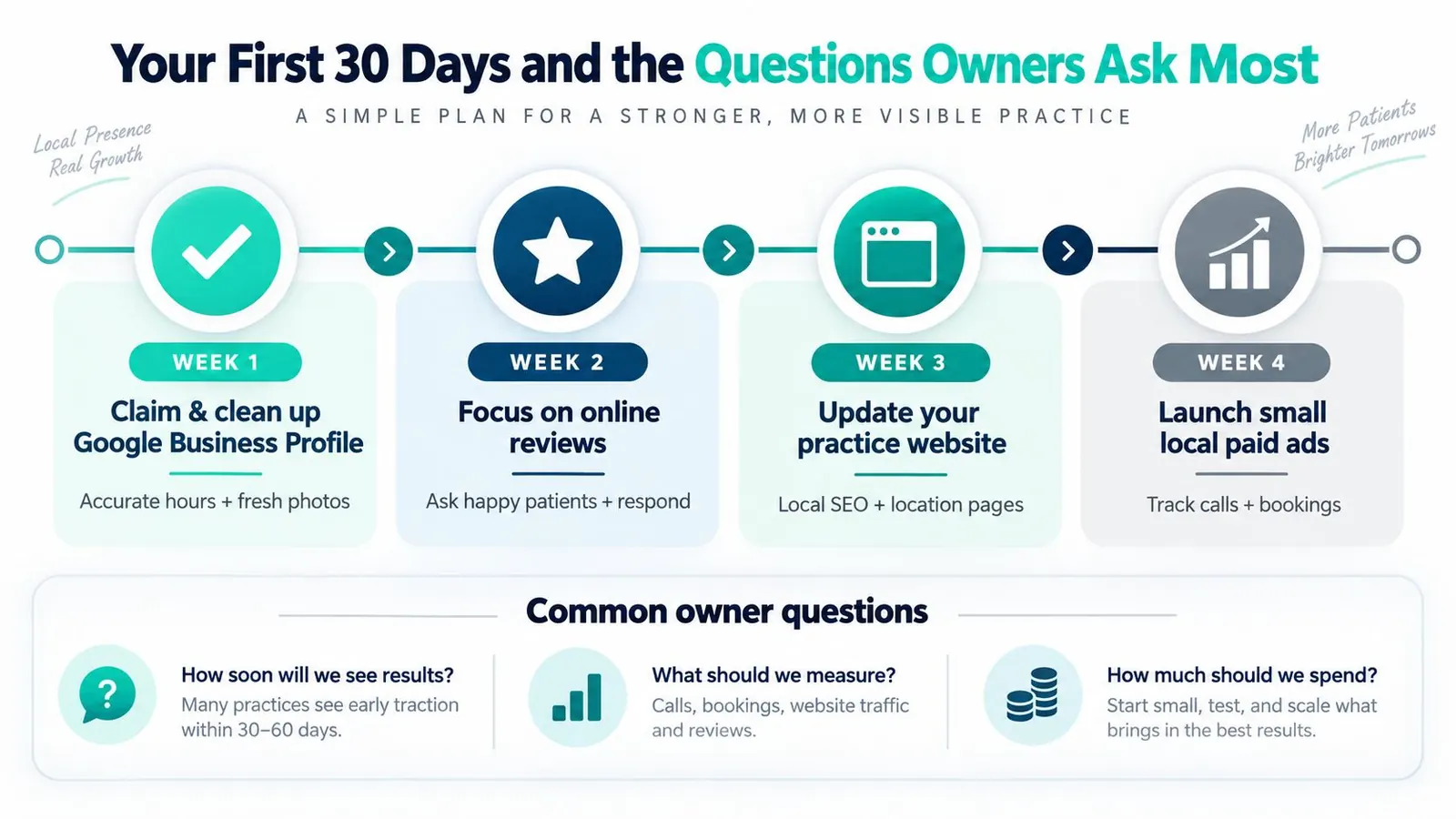
A first month should create reliable foundations, not an exhausting list of unfinished tasks.
Week one
Claim or verify the Google Business Profile. Correct the name, address, phone number, categories, hours, services, booking link, and photos. Ask a staff member to test the call and appointment paths from a phone.
Week two
Check that the practice's core information is consistent across important listings and the website. Create a simple review request process, then ask appropriate recent patients for honest feedback. The plan calls for ten fresh reviews during this week, but the practice should follow platform rules, consent requirements, and its own patient communication policies.
Week three
Publish one useful localized piece of content, such as an emergency dentistry page for a served community or a dry-eye guide tied to the optometrist's service area. Test a basic geo-targeted ad campaign for one priority service, with a clear budget and call or form tracking.
Week four
Review profile actions, website engagement, calls, forms, review activity, and booked outcomes. Keep the channel that is creating qualified opportunities, fix the weakest conversion step, and decide whether the next month should expand content, ads, reviews, or referral outreach.
How long does local SEO take to show results? It varies by market, competition, site condition, and consistency. Look for directional progress rather than expecting a fixed timetable.
Are paid ads required? No. A practice can build a strong local foundation through its profile, website, reviews, and community relationships. Ads can help capture demand faster when the fundamentals and follow-up process are ready.
What should we do about a negative review? Respond calmly, protect patient privacy, acknowledge the concern without revealing confidential information, and invite the person to continue the conversation through an appropriate private channel. Never argue in public.
What budget does a solo practice need? There isn't a universal amount. Start with the work the team can sustain, then fund paid promotion only after you know which service, audience, and conversion path deserve more reach.
If your practice needs a clearer service-area strategy, stronger local search visibility, or a marketing system that connects reviews, content, ads, and appointments, Leaping Lemur Media can help you build it around who you are and whom you serve. Visit the site to explore a practical partnership for making your practice easier to find, trust, and choose.
Looking for local help? Meet our Boise marketing agency.