Long Term Marketing Strategy for Growing Practices
LLSeptember 8, 202614 min read
Most practice owners are told to chase more leads, post more often, and judge marketing by what happened this month. That advice sounds practical, but it creates a fragile business. A dental office, medspa, eye doctor, or law firm can generate inquiries without building recognition, trust, repeat engagement, or referrals. When the campaign stops, the pipeline goes quiet.
A long term marketing strategy works differently. It treats every useful interaction as part of a larger system, one that helps people remember the practice, choose it with less hesitation, return when they need help, and recommend it to others. The aim isn't to abandon lead generation. It's to stop confusing temporary activity with durable growth.
Why Most Practice Marketing Plans Fail After 90 Days
The popular assumption is that a marketing plan should prove itself quickly through a rising lead count. That's the wrong test for a practice whose growth depends on trust. A paid campaign may produce inquiries while the website remains forgettable, the follow-up process remains inconsistent, and previous patients receive no reason to return.
The result is a treadmill. The owner changes agencies, the agency changes headlines, and the team watches another dashboard. Each new tactic gets judged before the practice has built enough familiarity for people to recognize its name or enough consistency for referrals to become a dependable source of demand.
A long term marketing strategy isn't a slower version of lead generation. It combines immediate demand capture with assets that become more useful over time:
Recognition: People know what the practice does and who it serves.
Trust: Prospects see clear proof, useful education, and a consistent experience.
Retention: Existing patients or clients receive thoughtful follow-up and relevant reasons to return.
Referrals: Satisfied customers have a clear story they can share with friends, family, or colleagues.
Practical rule: Keep the campaign running only if it supports a business asset that will still matter after the campaign ends.
A focused 90-day SEO playbook can help a practice organize early search work, but the first quarter shouldn't become the entire strategy. Use it to establish technical and content foundations, then keep publishing, improving conversion paths, and strengthening local relevance.
The practice itself must also own the direction. Your positioning, patient experience, and community presence should guide the agency, not the other way around. Review the Leaping Lemur Media about page if you're evaluating what a strategy partner should understand before recommending tactics.
The Economics Behind a Long Term Marketing Strategy
Retention makes the long-term case practical, not philosophical. Multiple industry sources report that acquiring a new customer can cost 5 to 25 times more than retaining an existing one, while a 5% increase in customer retention can raise profits by 25% to 95%. The same body of marketing research places the probability of selling to an existing customer at 60% to 70%, compared with 5% to 20% for a new prospect, as summarized by Rivo's customer retention statistics.
For a dentist, that means the hygiene recall process deserves as much strategic attention as a new-patient ad. For a medspa, it means post-treatment education and thoughtful rebooking can matter more than constantly discounting the next appointment. For a law firm, a well-maintained relationship with a former client can create future matters and referrals without restarting trust from zero.
Retention also extends customer lifetime value. By the 2020s, industry benchmarks commonly placed average retention around 75% globally, with one summary estimating a 75.5% average customer retention rate and active customers remaining loyal for about 40 months, according to SHNO's retention statistics overview. These benchmarks aren't a promise for any individual practice. They're a reminder that the relationship after the first transaction deserves a designed experience.
Brand building compounds the economics. The IPA's long-run evidence links stronger brand measures with gains in broader business metrics over extended periods. That matters locally because recognition reduces the amount of explanation a prospect needs before booking a consultation, scheduling an exam, or calling a firm.
Consistency reinforces that effect. Independent coverage of Lucidpress and Marq findings reports that companies with consistent branding can see an average revenue increase of about 23%, with a later report finding that the lift can reach up to 33%, based on surveys of hundreds of brand-management professionals across multiple editions, as summarized by Omnibound's brand consistency statistics. Your logo won't create loyalty by itself, but consistent promises, language, visuals, and service delivery make the practice easier to remember and trust.
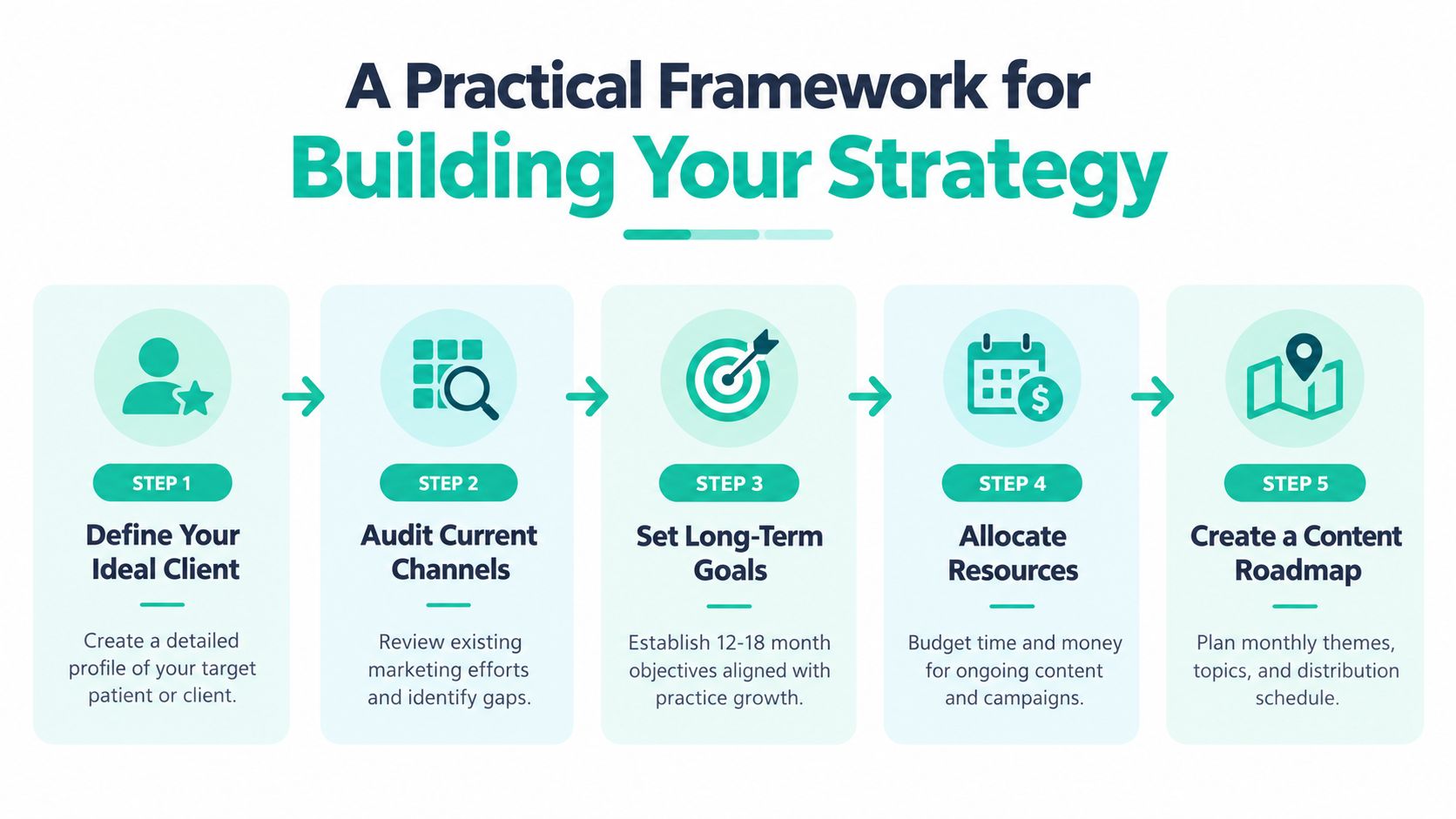
A Practical Framework for Building Your Strategy
Start with business reality, not a channel wish list. A practice needs to decide which services, locations, patient groups, and business outcomes deserve attention before anyone recommends ads, social media, or SEO.
Define the audience and the promise
Write a specific profile of the person you want more of. A dentist might focus on families seeking preventive care, anxious adults, or patients interested in restorative treatment. A medspa may serve people looking for a conservative treatment plan and a credible long-term relationship, not a one-time bargain.
Then state the practice's promise in plain language. Avoid claims every competitor can make, such as “quality care” or “personalized service.” Clarify the problem you solve, the experience you provide, and the reason a local prospect should remember you.
Build the message before choosing channels
Create a small messaging system that can survive leadership changes and campaign cycles. It should cover the practice's central positioning, proof points, frequently asked questions, tone, and boundaries around claims.
A good message should sound natural in several settings:
A homepage headline
A receptionist's explanation
A paid search ad
A patient email
A community sponsorship
A consultation conversation
If the message changes every month, the audience has to relearn the practice every month.
Choose channels for the journey
Use search to capture existing intent, content to answer questions, email or text communication to support follow-up, and community activity to strengthen local familiarity. Paid media can fill immediate gaps, but it shouldn't carry the entire growth burden.
Your content needs a distribution plan, not just a publication schedule. A useful effective content distribution strategy helps the team decide where each asset belongs, who should see it, and how it will be reused without becoming repetitive.
Install the retention system
Map what happens after an appointment, consultation, or completed matter. Assign ownership for review requests, recall reminders, educational follow-up, reactivation, referral prompts, and service-specific check-ins.
A small practice doesn't need a complicated technology stack. It needs clean contact records, dependable reminders, clear scripts, and someone responsible for completing the work.
Review and refine deliberately
Set a regular review cadence. Keep the strategic direction stable while adjusting weak creative, unclear conversion paths, underperforming content, and operational friction. Change the plan when customer behavior or business priorities change, not because a competitor launched a new social account.
How the Strategy Adapts Across Different Practices
The same principles produce different marketing choices because each practice has a different decision journey.
Dentists
Dental marketing benefits from a balance of immediate search demand and ongoing patient education. Someone with tooth pain may search and call quickly, while someone considering implants, orthodontics, or cosmetic treatment may spend longer evaluating expertise and comfort.
The durable content plan should answer clinical questions in accessible language, explain what the visit feels like, and show how the practice handles concerns such as anxiety, cost conversations, and follow-up. Retention depends on operational details, including recall communication, easy scheduling, and a patient experience worth discussing with family.
Medspas
A medspa has to manage aspiration, safety, credibility, and expectation setting. Before-and-after content may attract attention, but educational material helps prospects understand candidacy, treatment planning, recovery, and the importance of professional guidance.
The strongest long-term positioning avoids becoming interchangeable with every discount-driven provider. A clear point of view, consistent visual identity, careful consultation process, and relevant follow-up create a relationship that can extend beyond one treatment.
Eye doctors
Eye care marketing often combines recurring needs with seasonal or life-stage triggers. Families, contact lens wearers, older adults, and people seeking specialty care may need different messages even when they live in the same service area.
Useful content can explain exam preparation, vision changes, eyewear decisions, and what patients should expect from the practice. Local partnerships, school or employer relationships, and reliable recall systems can support visibility beyond search.
Law firms
Legal decisions carry high emotional and financial stakes, and the timeline can be unpredictable. A prospective client may read several pages, ask someone they trust, and delay contact while deciding whether the situation justifies a consultation.
A law firm should make its areas of focus unmistakable, explain next steps without offering careless guarantees, and demonstrate judgment through practical education. Community involvement and referral relationships often matter alongside search visibility, so don't force the firm into a consumer-brand playbook designed for quick purchases.
Traditional channels can still support local familiarity when they fit the audience and the practice's operating area. This overview of traditional marketing for local businesses offers useful context for weighing offline activity against digital work.
KPIs and Timelines That Keep You Honest
A long-term plan needs accountability, but weekly lead counts can't carry the entire burden. Measure whether the practice is becoming easier to find, understand, trust, and choose.
The first six months
Track leading indicators such as branded search behavior, qualified website actions, completed contact forms, call quality, consultation attendance, content engagement, review activity, referral conversations, and follow-up completion. These measures reveal whether the system is becoming healthier before revenue fully reflects the work.
Don't celebrate traffic that produces poor-fit inquiries. A smaller flow of appropriate patients or clients can be more valuable than a larger flow that overwhelms staff and fails to convert.
Around the one-year mark
Review retained patients or clients, repeat bookings, referral contribution, service mix, consultation quality, acquisition efficiency, and revenue connected to strategic channels. Compare these results with operational capacity. Marketing that fills the schedule with unsuitable work can damage margins and team morale.
The review rhythm
Use weekly meetings for execution issues, monthly reviews for channel and content decisions, and quarterly reviews for positioning, budget allocation, and business alignment. Communicate the time horizon to partners and staff before launch.
A slow month is a data point. It isn't automatically a reason to discard a strategy.
Keep a written record of major changes. If the team changes the message, offer, audience, landing page, and channel at once, nobody can identify what caused the result.
Budgeting and Channel Mix for Durable Growth
Budgeting should protect both sides of the business. Performance activation captures demand that exists now, while brand building creates familiarity and future demand. A practice that funds only the first category eventually asks paid media to overcome every weakness in recognition, positioning, and trust.
The widely cited 60/40 benchmark recommends directing roughly 60% of marketing investment to brand building and 40% to sales activation, based on Les Binet and Peter Field's analysis of hundreds of campaigns and reiterated in Mighty Roar's brand versus performance marketing analysis. Treat that as a planning reference, not a universal law. A new location, a service launch, or a capacity problem may justify a temporary adjustment.
Focus Area
Primary Role
Typical Budget Emphasis
Time Horizon
Brand building
Build recognition, distinction, trust, and memory
Larger steady allocation
Extended
Performance activation
Capture existing intent and drive immediate action
Focused response allocation
Immediate to near term
The danger is performance-only thinking. Independent analysis of the Brand×Performance tradeoff found that moving from a mixed strategy to performance-only produced a median 40% decline in revenue ROI, while shifting back to a balanced portfolio lifted returns by a median 90%, as reported by Inversion Agency's analysis. The lesson is clear. Don't cut brand investment because activation is easier to report.
Flat budgets require sharper choices, not panic. Gartner-linked coverage reported marketing budgets holding at 7.7% of company revenue for two consecutive years, while 2025 to 2026 analyses described spending shifts away from agencies and labor toward paid media and AI tools. One survey reported that 39% of CMOs planned to cut agency spend, 39% planned to cut labor spend, and 23% expected to allocate 16% to 20% of budget to AI tools, summarized by Emulent's marketing budget benchmarks.
For a small practice, protect the activities that build memory and retention, automate repetitive execution where appropriate, and cut channels that produce activity without qualified business outcomes.
Common Pitfalls That Quietly Undermine Long-Term Plans
The first warning sign is a discount becoming the practice's main message. Discounts can create response, but constant price promotion trains prospects to wait and makes distinctive expertise harder to communicate. Replace the discount-first approach with a clear offer, useful education, and a reason to act that fits the service.
The second is changing the brand whenever results feel slow. A new logo, color palette, or tagline won't repair weak follow-up or unclear positioning. Keep recognizable elements stable long enough for the market to associate them with a consistent experience.
Other traps deserve a direct audit:
Platform chasing: Don't open every new account. Choose channels your audience uses and your team can maintain.
Single-source dependence: Search, referrals, paid media, community presence, and retention should support one another. A single lead source makes every algorithm or market change feel like an emergency.
Vendor-driven strategy: Reject recommendations that begin with a tool instead of a business problem.
Internal inconsistency: Align the website, ads, front desk, consultation process, and follow-up language around the same promise.
A slow quarter often exposes a process problem rather than a branding problem. Review your message, response speed, scheduling friction, service quality, and retention workflow before commissioning another rebrand. You can also use the Leaping Lemur Media journal as a reference point when reviewing practical marketing topics and strategic decisions.
Your First 90 Days Implementation Checklist
The first quarter should create control, not chaos. Assign one owner, document decisions, and complete the foundational work before adding more channels.
Weeks one through four
Set the business priority: Choose the service, audience, location, or capacity issue marketing must support.
Interview the team: Ask clinicians, attorneys, front-desk staff, and recent patients what people misunderstand before choosing the practice.
Audit the experience: Review the website, listings, reviews, calls, forms, scheduling process, and follow-up.
Lock the positioning: Write the central promise, supporting proof, tone, and claims the practice can responsibly make.
Create a baseline: Record current qualified inquiries, consultations, bookings, repeat activity, referral sources, and response quality.
Weeks five through eight
Build the content roadmap: Select recurring themes based on real questions from patients or clients.
Repair conversion paths: Make the next action obvious, reduce unnecessary form friction, and ensure calls reach a prepared person.
Launch retention touchpoints: Set up recall, reactivation, post-visit education, review requests, and referral communication where appropriate.
Publish brand-building work: Create useful pages, articles, videos, or community content that reinforces the practice's position.
Train the team: Give staff practical language for explaining the promise and handling common objections.
Weeks nine through twelve
Review channel quality: Separate qualified opportunities from raw activity.
Compare message performance: Identify which topics create meaningful conversations, not just clicks.
Check operational capacity: Confirm the practice can deliver the experience its marketing promises.
Set the next quarter: Keep the strategic direction, improve weak execution, and assign owners for every priority.
A structured services overview can help you assess where strategy, brand positioning, SEO, content, and ongoing marketing support fit into the plan. The important decision is not whether to add more tactics. It's whether your team can consistently execute the few activities that build recognition, trust, and retention.
Leaping Lemur Media helps practices build marketing roadmaps around business goals, clarify positioning and voice, strengthen long-term SEO foundations, and review performance through ongoing tuning. Visit Leaping Lemur Media to discuss a durable strategy for your dental, eye care, medspa, law firm, or local service business.