

You're probably seeing the same pattern I see in many specialty practices: the phones aren't completely quiet, the website gets some traffic, and the team is busy. Yet growth still feels unpredictable. One month brings a strong run of consultations, and the next leaves valuable chair time, treatment capacity, or attorney hours unfilled.
The answer isn't another disconnected marketing tactic. Practice growth is an economic system. You need to know what a new patient costs, what that patient is worth over time, which channels produce qualified demand, and where your team loses people between inquiry and treatment. That's how to grow your practice without just buying more leads.
Table of Contents
- What Growth Really Costs Before You Spend a Dollar
- Defining Who You Serve and Why That Drives Everything
- Building a Brand People Can Actually Find and Trust
- Choosing the Right Acquisition Channels for Your Specialty
- Turning New Patients Into a Retention and Referral Engine
- Measuring What Matters So Growth Stays Profitable
- Your 90, 180, and 365 Day Growth Roadmap
What Growth Really Costs Before You Spend a Dollar
A practice can attract more inquiries and still become less profitable. The problem usually starts when the owner tracks lead volume instead of the economics behind each new patient.
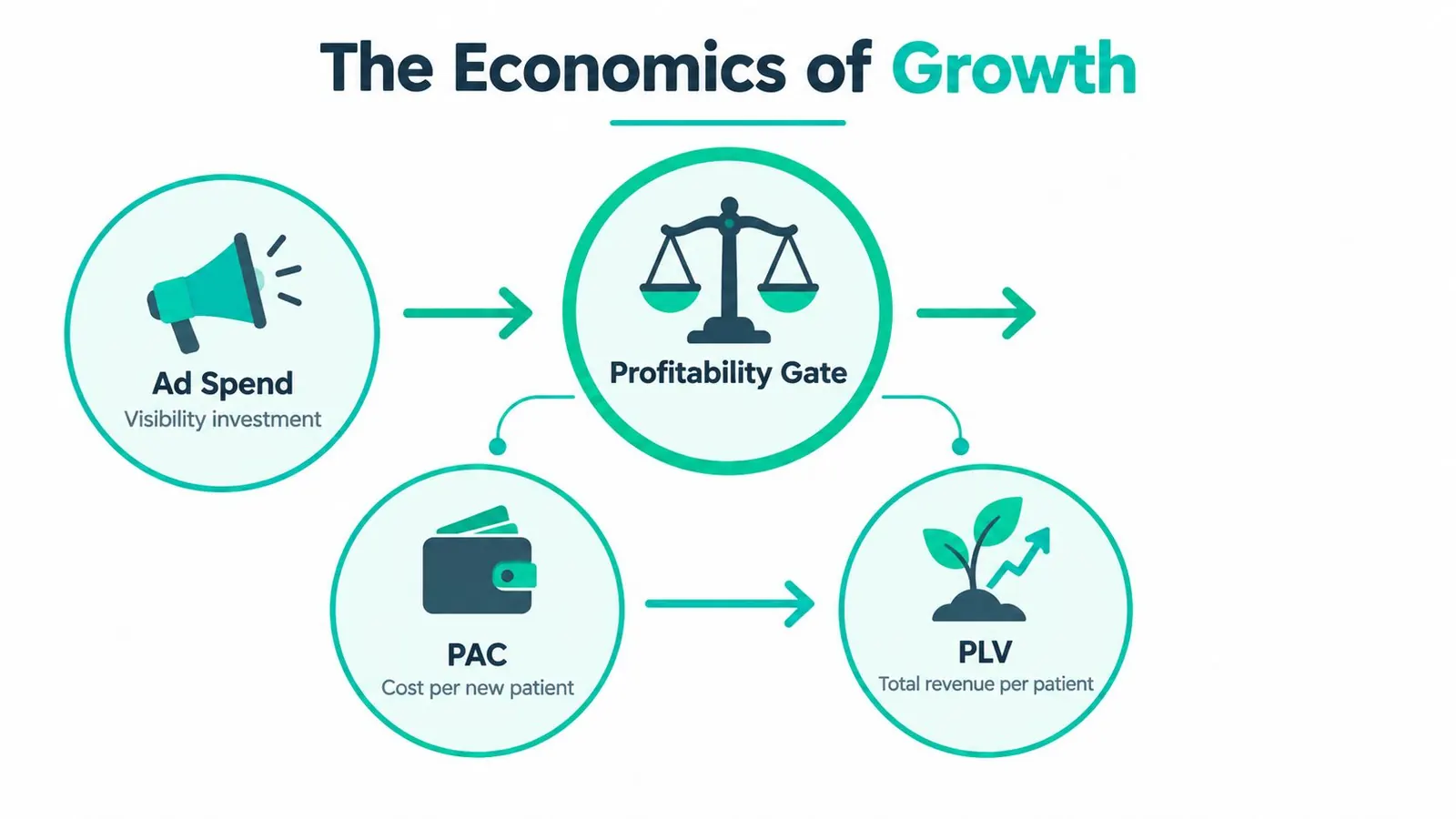
Patient acquisition cost, or PAC, is the total marketing and sales investment required to gain one new patient. Calculate blended PAC by adding spend across paid search, social advertising, creative, SEO, listings, and marketing labor, then dividing that total by new patients acquired from all sources. For channel-level PAC, divide the investment in one channel by the new patients it produces, not by clicks or form submissions.
Patient lifetime value, or PLV, is the total revenue a patient generates during the relationship. For a dental practice, that can include examinations, hygiene visits, restorative work, implants, and referrals. For an optometry practice, it may include examinations, eyewear, contact lenses, and repeat purchases. A medspa should account for recurring treatments and packages. A law firm should consider the revenue associated with accepted matters, not merely initial consultations.
Practical rule: A lead is not an asset until your team can turn it into a booked, attended, and financially viable patient relationship.
A useful economic check is to compare acquisition cost with lifetime value. General independent-practice benchmarks place sustainable PAC around 10% to 20% of patient lifetime value, with a 5:1 lifetime-value-to-acquisition-cost ratio considered healthy and 2:1 a warning sign, according to patient acquisition economics guidance. New practices may invest 15% to 25% of revenue in acquisition, while established practices often operate at 5% to 10%, and mature practices in competitive markets may spend 10% to 15% defensively to protect share. These are operating benchmarks, not permission to spend blindly.
Acquisition has also become more expensive. One 2026 benchmark reports an average cost of $217 per new patient, up 34% from $162 in 2020, while a broader benchmark places common practice acquisition costs between $150 and $350 depending on specialty, location, and channel mix, as reported in patient acquisition strategy research.
An empty chair or unfilled case carries an opportunity cost. You lose the revenue that appointment could have generated, but you may also lose follow-up visits, treatment acceptance, referrals, and future purchases. That's why pricing, average revenue per patient, visit frequency, show rate, and treatment acceptance matter more than follower counts.
Every tactic in this article should pass one test: does it lower PAC, raise PLV, or improve the conversion between them? Local search can lower PAC by producing high-intent demand. Better follow-up can raise PLV by increasing retention. A faster response can improve the economics of both. Activities without a measurable connection to those outcomes deserve a smaller budget.
Defining Who You Serve and Why That Drives Everything
Vague positioning is one of the most expensive problems in specialty practice marketing. If your message says you serve “everyone,” your website becomes generic, your ads compete on broad terms, and your front desk has no clear way to prioritize inquiries.
An ideal patient profile, or IPP, gives the team a sharper commercial and clinical focus. Define it using five inputs:
- Demographics: age range, location, household situation, and work context.
- Psychographics: concerns, motivations, anxieties, and decision triggers.
- Conditions or case types: the procedures, legal matters, or treatment needs you handle best.
- Payer mix: insurance, self-pay, financing, or other payment patterns.
- Lifetime value tier: low, medium, or high value based on expected relationship revenue.
The profile shouldn't become a fictional persona with an invented name and biography. It should become a practical filter for decisions. A dental implant clinic might focus on adults seeking a fixed solution after tooth loss, with the financial readiness and urgency to complete treatment. A boutique medspa might focus on local clients seeking a discreet, ongoing treatment plan rather than a one-time discount. A family law firm might focus on clients who need structured guidance through a complex separation or custody matter.
A practical comparison
| IPP Field | Dental Implant Clinic | Boutique Medspa | Family Law Firm |
|---|---|---|---|
| Primary need | Tooth replacement and restored function | Ongoing appearance and wellness treatments | Guidance through separation, custody, or related disputes |
| Main concern | Fear, trust, treatment clarity, and affordability | Privacy, quality, consistency, and natural-looking outcomes | Confidentiality, control, cost clarity, and legal strategy |
| Decision trigger | Loss of function or dissatisfaction with removable options | A personal milestone, concern, or desire for a structured plan | A major relationship or family change |
| Payer mix | Insurance contribution, self-pay, financing | Predominantly self-pay | Self-pay, retainers, or structured payment arrangements |
| Higher-value relationship | Implant treatment plus maintenance and referrals | Repeat visits, packages, and complementary services | Multiple stages of representation and related matters |
Turn the IPP into a positioning statement:
We help [specific audience] solve [specific high-value problem] through [distinctive approach], so they can [meaningful outcome].
For example, “We help adults with complex tooth loss restore comfortable function through carefully planned implant treatment, with clear guidance at every stage.” That statement can shape the homepage, consultation script, photography, office experience, and keyword strategy.
Specificity improves relevance because the right person recognizes themselves quickly. It also discourages poor-fit leads, which protects staff time and keeps PAC tied to patients your practice is equipped to serve.
Building a Brand People Can Actually Find and Trust
A trustworthy brand needs to work before anyone speaks with your team. Prospective patients compare your website, Google Business Profile, reviews, services, location, and provider information while deciding whether to contact you.
Start with the website. Build service pages around patient problems, not internal departments. A strong implant page should explain who may benefit, what the consultation covers, how the process works, what questions patients should ask, and what happens next. An optometry page should make the difference between examinations, eyewear, and specialty care clear. A law firm should separate case types and explain the first step without making unsupported promises.
The trust layer
Your core website assets should include:
- Clear calls to action: Offer online booking, a consultation request, or a direct phone option without forcing visitors to hunt.
- Useful provider bios: Show credentials, areas of focus, communication style, and relevant experience in plain language.
- Technical clarity: Use structured data where appropriate, make pages accessible, and keep the site responsive and fast.
- Proof with context: Use authentic reviews, team photography, treatment explanations, and location details.
- Consistent information: Keep the practice name, address, phone number, hours, and services aligned across listings.
Google says local results rely primarily on relevance, distance, and prominence, with prominence influenced by signals such as links from other websites and review volume in its official local ranking explanation. That means local visibility isn't created by one clever keyword. Your profile must accurately describe the practice, fit the search, and demonstrate that the business is established and trusted.
Google Business Profile deserves focused attention. Select the most accurate primary category, add relevant additional categories where appropriate, complete services, answer questions, publish useful updates, and add original photographs. Categories can include a primary category plus up to ten additional categories, and consistent business information supports local relevance, according to local ranking factor guidance.

A large study of 16,098 Google Business Profiles found top-three visibility rising from 39.3% with 1 to 5 reviews to 73.0% with 201 to 500 reviews. It also found photo count continued to improve performance at 500 or more images, while business descriptions delivered additional value when paired with review volume, as detailed in Localo's local SEO ranking factor study.
Ask for reviews after a meaningful moment, such as a completed treatment milestone or a clearly resolved concern. Use neutral language, never pressure patients, and respond professionally to both positive and negative feedback. Your website, profile, reviews, and front-desk experience should tell the same story. Practices that need help aligning these assets can also review Leaping Lemur Media's agency background as one possible resource.
Choosing the Right Acquisition Channels for Your Specialty
No channel deserves a permanent budget just because it worked once. Choose based on intent, capacity, conversion quality, and how quickly the practice can recover the investment.
Organic local SEO compounds over time and works well when your practice has durable service demand, useful expertise, and enough capacity to serve new patients. Google Business Profile captures local intent close to the booking moment. Paid search can create demand quickly, but it exposes weak intake systems immediately. Referral-influenced content supports trust when patients need education before they commit, especially for implants, elective medspa care, and legal matters.
The conversion ranges below are planning ranges specified for these specialty examples, not universal benchmarks.
| Channel | Best For | Conversion Rate | CAC Payback |
|---|---|---|---|
| Organic local SEO | Durable service demand and high-intent searches | Dental implant landing pages, 3% to 5% | Build toward recovery through repeat visits and treatment value |
| Google Business Profile | Local discovery and map-driven inquiries | Strong fit for location-based services | Prioritize when capacity is tight |
| Paid search | Immediate demand for documented services | Medspa consult bookings, 6% to 10% | Add only after close rate is documented |
| Referral-influenced content | Complex decisions and trust-sensitive cases | Law firm case evaluations, 2% to 4% | Layer after intake and attribution work |
For eyewear-focused practices, the growth lever may be photo velocity and profile completeness rather than more ad spend. Product photography, frames, team images, and an accurate services profile give local searchers a clearer reason to choose the practice.
Paid acquisition needs a hard economic gate. A common planning rule is that a new patient should generate four to seven times their first-visit revenue across lifetime value to justify paid acquisition. That isn't a substitute for calculating your actual PAC, but it prevents an owner from celebrating inexpensive clicks that never become profitable relationships.
Start with GBP and organic search when capacity is constrained. Add paid search after you know the close rate from booked consultation to accepted treatment or matter. Layer content, professional referrals, and community partnerships after CAC payback is under 90 days, using your own measured economics rather than assuming every specialty behaves the same.
Don't send Meta ads to a broad audience of women because the platform makes it easy. Fix the offer, landing page, response time, qualification, and booking flow first. For broader visibility and search measurement, a resource such as Rank on AI Overview can help teams think about how their practice appears across changing discovery surfaces. For implementation support across search and paid campaigns, review Leaping Lemur Media's marketing services.
Turning New Patients Into a Retention and Referral Engine
The highest-value growth opportunity is often inside the patient list you already have. A patient who returns, accepts appropriate treatment, purchases again, or refers someone new can improve PLV without requiring another full acquisition cycle.
Build retention into operations with five practical moves.
Start with the first follow-up
Send a personal 48-hour post-visit message. For a dental procedure, ask about comfort and provide the next-step contact route. For a medspa treatment, reinforce aftercare and the next recommended appointment. For a legal consultation, confirm the agreed action items and document request. Route replies to a named team member, not an unattended inbox.
Reactivate patients who went quiet
Create a lapsed-patient segment for people whose last visit was more than 12 months ago. Use a short sequence rather than one generic blast: a personal reminder, a useful reason to return, and a final low-pressure message. Exclude patients with unresolved complaints or care restrictions until a staff member reviews the record.
Make referrals easy to attribute
Give satisfied patients a direct, ethical script: “If someone you care about needs this kind of help, we'd be glad to speak with them. They can mention your name when they contact us.” Use a referral code or source field in the CRM. Avoid incentives that conflict with state board rules, professional ethics, fee-splitting restrictions, or legal advertising requirements. A thank-you note or permitted community contribution may be safer than a cash reward, but confirm the rule for your specialty and jurisdiction first.
Create a high-value care path
A VIP or membership tier can organize priority scheduling, maintenance reminders, bundled services, or education for patients receiving higher-value procedures. It should make the experience clearer, not pressure patients into unnecessary care. Document eligibility, benefits, renewal terms, and staff responsibilities.
Build one local partnership at a time
Choose one complementary local business per quarter. An optometrist might partner with a children's activity provider, a medspa with a wellness business, or a family law firm with a financial professional. Exchange useful education, not unqualified lists, and record the source of every inquiry.
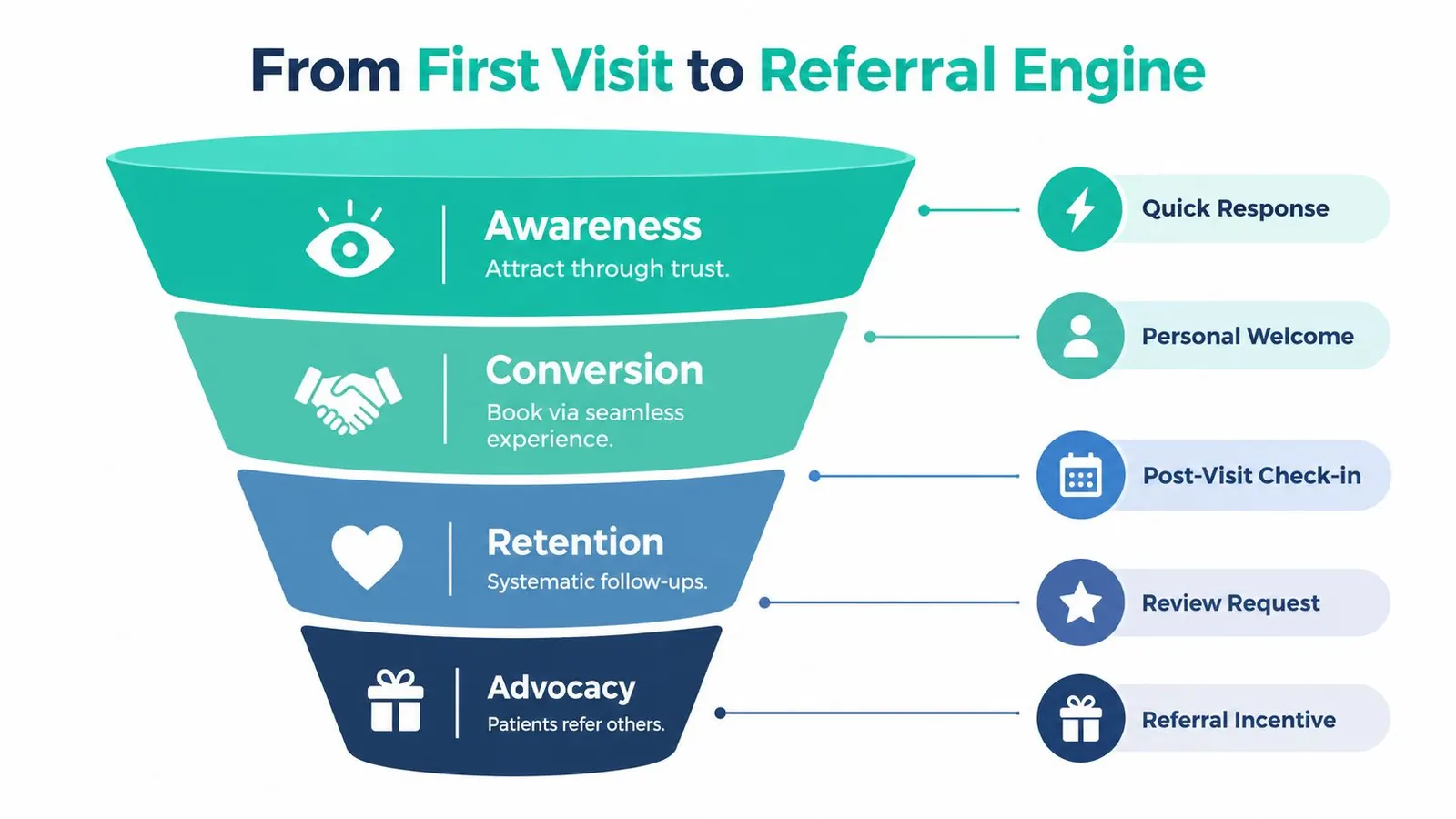
Retention belongs in the growth plan because it changes the economics of every acquisition channel. A 10% lift in retention can produce more revenue than a 20% lift in new acquisition at one-third the cost, according to the operational growth guidance in the small medical practice operations report. Review reminders, scheduling friction, wait times, and relationship quality before increasing ad spend.
Measuring What Matters So Growth Stays Profitable
A dashboard full of traffic can hide a failing practice. The useful measurement stack follows a person from discovery to booked consultation, attended appointment, accepted treatment, repeat visit, and referral.
Healthcare websites typically convert at 2% to 5% overall, while health-and-wellness landing pages have a 5.1% median, with dental services at 4.3% and medical treatment at 5.3%, according to Tebra's healthcare conversion guidance. The same source reports organic search converting prospective patients at 2.4% and PPC at 1.4%, with prospect-to-patient conversion of 76.9% for SEO and 64.2% for PPC. Treat those figures as reference points, then replace them with your own cohort data.
Separate predictive and outcome metrics
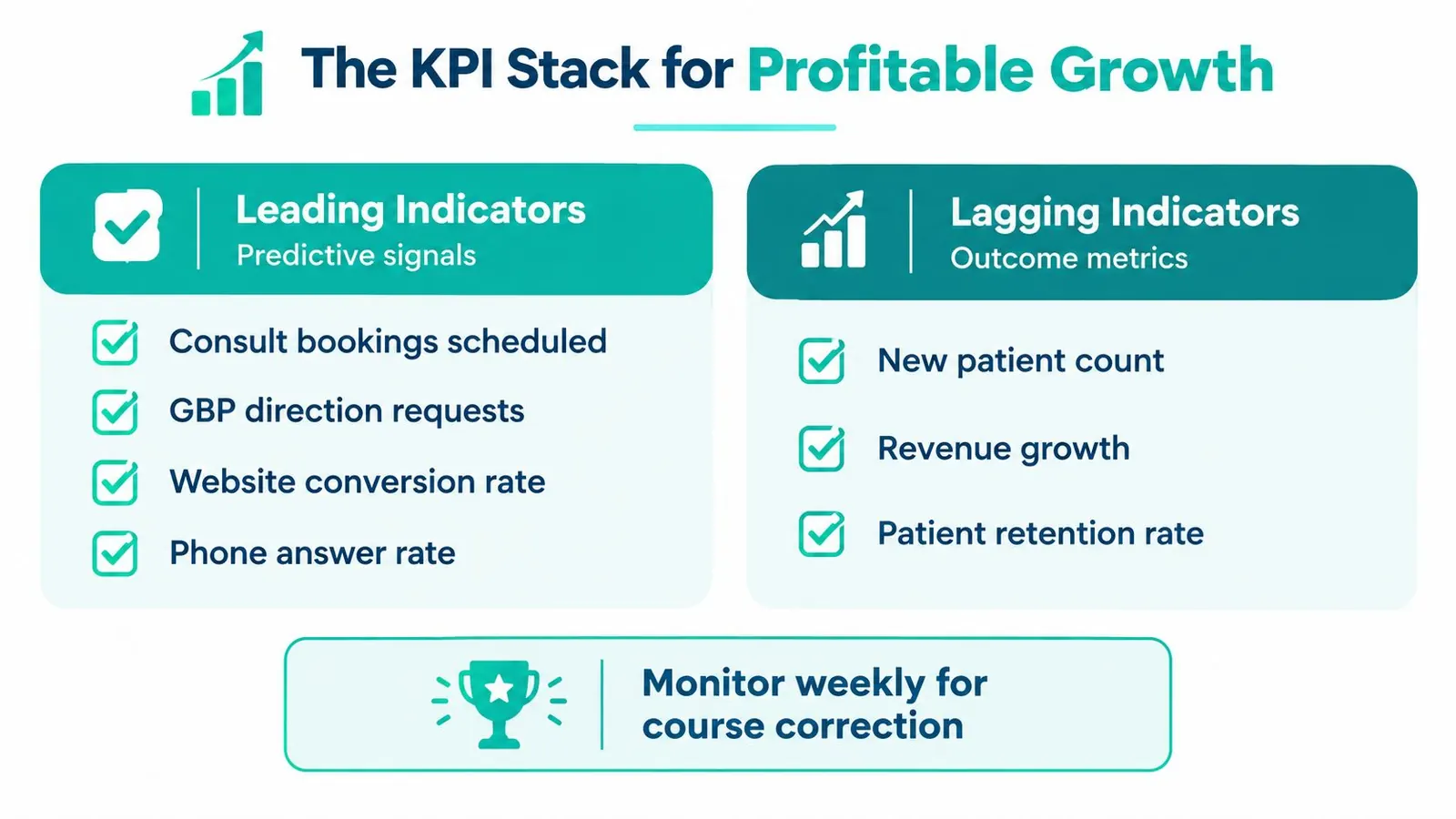
Review leading indicators weekly:
- Consult bookings scheduled: Are qualified prospects entering the calendar?
- GBP direction requests: Is local discovery producing action?
- Website conversion rate: Does the site turn relevant visits into inquiries?
- Phone answer rate: Does the team capture demand during operating hours?
Review lagging indicators monthly:
- New patient count: How many new relationships began?
- Revenue per new patient: What did each acquired patient produce?
- PAC payback period: How long did it take to recover acquisition investment?
- PLV and net retention: Are relationships becoming more valuable over time?
A simple funnel model might look like this:
- Search impression or referral exposure.
- Website visit, profile action, or phone inquiry.
- Consultation booked.
- Consultation attended.
- Treatment or matter accepted.
- Repeat visit, renewal, or referral.
The main dashboard mistake is tracking total patient count instead of qualified consultations and accepted treatment. A practice can add names to a database while losing profitability through poor-fit leads, missed calls, no-shows, or weak treatment acceptance.
Track leading indicators weekly for course correction, lagging indicators monthly for budget decisions, and full cohort economics quarterly. If you can't name your cost per booked consultation and revenue per accepted treatment, you're not ready to scale spend. Leaping Lemur Media's journal offers a place to continue building the strategy around measurable marketing and practice growth decisions.
Your 90, 180, and 365 Day Growth Roadmap
Growth stalls when nobody owns the hand-off. The strategist defines the market and economics, the content team builds the assets, the technical team measures behavior, and the front desk converts demand into attended appointments. Put those responsibilities on the calendar before launching anything.
| Phase | Focus | Key Deliverables | Owner | Success Metric |
|---|---|---|---|---|
| First 90 days | Foundations | IPP, positioning, service pages, optimized GBP, listing cleanup, analytics, call and form tracking | Owner, strategist, web lead, front desk | Reliable PAC, source, and conversion reporting |
| Days 91 to 180 | Experience and testing | Follow-up sequence, review process, reactivation campaign, one referral partnership, one paid-channel test with a capped budget | Operations lead, front desk, content lead | Improved booking quality and documented close rate |
| Days 181 to 365 | Efficient scale | Expand proven search activity, add community partnerships, launch lifecycle marketing, improve PLV reporting | Owner, marketing lead, operations lead | Profitable growth from repeatable channels |
The first 90 days
Lock the IPP and positioning before rewriting pages. Audit the website, claim and complete the Google Business Profile, correct business listings, define conversion events, and connect calls and forms to source data. The front desk should receive a response-time standard and a clear qualification script.
Days 91 to 180
Install the 48-hour follow-up, review request workflow, lapsed-patient sequence, and referral source field. Choose one complementary partner and one paid channel test. Set a budget cap before launch, agree on the stop conditions, and review booked consultations rather than impressions.
Days 181 to 365
Scale only the channels that meet the economic threshold. Add community partnerships, segment lifecycle communications, improve repeat-visit scheduling, and revisit service pages based on actual questions from patients. Teams working on response speed can also borrow operational ideas from Expressify AI's speed to lead strategy for HVAC plumbers, adapting the principle to practice intake rather than copying the trade-specific workflow.
Use this weekly checklist:
- Monday: Review inquiries, booked consultations, missed calls, and capacity.
- Tuesday: Check GBP actions, review requests, and new patient sources.
- Wednesday: Publish or improve one trust-building asset.
- Thursday: Audit open follow-ups, no-shows, and unbooked treatment opportunities.
- Friday: Record decisions, assign owners, and pause activities without a clear economic role.
The owner approves positioning and budget. The strategy lead owns priorities and measurement. Content owns pages, profiles, and patient education. Front-desk operations owns response, booking, follow-up, and attribution. That hand-off structure turns how to grow your practice from an aspiration into a managed operating system.
Leaping Lemur Media helps practices clarify positioning, improve local search visibility, build conversion-focused websites, and manage measurable Google, Meta, and TikTok campaigns. Visit Leaping Lemur Media to discuss a growth plan tied to PAC, PLV, patient experience, and the channels your team can profitably sustain.