
A practice owner usually reaches this decision after a frustrating month. New patient inquiries are coming in, but follow-up is inconsistent. The website needs work, social content feels random, and the owner is deciding whether to hire a marketing coordinator or sign an agency agreement. Meanwhile, the front desk is already stretched, and nobody has time to manage another complicated system.
That tension makes in house vs agency marketing feel like a simple question about price. It isn't. The decision is about ownership, speed, specialist skill, brand trust, and the amount of marketing work your practice can keep moving every week.
A dentist may need the front desk and doctor to protect the patient experience while outsourcing paid search and technical SEO. An eye doctor opening another location may need internal leadership with outside execution. A medspa launching a new treatment may need a team that can move quickly. A law firm may need tightly managed intake more than another batch of social posts.
This guide uses that practical lens. You'll see the three operating models, a side-by-side comparison, total-cost considerations, scenarios for healthcare and legal practices, and a straightforward implementation roadmap. If you want to understand the team behind this approach, visit Leaping Lemur Media's about page.
Table of Contents
- Introduction Why This Choice Feels So Hard Right Now
- Understanding Your Three Marketing Operating Models
- Detailed Comparison Across What Actually Matters
- What It Really Costs and When Each Model Pays Off
- Real World Scenarios for Dentists Eye Doctors Medspas and Law Firms
- Defining Roles KPIs and Who Owns What
- Your Decision Checklist and Implementation Roadmap
Introduction Why This Choice Feels So Hard Right Now
The hardest part isn't choosing between two vendors. It's deciding which parts of marketing should remain close to the people who deliver care or legal services, and which parts need dedicated specialists.
A solo dentist often knows exactly how patients should feel when they call, walk into the office, or read a treatment page. That knowledge belongs inside the practice. Yet the same dentist may not have time to manage Google Ads, review conversion tracking, write service pages, monitor search visibility, and test landing pages. Hiring one person to handle all of that can create a different problem, a generalist with too much responsibility and too little backup.
An agency solves the depth problem, but it can create a distance problem. If the team doesn't understand your community, patient questions, referral relationships, or intake process, the work may look polished without sounding like your practice. That disconnect is especially damaging in healthcare and law, where trust affects whether someone books a consultation or calls after a stressful event.
The decision isn't really either or
The Association of National Advertisers reported that 42% of advertisers had in-house agencies in 2008, rising to 58% in 2013, 78% in 2018, and 82% in 2023 among ANA members. In the same 2023 study, 88% said their in-house workload had increased, with 67% saying it had increased “a lot” (Association of National Advertisers data).
That pattern matters for practice owners. Internal marketing is becoming more common, but internal teams are also absorbing more work. Adding a staff member doesn't automatically eliminate the need for outside expertise.
The useful question is capability by capability:
- Who owns the brand voice?
- Who responds to leads?
- Who knows the patient or client experience best?
- Who handles search, paid media, creative, websites, and analytics?
- Who has enough capacity to keep campaigns moving?
Most growing practices need a deliberate combination rather than a permanent commitment to one side.
Understanding Your Three Marketing Operating Models
An in-house marketing model puts responsibility inside the practice. That may mean an office manager coordinating vendors, a marketing coordinator managing content, or a larger team with separate people for communications, advertising, and patient acquisition. The practice owns the priorities, approvals, data access, and day-to-day decisions.
An agency model gives an external team responsibility for agreed services. The agency may provide strategy, creative, paid media, SEO, website work, reporting, or lead-handling support. The practice still owns the business goals and final approvals, but specialists handle much of the planning and production.
A hybrid model divides the work intentionally. The practice keeps functions that depend on internal knowledge, patient trust, and fast access to decision-makers. The agency handles work that benefits from specialized tools, channel expertise, testing, and flexible capacity.
What each model optimizes
In-house teams optimize for proximity. They can hear patient objections, see scheduling bottlenecks, and adjust messaging based on real conversations. Their weakness is usually depth. A small team may not have strong expertise across paid search, technical SEO, video, design, analytics, and conversion strategy.
Agencies optimize for specialization and flexibility. They can bring different disciplines into one campaign and adjust resources as priorities change. Their weakness is context. They need clear access to the practice, strong briefing, timely approvals, and a reliable internal owner.
Hybrid teams optimize for fit. They don't outsource because marketing is unimportant. They outsource because some tasks require a different operating rhythm than patient care or legal work.
The World Federation of Advertisers and The Observatory International found that 66% of global brands already had some form of in-house agency, while 21% were considering building one. The same survey reported that 56% planned to move more digital production in-house over the next three years, with 83% citing cost efficiency, 76% agility, and 59% easier integration and deeper brand knowledge as reasons (Marketing Dive's report on the WFA survey).
For a local practice, that doesn't mean copying a large brand's structure. It means separating closeness from capability and assigning each job to the team best equipped to do it.
Detailed Comparison Across What Actually Matters
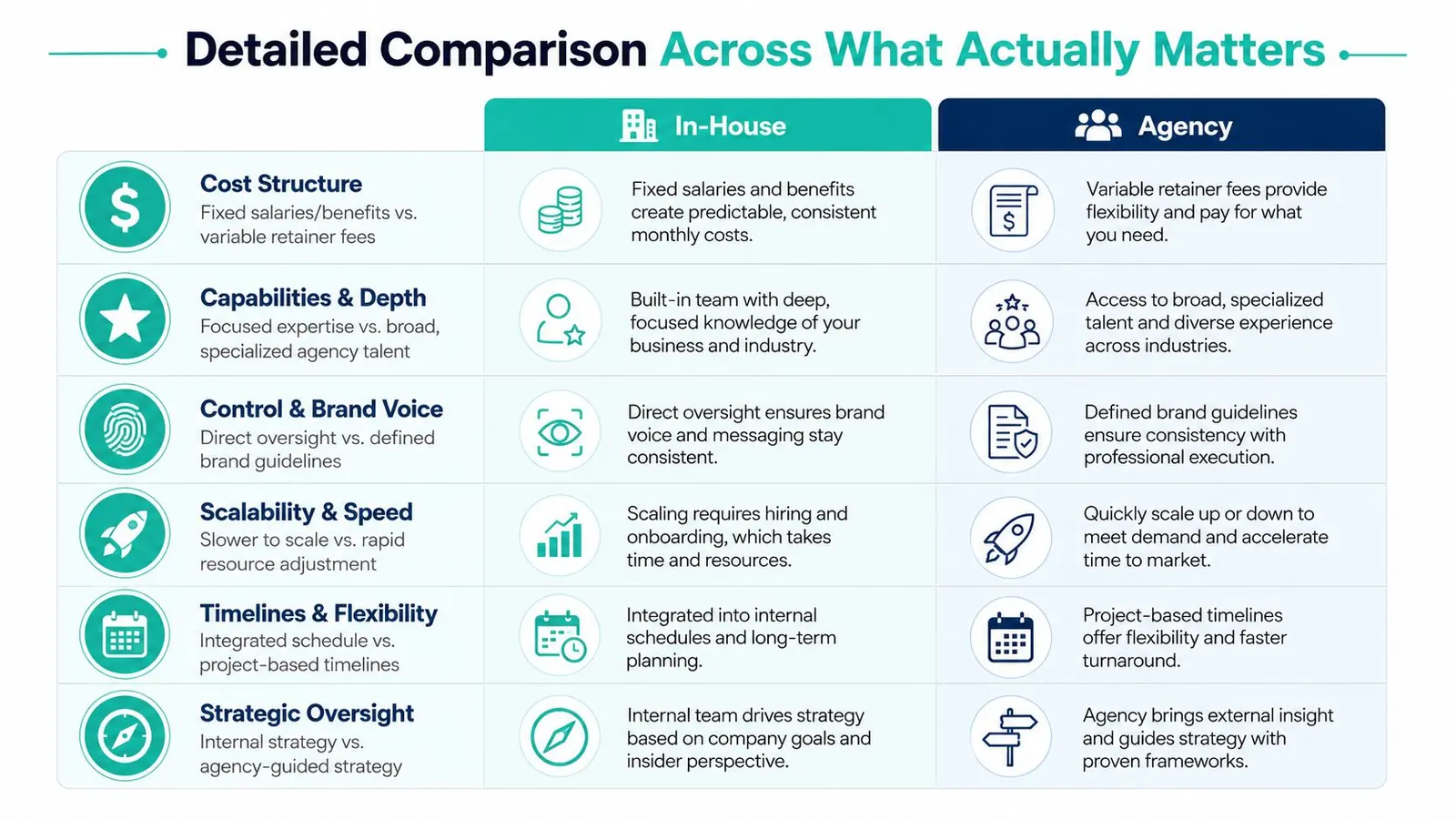
The table below is a practical starting point for owners comparing in-house vs agency marketing. The hybrid column shows where a split often makes sense for a practice.
| Criteria | In House | Agency | Hybrid Sweet Spot |
|---|---|---|---|
| Cost structure | Fixed salaries, benefits, tools, and management time | Variable retainers and project fees | Keep core coordination internal, buy specialist capacity as needed |
| Capabilities and depth | Strong practice knowledge, narrower specialist range | Broad access to channel and creative specialists | Internal subject knowledge with external execution depth |
| Control and brand voice | Direct oversight and daily access | Control through guidelines, approvals, and strategy meetings | Practice owns voice, agency applies it consistently across channels |
| Scalability and speed | Capacity grows through hiring and training | Resources can shift with campaign needs | Internal priorities, external surge capacity |
| Timelines and flexibility | Work fits the practice calendar but competes with other duties | Project timelines and defined production workflows | Shared calendar with clear approval windows |
| Strategic oversight | Strategy stays close to leadership | Agency can challenge assumptions and identify opportunities | Practice sets business direction, agency translates it into marketing action |
Cost structure
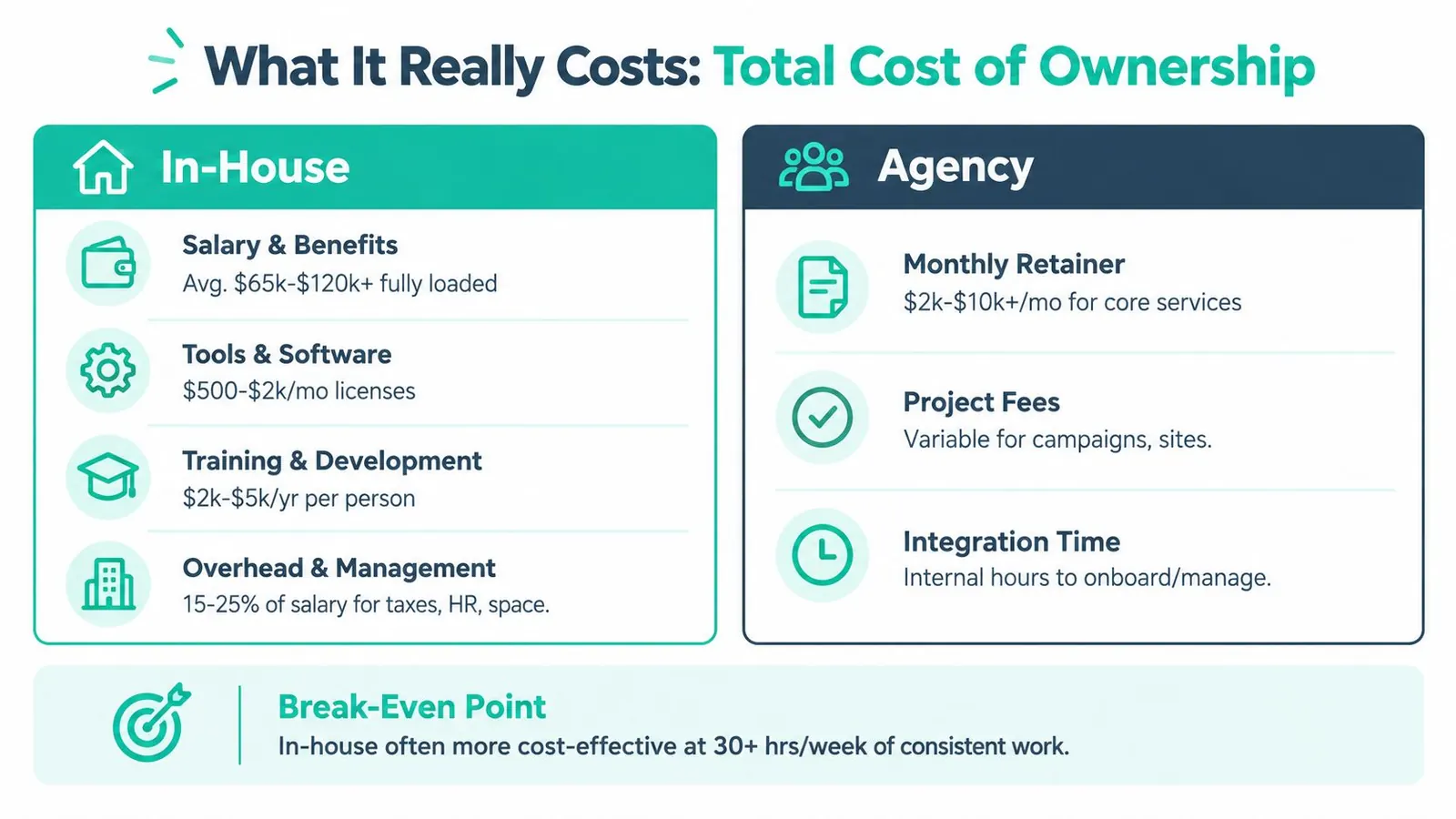
In-house spending looks predictable because payroll appears on one budget line. Cost includes benefits, taxes, software, training, recruiting, management, and the time required to supervise the work.
Agency spending is easier to scale up or down, but the agreement must define what the retainer includes. A low fee can become expensive if every landing page, campaign, revision, or reporting request creates a separate project charge.
Capabilities and depth
A practice employee may understand your services better than anyone outside the organization. That doesn't mean the employee can perform every specialist function well. Search strategy, paid media, conversion optimization, design, photography, video, and analytics each require different judgment.
Agencies bring breadth, but you should ask who will work on the account. A sales presentation with specialists is not enough. You need named responsibilities, review processes, and evidence that the team can explain healthcare or legal marketing without relying on generic language.
Control and brand voice
Internal teams have immediate access to doctors, attorneys, office managers, and staff. They can capture real stories and answer questions quickly. They can also become too close to the practice, approving content that feels familiar internally but unclear to a prospective patient or client.
An agency needs a usable brand system, not a vague instruction to “sound professional.” Give it examples of phrases your team uses, topics you avoid, patient concerns you hear, and the difference between an acceptable claim and an unacceptable one.
Practical rule: Keep the final voice and patient experience inside the practice. Don't confuse that ownership with doing every production task yourself.
Scalability and speed
Hiring creates durable capacity, but recruiting and onboarding take time. An agency can often add specialist support without asking the practice to redesign its staffing structure.
Speed still depends on approvals. A fast agency can't overcome delayed access, unclear offers, missing creative assets, or a physician who can't review a treatment page. Assign one internal decision-maker and set a regular approval rhythm.
Timelines and agility
Internal work can fit naturally around launches, community events, and seasonal demand. It can also slip because marketing competes with patient care, staff shortages, and daily administration.
External teams work best with a shared calendar. Use it to mark promotions, new services, location openings, compliance reviews, photography days, and campaign deadlines. The calendar creates flexibility without turning every request into an emergency.
Strategic oversight and accountability
An internal owner sees the business context. An agency can bring outside perspective and challenge assumptions. Neither model works if nobody connects marketing activity to booked consultations, qualified inquiries, signed matters, or profitable services.
For a practical service overview covering strategy and execution support, review Leaping Lemur Media's services. The right partner should help define what success means before producing more content.
What It Really Costs and When Each Model Pays Off
The salary-versus-retainer comparison is incomplete. A small internal team can look affordable until you add the costs that make the work possible.
A neutral industry breakdown estimates that a typical four-person in-house marketing team costs about $495K to $533K per year fully loaded, while a comparable full-service agency retainer is often $30K to $120K annually. That source estimates 12-month ROI at about 4.1x for agency-led marketing versus 1.8x for in-house teams, with a break-even point around $190K in annual marketing spend (DM Tech Labs' agency versus in-house analysis).
Those figures aren't a universal quote for every practice. They illustrate the financial mechanic. A four-person team has idle capacity when demand is uneven, and a single coordinator may lack the expertise required for complex campaigns. An agency can spread specialist capacity across accounts, but you pay for the scope and access defined in the agreement.
Count the loaded cost
Include these categories in your calculation:
- People: Salary, benefits, payroll taxes, recruiting, leave coverage, and management.
- Infrastructure: Software, reporting platforms, design tools, call tracking, training, and equipment.
- Leadership: Time spent briefing, reviewing, correcting, coordinating, and resolving missed handoffs.
- Unused capacity: Hours paid for when campaigns pause, priorities change, or the employee lacks the skills needed for the next project.
A separate estimate places a fully loaded four-person in-house marketing team at about $400K to $800K or more per year, compared with roughly $60K to $180K annually for an agency covering comparable scope (Agency Review's 2026 guide). Another industry guide reports published estimates for four-person teams often cluster around $350K to $600K annually before ad budgets, because loaded cost includes benefits, tools, training, software, taxes, and management overhead (AM World Group's comparison).
Use break-even as a lens, not a promise
UK-focused guidance places the in-house-versus-agency break-even point around £120K to £150K in annual marketing spend, with agency or hybrid approaches favored below that range and in-house becoming more cost-efficient above it by roughly 20% to 35% (Marketing Mary's UK guidance).
The spread across estimates proves why you shouldn't choose from a generic calculator. Compare your actual workload, required expertise, leadership availability, and growth priorities.
AI complicates the calculation. Recent ANA-related reporting says only 9% now view cost-saving as the primary benefit of in-house agencies, down from 30% in 2023, while 49% say AI lets internal teams do more without reducing external spend (IHALC's analysis of the ANA report). AI can increase output, but it doesn't remove strategy, review, compliance, coordination, or accountability.
Real World Scenarios for Dentists Eye Doctors Medspas and Law Firms
A solo dentist in a competitive neighborhood may have excellent patient knowledge and almost no marketing capacity. The practice should keep messaging decisions, patient stories, service priorities, and front-desk follow-up internal. Outsource search strategy, paid campaigns, landing pages, and reporting so the dentist isn't trying to become a media buyer after a full day of procedures.

An eye doctor opening multiple locations has a different problem. The practice needs consistent positioning, location-specific information, accurate scheduling paths, and a central view of performance. An internal marketing lead can protect the system and coordinate doctors, office managers, and leadership. An agency can manage local search, paid media, creative production, and location pages without forcing the practice to hire every specialty.
A medspa launching a new service needs speed and disciplined education. The owner should decide how the treatment is described, who it's for, what questions staff must answer, and which claims require careful review. An external team can build the campaign structure, creative variations, audience targeting, and landing-page workflow while the practice focuses on safe delivery and consultation quality. For operational support around patient communication and administrative capacity, a Medical virtual assistant may also help the practice keep inquiries and scheduling tasks organized.
A law firm usually needs consistency more than constant novelty. The partners should own practice-area priorities, intake standards, geographic focus, and the tone used with prospective clients. An agency can support content, search visibility, paid campaigns, conversion paths, and reporting, while the firm assigns one person to approve messaging and confirm that inquiries are routed correctly. Ideas for ongoing content and marketing planning can be explored through the firm's marketing journal.
The common thread
Each practice keeps the knowledge that outsiders can't safely guess. Each outsources work that benefits from repeatable systems and specialist execution.
The mistake is assigning every function to the same side. A front desk employee shouldn't be expected to master attribution, and an agency shouldn't invent the emotional experience of a patient consultation without input from the practice.
Defining Roles KPIs and Who Owns What
The operating model becomes manageable when every important task has one owner. Shared responsibility sounds collaborative, but it often creates missed deadlines and duplicated work.
Start with a simple responsibility map:
- Practice leadership: Sets growth goals, approves priorities, protects compliance, and decides which services deserve attention.
- Internal marketing owner: Supplies context, gathers approvals, coordinates staff, and connects campaigns to the patient or client experience.
- Agency or specialist: Builds the strategy, produces assets, manages channels, tests performance, and explains decisions.
- Front desk or intake team: Responds to inquiries, records outcomes, identifies common objections, and reports where prospects drop off.
Measure movement, not activity
A practice shouldn't judge marketing by how many posts went live. Track whether the right people are finding the right service, taking the next step, and receiving a timely response.
Useful measures include:
- Qualified calls and form submissions
- Consultation or appointment requests
- Booked appointments and completed consultations
- Cost per qualified inquiry
- Lead response time
- Show rate and cancellation patterns
- Revenue or signed matters tied to marketing sources
- Search visibility for priority services and locations
Don't assign the agency responsibility for booked appointments if the practice can't report whether staff answered calls or followed up. Don't blame the front desk for weak campaign targeting if nobody owns the advertising account.
Build a review rhythm
Hold a regular performance meeting with a fixed agenda: what changed, what the data says, what patients or clients are asking, what needs approval, and what happens next. Keep a shared asset library with approved logos, photos, offers, disclaimers, service descriptions, and frequently asked questions.
If appointment outreach is a major bottleneck, compare vendors carefully and review guidance on the best place to hire appointment setters before assigning that responsibility. The tool or provider matters less than clear scripts, handoff rules, and outcome tracking.
Your Decision Checklist and Implementation Roadmap
Choose in-house first when your practice has steady marketing volume, a capable internal leader, strong content access, and enough work to keep specialist capacity productive.
Choose agency first when you need specialist execution, faster campaign development, a broader channel mix, or outside accountability without building a full department.
Choose hybrid when brand trust must stay close to the practice but execution is too technical, varied, or time-consuming for the current team.
Use this checklist before signing a contract or posting a job:
- Capacity: Who has protected time every week?
- Complexity: Which services, locations, or audiences need different strategies?
- Speed: Is there a launch, expansion, or revenue priority that can't wait for a long hiring cycle?
- Leadership: Who will approve work and connect it to business goals?
- Financial fit: What is the fully loaded cost of internal work, including management and tools?
- Accountability: Can you track inquiries, appointments, consultations, signed matters, and revenue?
A practical 30 60 90 day roadmap
Days 1 to 30: Audit current campaigns, tracking, website paths, intake, staff capacity, and existing contracts. Select one decision-maker and define the first business outcome.
Days 31 to 60: Build the brand and service brief, confirm responsibilities, clean up access, establish reporting, and launch the highest-priority work.
Days 61 to 90: Review lead quality, response handling, booked outcomes, campaign efficiency, and internal workload. Keep what works, stop low-value activity, and adjust the division between internal and external teams.
Don't buy a model. Build an operating system that gives your practice ownership where trust matters and specialist support where execution demands it.
Leaping Lemur Media helps practices connect positioning, paid media across Meta, Google, and TikTok, and AI-supported intake so marketing work supports real conversations rather than vanity metrics. Visit Leaping Lemur Media to discuss which capabilities should stay in-house, which should be outsourced, and how a practical hybrid plan could fit your practice.