Your receptionist has just finished a call with a prospective patient who found you through an expensive local ad. The patient asked one question, hesitated, and said they'd think about it. Meanwhile, a nearby business serves the same kind of person every day, but you've never discussed working together. Your practice keeps paying for attention while trusted local relationships sit unused.
A thoughtful marketing partnership strategy gives small practices another way to earn visibility, referrals, and bookings. A dentist can collaborate with an orthodontist, an eye doctor can work with a luxury eyewear boutique, and a medspa can create a useful experience with a high-end salon. The strongest partnerships don't feel like lead swapping. They make the customer's next decision easier.
Table of Contents
- Why Local Practices Need a Marketing Partnership Strategy
- Identifying High-Value Partners in Your Community
- Crafting a Mutual Value Proposition and Pitch
- Designing Co-Marketing Tactics and Campaigns
- Navigating Legal Agreements and Operational Onboarding
- Measuring Success and Scaling the Partnership
Why Local Practices Need a Marketing Partnership Strategy
Paid advertising can create reach, but it doesn't automatically create trust. A prospective patient may see your dental clinic repeatedly in search results and still choose a practice recommended by a family member, physician, salon owner, or another professional they already know. Local practices have an advantage that large brands often struggle to reproduce, which is proximity to real community relationships.
A marketing partnership strategy turns that proximity into a deliberate growth channel. You identify a non-competing business with a compatible audience, build a useful offer or experience together, and agree on how each side will promote and measure it. The result isn't merely another logo beside yours. It's a clearer path for someone who already has a related need.
One industry compilation reports that 72% of companies say partners lower customer acquisition costs, while co-hosted webinars deliver 53% higher attendance. The same compilation says high-growth brands are 3x more likely to use marketing partnerships than no-growth firms. Those figures come from broader markets, but the underlying logic applies locally: a trusted introduction can reduce the amount of paid persuasion your practice needs. (Industry partnership growth data)
Referral exchange versus integrated partnership
A transactional referral exchange sounds simple: “Send me patients, and I'll send you clients.” It usually fails because neither owner knows when to make the referral, what to say, or how to tell whether the relationship is working.
An integrated partnership has a shared customer problem at its center. A dentist and orthodontist might create a clear referral path for patients who need a different treatment. A medspa and salon might coordinate a wedding preparation consultation with defined services, booking steps, and follow-up. Each business contributes something concrete, such as expertise, space, email access, staff time, content, or an offer.
Practical rule: If the customer experience doesn't improve, the partnership is probably just a referral arrangement with extra branding.
Small practices also need a realistic operating model. Before promising a campaign, decide who will write the email, approve the graphics, answer questions, route inquiries, and follow up with people who don't book immediately. Practical guidance on affiliate and referral structures, including partner expectations and promotion mechanics, is available in these ViralRef partner program tips. For broader planning ideas around local positioning and content, review the Leaping Lemur Media journal.
Identifying High-Value Partners in Your Community
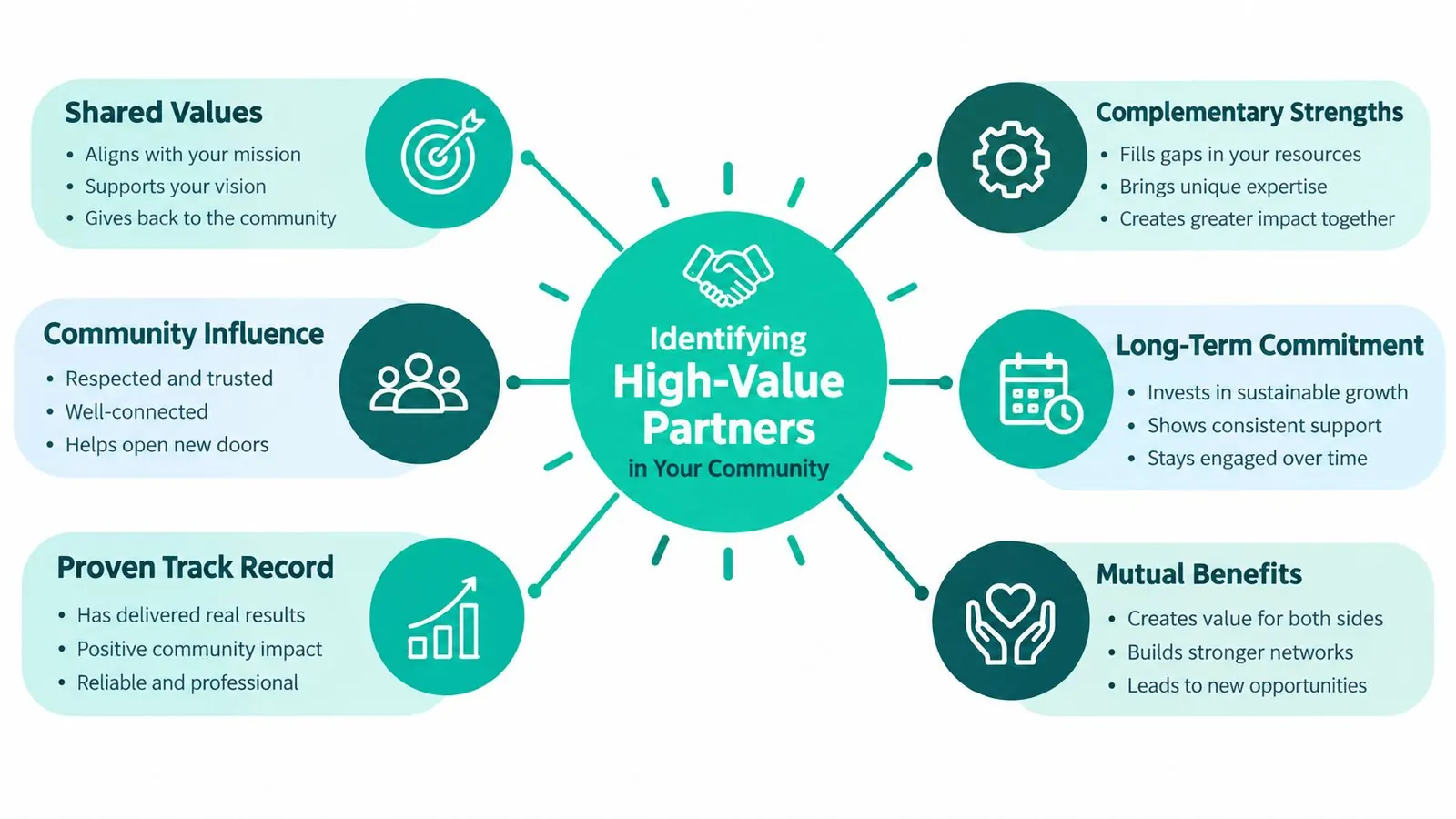
The right partner isn't necessarily the business with the largest following. Look for a company that reaches the same kind of person, solves a related problem, protects its reputation, and can reliably complete the work it promises.
Start with the customer journey. Write down what your ideal patient or client does before contacting you, what happens during the service, and what they may need afterward. A family law firm might serve someone who also needs a financial planner, therapist, mediator, or estate professional. An eye doctor might share customers with a local eyewear boutique, occupational health provider, or independent optician.
Build a local partner map
Use a spreadsheet, a paper map, or a tool such as Google Maps. Search by service category and neighborhood, then record businesses that appear repeatedly in your customers' lives. A resource on Google Maps ranking help can also help you understand how local visibility and industry relationships support one another.
For every candidate, assess:
- Audience overlap: Do their customers match your ideal patient or client in need, location, priorities, and spending comfort?
- Service complementarity: Can each business extend the other's customer journey without competing for the same appointment?
- Reputation: Read recent reviews, inspect complaint patterns, and ask people in the community what the business is known for.
- Brand compatibility: Compare tone, standards, accessibility, and community values. A premium medspa may not suit a partner whose promotions rely on constant discounting.
- Operational reliability: Does the owner respond promptly, honor appointments, and keep promises to customers?
- Commercial clarity: Can the partner discuss goals, responsibilities, costs, and attribution without becoming defensive?
Partnership strategy has evolved over time. It moved from licensing and sponsorship into a more formal growth discipline as mass media expanded during the 20th century, then accelerated in the 1980s through celebrity endorsements and more advanced audience segmentation. A frequently cited milestone is the 2006 launch of the Nike+iPod Sport Kit, which combined complementary capabilities to create a customer experience rather than a simple advertisement. (Brand partnership history and examples)
Check the red flags before you commit
Don't ignore poor communication because the proposed audience looks attractive. A partner who misses deadlines, makes unsupported claims, mishandles customer information, or treats staff poorly can transfer that risk to your practice.
Ask for a small test before agreeing to a broad campaign. A joint educational post, a private introduction between owners, or a modest event can reveal whether both teams communicate well. The best local partner is one whose standards you'd be comfortable recommending even when there isn't a commercial benefit.
Crafting a Mutual Value Proposition and Pitch
Your first pitch should answer one question for the other owner: why is this worth their time? “I want access to your audience” is honest, but it isn't a value proposition. A stronger approach connects your idea to a customer need, a business outcome, and a manageable execution plan.
Suppose you run a dental practice and want to approach an orthodontist. Don't lead with your desire for more referrals. Explain that patients often ask your team about alignment options, that the orthodontist can provide a trusted next step, and that both practices can create a clear educational resource without making either team responsible for treatment decisions outside its expertise.
Use a four-part pitch
-
Name the shared audience. Describe the specific people both businesses already serve. Avoid “everyone in town.” Say “parents seeking coordinated care for children” or “local professionals preparing for a visible event.”
-
Define the customer problem. Explain what feels confusing, inconvenient, or disconnected today. Partners respond better to a customer-centered problem than to a vague promise of exposure.
-
Offer a concrete activation. Suggest one campaign, one event, or one content asset. Include the proposed timeline, booking route, promotional channels, and what each business supplies.
-
Set a fair exchange. State how costs, staff time, leads, content production, and follow-up will be handled. The exchange doesn't have to be identical, but it should feel balanced and visible.
A useful opening message might be: “We serve many of the same local families at different points in their care journey. I'd like to test a short educational campaign that answers a question they already ask both teams. We can prepare the landing page and draft the email, while your team reviews the clinical information and shares the invitation with appropriate patients.”
Handle objections without overselling
A partner may worry about brand dilution, privacy, workload, or appearing too promotional. Address the concern directly. Offer approval rights over shared creative, keep the first activation narrow, and agree that either party can stop using an asset that no longer meets its standards.
The 2026 partner-marketing benchmark report says 89% of organizations had some version of a partner marketing strategy, 37% of overall marketing budgets were spent on partner activities in the prior year, and 62% expected that share to increase. (Foundry partner-marketing benchmark) That doesn't mean a local practice should imitate enterprise spending. It does mean partnership activity deserves a defined budget and process, rather than leftover attention after every other marketing task is complete.
Bring a one-page proposal to the meeting. It should show the audience, problem, campaign, responsibilities, approval process, booking route, and review date. A partner can approve a clear experiment. They can't easily approve an idea that exists only as enthusiasm.
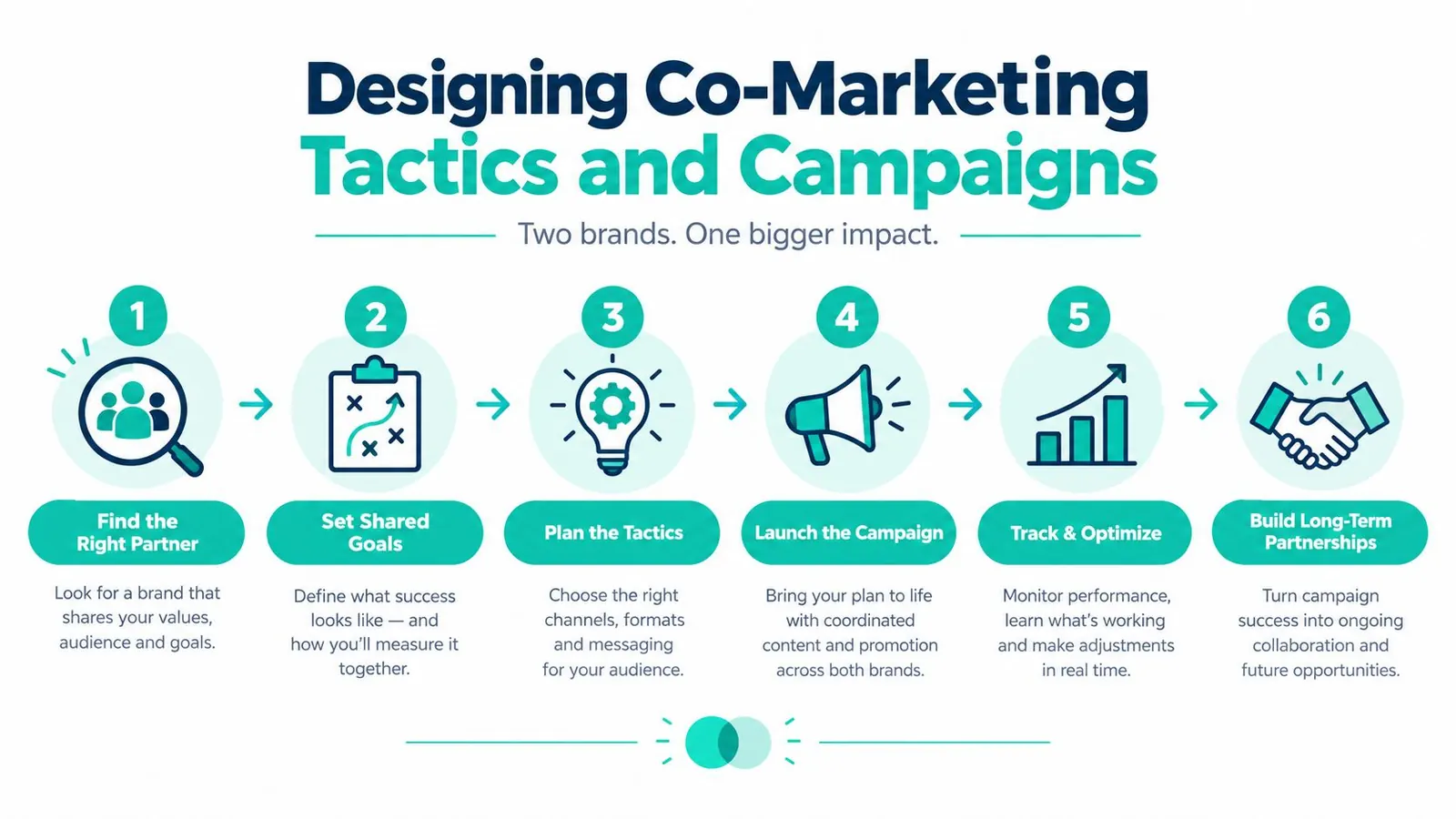
Designing Co-Marketing Tactics and Campaigns
The best local campaigns give people a reason to participate beyond “meet two businesses.” They answer a practical question, simplify a decision, or create a timely experience. Three formats work particularly well for service practices because they use expertise and existing customer relationships rather than requiring a large media operation.
Joint educational workshop
A medspa and dermatologist could host a skincare aging seminar. The event should focus on education, not a disguised sales pitch. Choose a narrow topic, assign each professional a distinct role, and make registration simple through one shared page.
The execution can follow this sequence:
- Select one question: For example, how to build a safe skincare routine before considering treatments.
- Divide expertise: The dermatologist covers medical considerations, while the medspa explains service options and preparation.
- Create one registration path: Use a dedicated form that records the source and gives both teams permission to follow up according to applicable rules.
- Promote equally: Each partner sends an email, publishes social posts, and displays a printed invitation at its location.
- Plan the next step: Offer a consultation or educational resource that matches the attendee's interest, without pressuring people during the event.
- Review attendance and bookings: Compare registrations, attendance, questions, consultations, and eventual revenue.
A 2026 industry summary reports that 85% of organizations invest in webinars and events, while 45% are launching 1:1 account-based marketing with their top partners. It also reports that about 41% of market development funds are unused or underutilized, a warning that money alone won't fix a campaign without ownership and follow-through. (Partner marketing activation data)
Bundled service experience
A dentist and local spa might coordinate a wedding preparation package, but neither should casually combine services without checking professional, insurance, and promotional requirements. The offer could instead bundle appointment coordination, educational content, and carefully defined perks, with each practice billing for its own service.
Put one person in charge of the customer journey. The customer should know where to book, what each service includes, whether the offer expires, and who to contact with questions. If your practice needs help selecting channels, defining audiences, and connecting campaigns to conversion paths, the Leaping Lemur Media services provide a relevant planning reference.
Shared local content
A family law firm and financial planner could publish a local guide to the financial decisions that arise during a separation. An eye doctor and eyewear boutique might create a guide to choosing frames for work, driving, and screen-heavy routines.
Keep the content useful. Draft it together, include both brands in the byline or author section, use local examples without exposing client information, and distribute it through email, social media, waiting-room materials, and each partner's website. Add separate calls to action so you can see which partner generated each inquiry.
The campaign should have one owner, one deadline, and one approval checklist. Without those details, co-marketing becomes a series of good intentions that staff members postpone when appointments and urgent client work take priority.
Navigating Legal Agreements and Operational Onboarding
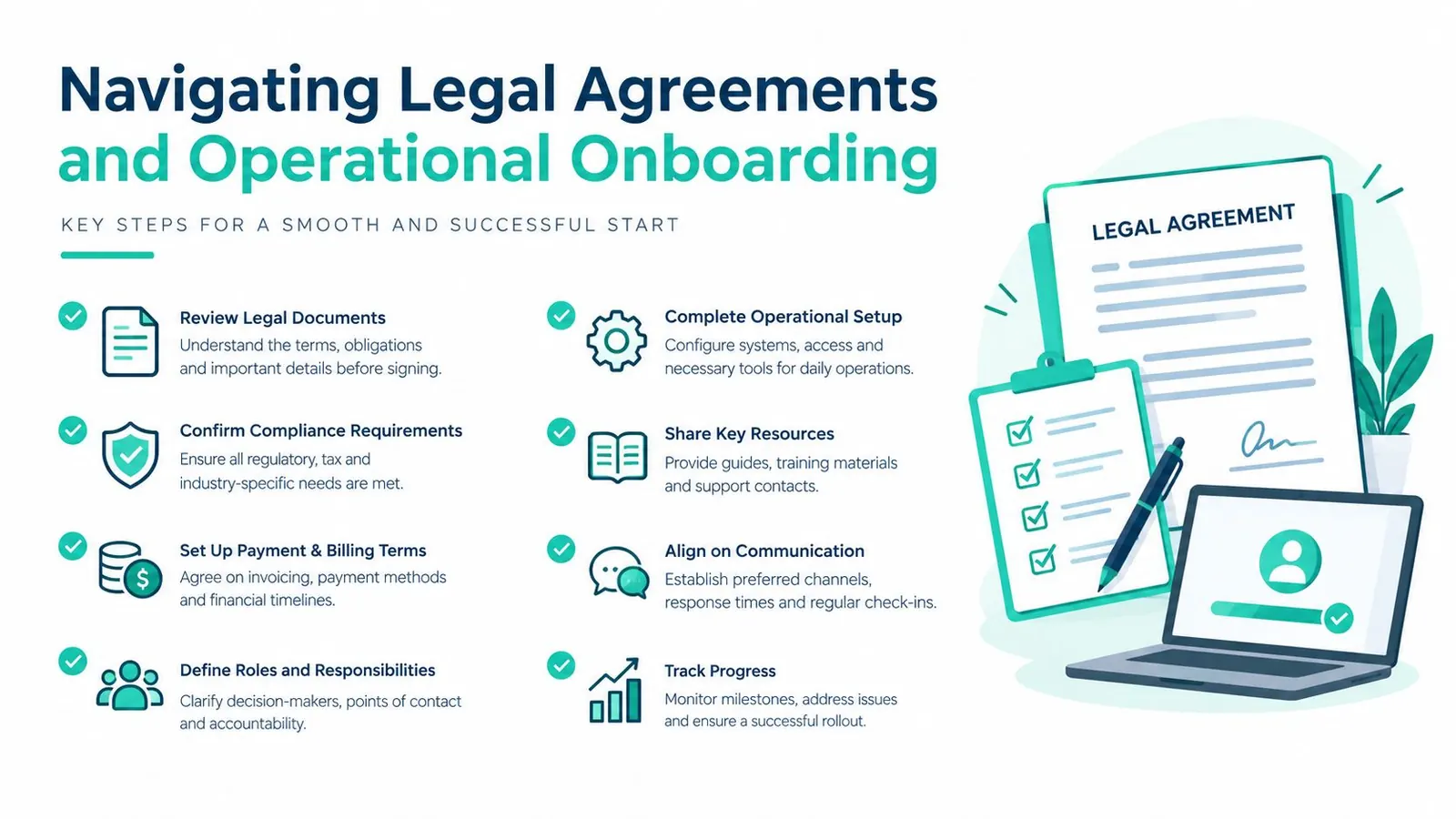
A verbal agreement may feel friendly at the beginning, but it becomes inadequate as soon as money, customer data, intellectual property, or public claims enter the relationship. A short written co-marketing agreement protects the friendship as well as the business because both owners can refer to the same expectations.
The agreement should identify the parties, campaign purpose, deliverables, approval rights, payment responsibilities, and duration. It should also explain what happens if one partner misses a deadline, changes its brand, receives a complaint, or wants to end the campaign.
Put the commercial terms in writing
Independent co-marketing guidance recommends specifying budget and cost sharing, branding and intellectual property usage, timeline and termination terms, and compliance obligations. It also notes that paid promotions must disclose material connections and that claims must be truthful under the FTC Endorsement Guides. (Co-marketing agreement and disclosure guidance)
At minimum, address:
- Costs: State who pays for design, venue hire, advertising, printing, software, and refunds.
- Assets: Define who owns photos, videos, landing pages, written content, logos, and customer lists.
- Approvals: Name the people who can approve claims, creative, offers, and final publication.
- Customer information: Specify what data is collected, why it is collected, who can access it, and how it is stored.
- Professional rules: Healthcare, legal, financial, and other regulated practices should have appropriate counsel review claims and referral arrangements.
- Exit terms: Explain notice, campaign cancellation, asset removal, outstanding invoices, and follow-up responsibilities.
Don't treat a disclaimer as a substitute for truthful marketing. A dental practice shouldn't imply that every patient is suitable for a treatment, and a law firm shouldn't promise an outcome. Each partner remains responsible for the accuracy and compliance of its own professional claims.
Make onboarding easy for busy teams
Onboarding operations must align with the everyday reality of a small practice. Use a shared folder, a simple project board such as Trello or Asana, and one communication channel for campaign decisions. Create a one-page partner brief containing the offer, audience, approved description, contact details, deadlines, logos, and escalation process.
Then rehearse lead routing. Decide whether inquiries go to a shared inbox, a tracked phone number, a booking form, or a named coordinator. Train reception staff with a short script so they know what the partnership includes and where to send questions.
Set a recurring check-in, but keep it purposeful. Review completed tasks, pending approvals, new inquiries, and customer feedback. If the relationship needs strategic support, contact Leaping Lemur Media for help shaping a practical marketing process around your practice and its local partners.
Measuring Success and Scaling the Partnership
Likes, shares, and event photos can make a collaboration look active while producing little commercial value. A marketing partnership strategy should connect activity to inquiries, attended appointments, completed services, and revenue. Visibility matters, but it isn't the final score.
Strategic partnership failure is repeatedly reported at roughly 60-70%, with common causes including unrealistic expectations, misaligned objectives, poor communication, and lack of trust. The operational lesson is straightforward: define shared KPIs, an operating cadence, and attribution rules before launch. (Partnership failure causes and governance guidance)
Build a measurement path
Track the customer from introduction to outcome. You don't need an expensive partner platform to start. A spreadsheet, shared CRM field, dedicated landing page, tracked phone number, or campaign-specific booking option can create enough visibility for a local test.
| Stage | What to record | Why it matters |
|---|---|---|
| Exposure | Email sends, event invitations, content distribution | Shows whether both partners promoted the campaign |
| Response | Form submissions, calls, replies, registrations | Measures initial interest |
| Qualification | Relevant inquiries and consultation requests | Separates curiosity from genuine fit |
| Conversion | Attended appointments and completed services | Connects the partnership to business activity |
| Economics | Revenue, costs, staff time, and follow-up effort | Shows whether the motion is sustainable |
Agree on attribution before anyone receives the first lead. Decide whether a person counts as partner-sourced when they use a campaign form, mention the partner by name, use a referral code, or is manually recorded by reception. Use one rule consistently, and don't claim precision your process can't support.
For founders who want a deeper financial framework, this guide to understanding partnership ROI for founders offers useful context. Local practices should adapt the model to their own margins, appointment capacity, and follow-up workload.
Review the relationship, not just the campaign
Hold a post-campaign meeting while the details are still fresh. Ask which message generated useful conversations, whether the booking process confused customers, how quickly each team followed up, and whether the effort was fair. Record what you'll keep, remove, and test next.
Scale only when the partnership works operationally. A successful event may become a recurring educational series. A useful local guide may become a shared content calendar. A reliable referral path may become a formal alliance with regular staff training and quarterly planning.
Don't scale a weak process because the idea feels exciting. Fix the handoff, attribution, approvals, or customer experience first. Sustainable partnerships grow from repeatable behavior, not from a single impressive launch.
Leaping Lemur Media helps practices clarify their positioning, plan local marketing channels, and build thoughtful growth systems that reflect how they serve their communities. Visit Leaping Lemur Media to explore a partnership-first approach and start a conversation about making your next local collaboration easier to execute and measure.