
Marketing Partnership Strategy for Small Practices
Learn how small practices build local marketing partnerships with nearby businesses to earn referrals and cut reliance on expensive ads.
Read

Marketing Strategy
A prospective patient is comparing three dentists on a phone during a lunch break. One site promises “exceptional care,” another shows polished staff photos, and the third explains what an initial visit includes, what may affect the cost, who performs each step, and what happens if treatment isn't suitable. The third practice has made the decision easier without making a louder claim.
That's the practical power of marketing transparency. For dentists, eye doctors, medspa owners, law firms, and other local businesses, transparency turns uncertainty into useful information. It helps people decide whether your practice is right for them, while creating a clearer foundation for acquisition, retention, compliance, and long-term trust.
A dental practice can publish every service it offers and still be opaque. If the website hides the consultation process, uses vague pricing language, or presents every result as guaranteed, visitors have information but not clarity.
Marketing transparency means making customer-facing decisions easier to understand. A patient should be able to tell who you serve, what you offer, how the process works, what it may cost, what the limitations are, and what happens next. An eye doctor can explain the difference between an exam and a contact lens fitting. A medspa can describe who should avoid a treatment and what results depend on. A law firm can state which matters it handles and when a consultation may not be appropriate.
That isn't oversharing. It's selective, relevant disclosure.
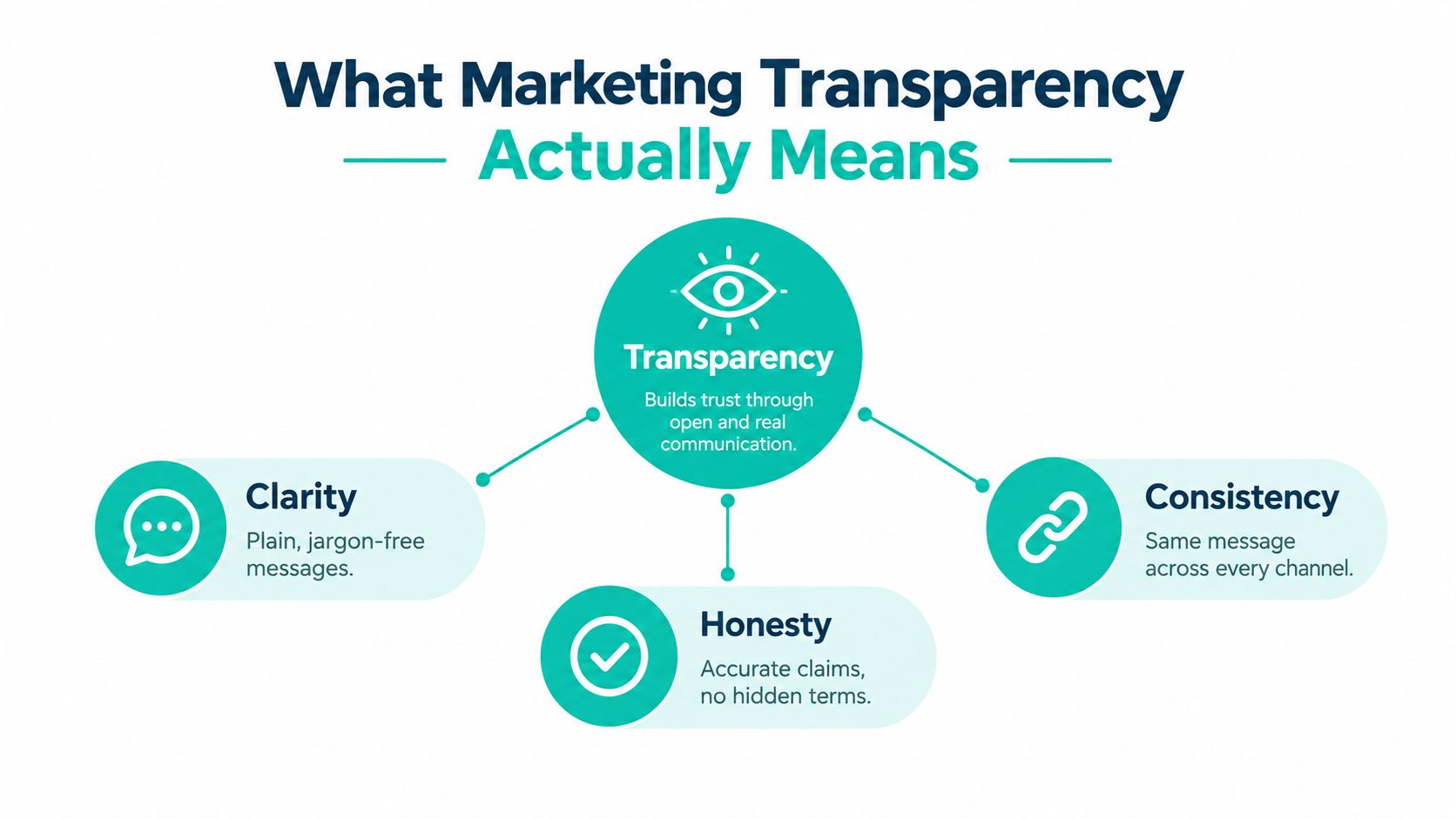
Use three questions to evaluate every important marketing claim:
A practice fails the clarity test when a visitor needs professional knowledge to interpret the offer. It fails the honesty test when a testimonial implies an outcome that the average person can't reasonably expect. It fails the consistency test when an ad promotes one price but the booking page introduces different terms.
Transparency also includes the things you choose not to promise. A medspa can explain that outcomes vary by treatment area, skin condition, provider assessment, and follow-up. A lawyer can explain that an initial conversation doesn't guarantee representation. A dentist can show that a treatment plan follows an examination rather than pretending a form submission can determine the right procedure.
A widely cited benchmark says 56% of consumers say they would be very likely to remain loyal to a brand for life if it offered complete transparency, linking openness about pricing, sourcing, product limits, and company practices to long-term retention (Acumen Academy on ethical marketing). For local practices, the lesson isn't to publish every internal document. It's to answer the questions that create hesitation before someone books.
Your practice story and approach should support that effort. Explain why the practice exists, who works there, how decisions are made, and what patients can expect from the relationship. When those details appear consistently, marketing stops sounding like persuasion and starts functioning like orientation.
Transparent marketing improves the commercial path from first impression to repeat business because it addresses the reason people hesitate: they don't yet know whether they can trust the claim, the provider, or the process.
A large consumer-brand transparency study found that perceived brand transparency significantly increases purchase intention, with brand trust mediating the effect in an experiment with 225 consumers (Journal of Consumer Marketing study). The practical sequence is straightforward:
This is why a dental practice that explains examination steps may outperform one that merely says “gentle care.” The explanation gives a nervous visitor something concrete to evaluate. An optometry clinic that distinguishes services clearly can attract a better-informed appointment rather than forcing staff to correct confusion after the booking.
Practical rule: If a claim sounds impressive but doesn't help someone make a decision, rewrite it.
Clarity can reduce avoidable questions and mismatched leads. A law firm that explains its practice areas may receive fewer inquiries outside its scope. That can improve staff focus without pretending every inquiry has equal value. A medspa that explains candidacy and aftercare can discourage unsuitable bookings while preparing appropriate prospects for a more productive consultation.
The same principle applies to retention. Patients are more likely to continue a relationship when the practice sets expectations before treatment, communicates changes promptly, and explains recommendations in plain language. Transparency doesn't guarantee agreement, but it gives people a fair basis for deciding.
Disclosure can help performance when it works within an existing relationship of trust. Research summarized in the Harvard Business School and Journal of Consumer Research material found that disclosures about acceptable information flows were particularly effective under high trust, while field studies on a loyalty-program website showed transparency can improve effectiveness in trusted contexts (Journal of Consumer Research article).
That finding should change how practices deploy transparency. Don't place a dense legal notice at the point where a visitor needs a simple answer. Use layered communication instead:
Transparency should remove suspicion, not create a maze. If disclosure makes the message harder to understand, improve the design and wording before concluding that openness hurts conversion.
Regulated practices need a higher standard than attractive copy. Dentists, eye doctors, medspas, and law firms must make claims that are accurate, supportable, and appropriate for the professional context. The exact rules vary by jurisdiction and profession, so a marketing review should involve the relevant regulator, professional body, or qualified legal adviser when a claim carries material risk.
The safest operating principle is simple: say what you can substantiate, explain what people need to know, and don't use disclosure as a loophole.

The FTC's 2019 guidance says the influencer, not the brand, is responsible for disclosing endorsements, and influencers can't assume followers already know about a brand relationship. The agency explains when disclosures are required and how they should be presented so followers can see them (FTC guidance for online influencers).
A material connection can include payment, free or discounted services, affiliate commissions, employment, or a family or personal relationship. The disclosure must be clear and conspicuous, meaning people shouldn't have to find it in a profile biography, expand a caption, click another page, or interpret a dense cluster of hashtags. A practical label such as “paid partnership,” “sponsored,” or “I received this treatment at no cost” is more useful than ambiguous language.
For healthcare and professional services, apply the same discipline to testimonials and results:
Buying reviews creates a transparency problem before it creates a reputation problem. Practices should understand why buying Google Reviews destroys trust, especially when prospective patients use reviews to judge whether a provider's claims match real experiences.
Ask for honest feedback through a consistent process, but don't script praise or pressure people to omit criticism. Respond to negative reviews without disclosing private details. A calm explanation of what you can do next is more credible than a defensive argument.
Your privacy policy should also match your actual data practices. Explain what information you collect through forms, booking tools, calls, cookies, newsletters, and advertising systems. Don't promise privacy in broad terms if third-party platforms or tracking tools operate behind the scenes.
Before launching an ad, testimonial, landing page, or influencer collaboration, ask:
If the answer to any question is no, revise the content. Compliance isn't the enemy of persuasive marketing. It forces the practice to build persuasion on information people can trust.
A dental office once relied on broad language about “personalized care.” Visitors couldn't tell whether the first appointment included imaging, a treatment discussion, or a cleaning. The practice replaced general promises with a plain-language appointment guide, explained what could change the recommended treatment, and gave patients a clear next step. The message became less glamorous and more useful.
An eye care clinic took a different approach. Its service pages separated routine eye exams, contact lens services, urgent concerns, and eyewear support. The clinic also explained when a patient might need a referral or a follow-up appointment. That structure helped visitors choose the right entry point instead of treating every visit as the same product.
A medspa built trust by discussing candidacy rather than showing only idealized outcomes. Its content explained that treatment decisions depend on a consultation, that results vary, and that aftercare matters. The practice still presented its expertise, but it stopped implying that a single image could represent every patient's experience.
A law firm made its marketing more transparent by stating the matters it accepts, the questions a prospective client should prepare, and the circumstances in which it may recommend another resource. That approach respects the visitor's time and helps the firm focus conversations on cases it can actually evaluate.
| Practice Type | Transparency Focus | Key Disclosure Areas | Patient Response |
|---|---|---|---|
| Dental practice | Appointment and treatment clarity | What the first visit includes, possible next steps, factors affecting recommendations | More informed booking decisions |
| Eye care clinic | Service selection | Exam types, contact lens process, referral situations, eyewear support | Fewer mismatched inquiries |
| Medspa | Candidacy and outcomes | Consultation requirements, limitations, aftercare, variation in results | More realistic expectations |
| Law firm | Scope and fit | Practice areas, consultation purpose, possible limitations, referral options | Better-qualified conversations |
These examples share a pattern: none of the practices depended on radical disclosure. They made the relevant process visible at the moment people needed it. That same discipline applies to other regulated professional brands. Guidance on compliant branding for RIAs offers a useful reminder that trust-based marketing works best when identity, claims, and disclosures reinforce one another.
The result isn't guaranteed conversion from every visitor. It's a better match between what the practice says, what the person expects, and what the team can deliver.
Start with the pages and campaigns that influence a decision today. Don't attempt to rewrite your entire brand at once. Choose one service, one audience, and one conversion path, then make the information easier to verify and understand.
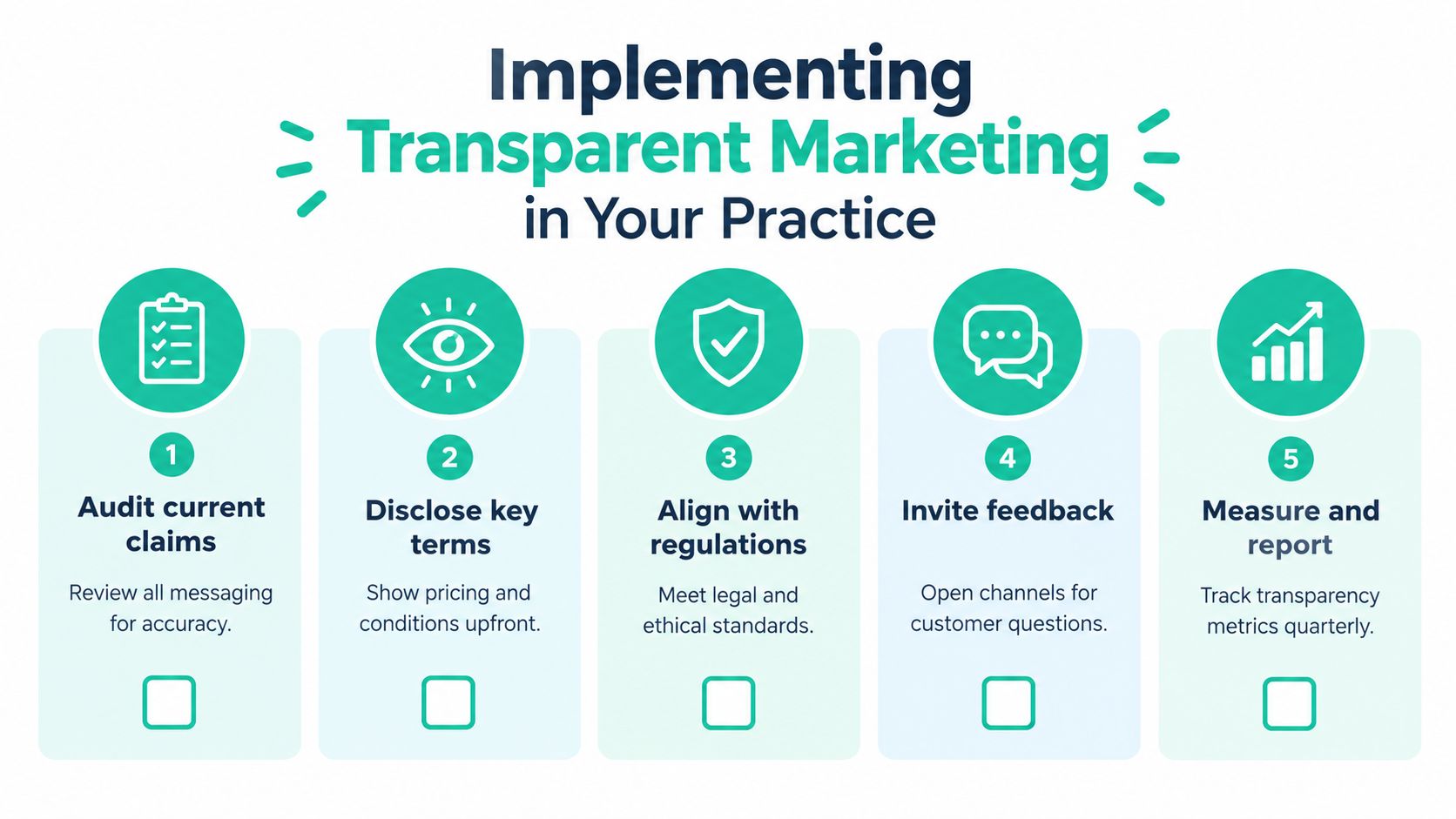
Audit current claims. Collect the promises appearing on your homepage, service pages, ads, social posts, review requests, and staff scripts. Mark each claim as supported, unclear, outdated, or prohibited by your internal standards. Replace “best” and “guaranteed” language with specific descriptions of experience, process, qualifications, or scope.
Show key terms early. If price depends on an examination, consultation, treatment area, case complexity, insurance, or product choice, say so near the relevant offer. You don't need to publish a misleading fixed price. You do need to explain what determines the price and when the person will receive a more precise estimate.
Make the process visible. Add a short “what happens next” sequence to priority pages. Include preparation, appointment steps, follow-up, and a clear contact route. Behind-the-scenes content can help when it demonstrates real work, such as sterilization procedures, eyewear fitting, intake preparation, or the review process for a legal matter.
Use consent-based proof. Confirm that testimonials and images are authorized. Preserve the original context, identify material relationships, and avoid editing a story until it implies a different outcome.
A simple measurement system keeps transparency from becoming a vague brand aspiration:
Don't judge a disclosure by a single response signal. The research cited earlier indicates that transparency performs particularly well when people already trust the platform or brand. Measure the whole journey, not only the first click.
Review your claims and customer questions regularly. Add new questions to service pages, update outdated terms, and ask front-desk staff which promises create confusion. A quarterly review is a practical cadence for many small practices, while high-volume campaigns may need more frequent checks.
If you need help connecting content, search visibility, reporting, and conversion paths, Leaping Lemur Media's services describe an approach that includes clear reporting and marketing support. Whether you work with an agency, an internal team, or a solo operator, insist on reporting that explains what happened and what action follows. A dashboard full of unexplained figures isn't transparent marketing.
Transparency becomes a competitive advantage when it appears in ordinary operations, not only in a campaign designed to signal virtue. The practice that explains its process, corrects its mistakes, respects consent, and reports with accuracy gives patients more reasons to stay when competitors copy its colors, offers, or ad language.
Regulation is reinforcing that direction. The European Union adopted Regulation (EU) 2024/900 to address the growth and complexity of online political advertising, cross-border campaigns, and advanced targeting that can enable information manipulation. It entered full application on 10 October 2025, creating one of the first EU-wide legal frameworks focused specifically on clearer disclosure and targeting rules for ads (European Commission overview of political advertising transparency). The rule concerns political advertising, but its broader direction matters to every marketer: advertiser identity, targeting logic, and disclosure are becoming trust and compliance issues, not optional decoration.
Transparency also needs judgment. A 2025 study found that AI disclosure in cause-related marketing negatively affected purchase intentions, showing that openness doesn't automatically improve immediate conversion (study on AI disclosure and purchase intentions). The answer isn't to hide AI use. It's to explain the role of automation clearly, preserve human accountability, and test whether the disclosure is useful, timely, and understandable.
Your community doesn't need perfect marketing. It needs accurate answers, visible standards, and a practice that does what its messaging promises. Start with one service page this week, document what you changed, and make transparency part of how your team works.
Leaping Lemur Media helps practices clarify their positioning, create patient-centered content, and build reporting that makes marketing performance easier to understand. Visit Leaping Lemur Media to explore a transparent, strategy-led approach for your practice.
Learn how small practices build local marketing partnerships with nearby businesses to earn referrals and cut reliance on expensive ads.

A practical roadmap for growing your practice: fix the foundation, track what drives consultations, and build predictable patient growth.
In-house vs agency marketing: compare costs, skills, and accountability to decide which model will grow your practice.
Enough reading
If a dispatch struck a nerve, that's usually the start of a project. Tell us what's broken — we'll tell you honestly whether we can help.