

Your phone isn't dead. Your referrals haven't vanished. But you keep seeing competing firms show up when you search the exact matters your firm handles, and your own website looks invisible unless someone already knows your name.
That's the position a lot of firms are in when they start looking for an SEO company for a law firm. They're not starting from zero. They already have a decent reputation, solid attorneys, and past clients who would recommend them. What they don't have is reliable visibility when a prospective client opens Google at the moment legal intent becomes urgent.
That gap matters because legal SEO isn't just about rankings. It's about being discoverable without cutting ethical corners, publishing content that respects attorney advertising rules, and turning search visibility into consultations with the right cases. If an agency can't do all three, it's not a fit for your firm.
Table of Contents
- Why Your Next Client Is Searching Not Networking
- Essential Vetting Criteria for a Legal SEO Partner
- Key Interview Questions That Reveal True Expertise
- Decoding SEO Pricing and Defining Key Deliverables
- Onboarding and Managing Your New SEO Partner
- Choosing a Partner Not Just a Provider
Why Your Next Client Is Searching Not Networking
Most managing partners still trust referrals more than marketing. Fair enough. Referrals usually produce better-fit matters and less price shopping. But referrals no longer control the top of the funnel. Search does.
According to FindLaw, 62% of legal-related searches are non-branded queries, such as “Boston divorce attorney” or “personal injury lawyer near me,” which means most prospective clients aren't searching for your firm by name in the first place. They're searching for a problem and a location, as noted in this legal search analysis.
What this means for your firm
If your marketing still depends mainly on reputation, networking, and existing referral sources, you're missing the largest pool of people who need counsel now. These searchers are comparing firms in real time. They're scanning map listings, title tags, attorney bios, reviews, and practice area pages before they ever call anyone.
That changes how you should evaluate a prospective SEO partner. You don't need a firm that talks about “brand awareness” in the abstract. You need a team that understands local search intent, practice-area intent, and how legal consumers decide who looks credible enough to contact.
A lot of law firms also make a staffing mistake here. They hire a general marketing person, then expect that person to vet agencies, manage SEO, write legal content, and interpret reporting. That usually ends badly. If you're sorting out internal hiring before choosing an outside agency, this guide on avoiding bad marketing hires for law firms is worth reading.
Search is now part of client intake infrastructure
A strong website isn't a brochure anymore. It's part of intake.
That means your site needs pages built around what people search when they need representation in your jurisdiction. It also needs to answer practical questions fast, establish trust quickly, and move visitors toward a consultation without sounding like it was written by a non-lawyer guessing at legal terminology.
Practical rule: If your firm only shows up when someone searches your exact name, your online visibility is too narrow.
For firms that want a sharper view of how modern service businesses approach visibility, positioning, and organic growth, the Leaping Lemur Media journal is a useful starting point.
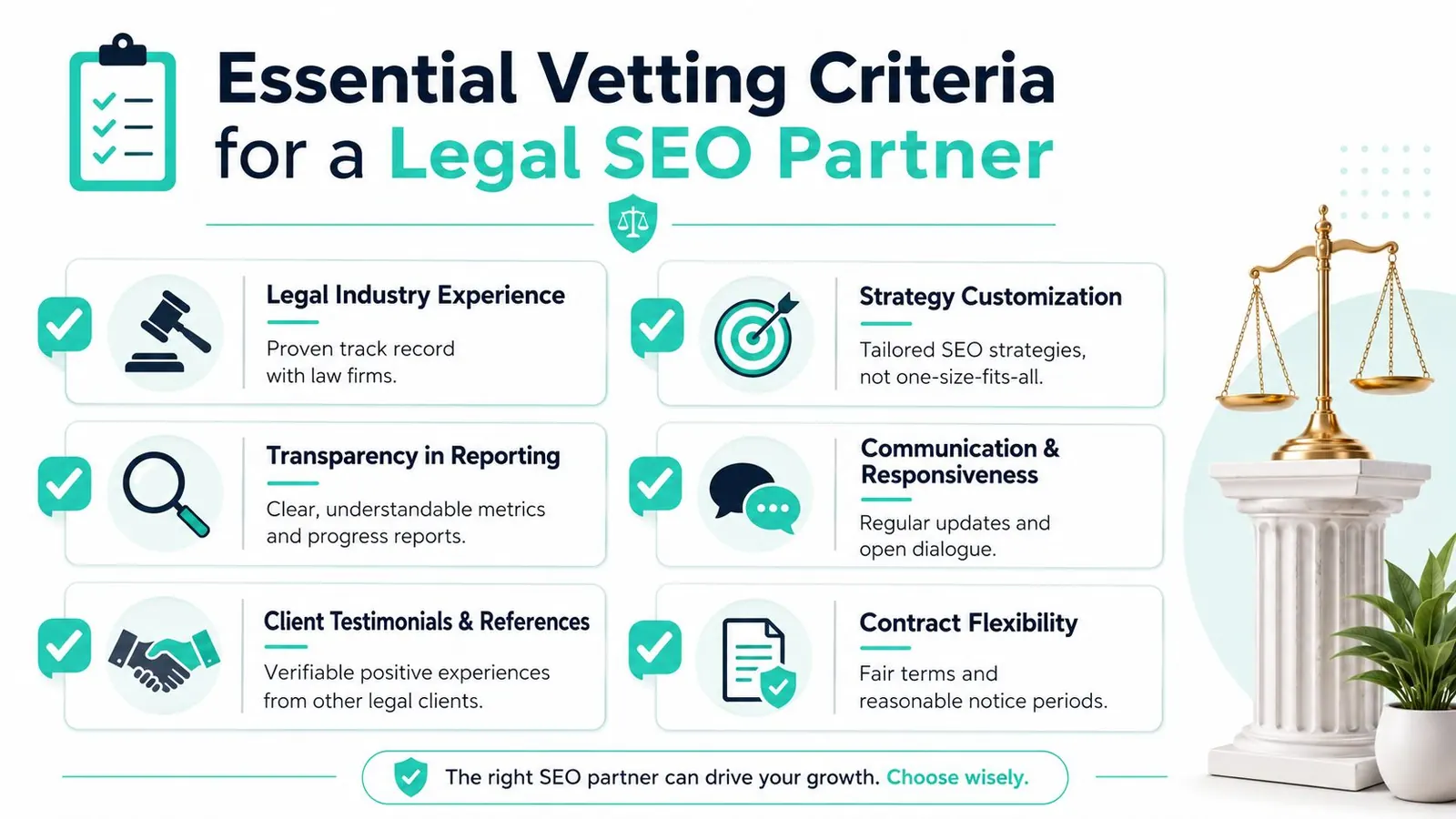
Essential Vetting Criteria for a Legal SEO Partner
Most agencies can talk about backlinks, content calendars, and technical fixes. That's not enough. A legal SEO partner needs to understand the profession they're marketing, including what your firm cannot say, cannot imply, and should not publish.
Start with compliance not keyword rankings
If an agency leads with “we'll get you to page one” before asking about your jurisdiction, intake process, review policy, or advertising restrictions, that's a bad sign.
The legal field is different. Content can create risk. Testimonials can create risk. Comparative claims can create risk. Practice area copy written too aggressively can create risk. Your SEO company for a law firm must know how state bar rules, confidentiality concerns, and attorney advertising standards affect page copy, FAQs, reviews, schema choices, and calls to action.
The most common pitfall causing law firm SEO failure is targeting generic keywords instead of intent-to-hire keywords combined with local jurisdiction terms, which results in high traffic but low conversion rates, according to this breakdown of why legal SEO campaigns fail.
That point matters because generic SEO agencies often chase volume first. They want broad phrases because those are easy to put on a report. Law firms need the opposite. They need pages that match commercial intent in the right market.
Watch for vanity metrics dressed up as strategy
A polished report can hide a weak campaign. Firms get monthly decks full of keyword movement, impressions, and blog output while intake stays flat.
You should be skeptical if an agency:
- Celebrates traffic without discussing case fit. More visitors doesn't help if they want free legal information, live outside your service area, or need a practice area you don't handle.
- Pushes broad educational topics as the center of the strategy. Informational content has a place, but it should support your high-intent pages, not replace them.
- Avoids legal-specific technical topics. If they can't talk about LegalService schema, FAQPage schema, Core Web Vitals, ADA accessibility checks, and local pack visibility in plain English, they're not ready.
- Uses the same template across every practice area. Personal injury, criminal defense, family law, and estate planning do not convert the same way. The intake urgency, content tone, and search behavior differ.
A legal SEO campaign should produce business clarity, not just reporting activity.
What a serious legal SEO partner should show you
Don't ask an agency to impress you. Ask it to show its process.
Here's the checklist I'd use:
-
Legal niche experience
Not just “professional services.” Not just “local businesses.” Actual law firms. -
Compliance fluency
They should speak comfortably about review use, disclaimers, testimonial handling, and content approval workflows. -
Content judgment
They should know when to publish educational articles and when to prioritize city-plus-practice pages, attorney bios, and service pages. -
Technical competence
They should identify crawl issues, page speed problems, schema gaps, broken internal linking, and accessibility issues without resorting to jargon. -
Transparent reporting
You should understand the report without needing a translator. -
Contract sanity
If the agreement is rigid, vague, or written to make exit difficult, move on.
One more point. Ask who does the work. Many agencies sell with a senior strategist, then hand your account to a junior coordinator who's never worked with a law firm.
Key Interview Questions That Reveal True Expertise
A good sales call should feel less like a pitch and more like a diagnostic. If you ask generic questions, you'll get rehearsed answers. Ask sharper ones.

Ask questions that force specifics
Start with this one: How do you ensure our website content complies with attorney advertising rules in our jurisdiction?
A real specialist won't panic. They'll talk about content approval, avoiding unsubstantiated claims, careful testimonial use, disclaimer placement, and review procedures. A generalist will drift into vague language about “best practices.”
Then ask: How would your strategy differ for a personal injury firm versus a family law firm?
That question exposes whether they understand client urgency, search behavior, and conversion context. It also tests whether they rely on a single playbook.
Most agencies promote traffic growth as the primary metric, but data shows that for legal practice areas like personal injury or family law, ranking for broad questions often yields zero client leads compared to hyper-local, intent-driven pages, as explained in this analysis of law firm SEO companies.
That should shape your interview.
Ask these next:
- Which pages would you build first, and why?
- How do you decide between practice area pages, city pages, FAQs, and blog content?
- What would you track besides rankings and traffic?
- How do you handle Google Business Profile optimization for firms with one office versus several?
- Who writes the content, and how is legal accuracy reviewed?
- What parts of the work are done in-house versus outsourced?
The answers matter more than the pitch deck
You're listening for precision, not charisma.
A weak agency says, “We'll improve your authority and publish optimized content.” That sounds competent and says nothing.
A stronger agency might say they'd audit your current practice pages, identify gaps in city-plus-service intent, improve internal links between attorney bios and service pages, tighten local relevance signals, and build content around commercial search behavior instead of broad legal education. That's a real answer.
Ask this plainly: “If our traffic increases but qualified consultations don't, what changes first?”
That question does two things. It tells you whether they care about business outcomes, and it reveals whether they know how to diagnose lead quality.
I'd also ask for a walkthrough of a report. Not a sample dashboard screenshot. A real explanation. Ask them to show how a partner would know whether the campaign is working.
Finally, ask what they won't do.
A mature agency will have limits. It won't guarantee rankings. It won't publish risky claims for the sake of clicks. It won't flood your site with thin AI copy and call it content strategy. If they're willing to do everything, they probably understand very little.
Decoding SEO Pricing and Defining Key Deliverables
The wrong way to compare SEO proposals is by monthly fee alone. The right way is to compare scope, deliverables, level of senior involvement, and the likelihood that the work will produce qualified matters.
Pricing models are only useful if scope is clear
Most law firms will see one of three structures: a monthly retainer, a project fee, or a hybrid arrangement where an upfront build transitions into ongoing monthly work.
None of those is automatically right or wrong. The issue is clarity. If a proposal says “ongoing SEO management” and doesn't define what gets built, optimized, reviewed, and reported, it's not a proposal. It's a blank check.
For firms that want an outside team rather than a patchwork of freelancers, Leaping Lemur Media services are one example of a senior-led agency model serving law and medical practices. Whether you hire that kind of team or another legal-focused provider, the standard should be the same. Defined work, clear ownership, and reporting tied to business goals.
Deliverables you should expect in writing
A serious SEO company for a law firm should specify outputs.
That usually includes:
- Core practice area pages. High-intent city-plus-practice pages should be built to answer real search intent and support conversion. Guidance in the verified data sets the benchmark at 3,000 to 5,000 words for these pages, with FAQs, internal links, and a conversion-focused structure, based on this legal SEO guidance.
- Content publishing cadence. Law firms should publish at least two high-quality blog posts per month to maintain visibility and engagement in legal search results, according to this benchmark review.
- Technical SEO work. Site speed, crawlability, internal linking, schema implementation, and accessibility review should be included somewhere in the engagement.
- Local SEO execution. Google Business Profile work, review strategy guidance, and location relevance should not be treated as optional add-ons.
- Reporting tied to leads. Not just traffic, rankings, and impressions.
Common Law Firm SEO Pricing Models
| Model Type | Typical Monthly Cost | Best For |
|---|---|---|
| Monthly retainer | Varies by scope and market | Firms that need continuous content, technical work, local SEO, and reporting |
| Project fee | Usually tied to a fixed build or audit | Firms that need a site overhaul, migration support, or foundational SEO work |
| Hybrid model | Upfront build plus ongoing monthly management | Firms launching a stronger organic program and then maintaining momentum |
The “typical monthly cost” column is intentionally qualitative here because fees vary widely and you shouldn't trust neat pricing averages without context. Ask what work is included, who performs it, and how often strategy changes.
ROI has to be evaluated by practice area
Not every legal niche matures on the same timeline. That's normal.
Law firms in the personal injury sector typically achieve an ROI of 500% to 1,000% within 18 to 24 months, while family law firms see 200% to 500% ROI within 12 to 18 months, according to this law firm SEO ROI analysis.
That doesn't mean your firm should expect the midpoint of a range because you signed a contract. It means SEO can be a strong investment when the campaign targets high-intent searches, local relevance, and a service area large enough to support the effort.
If a proposal can't explain how the work maps to signed consultations in your actual market, the fee is secondary. The strategy is the core problem.
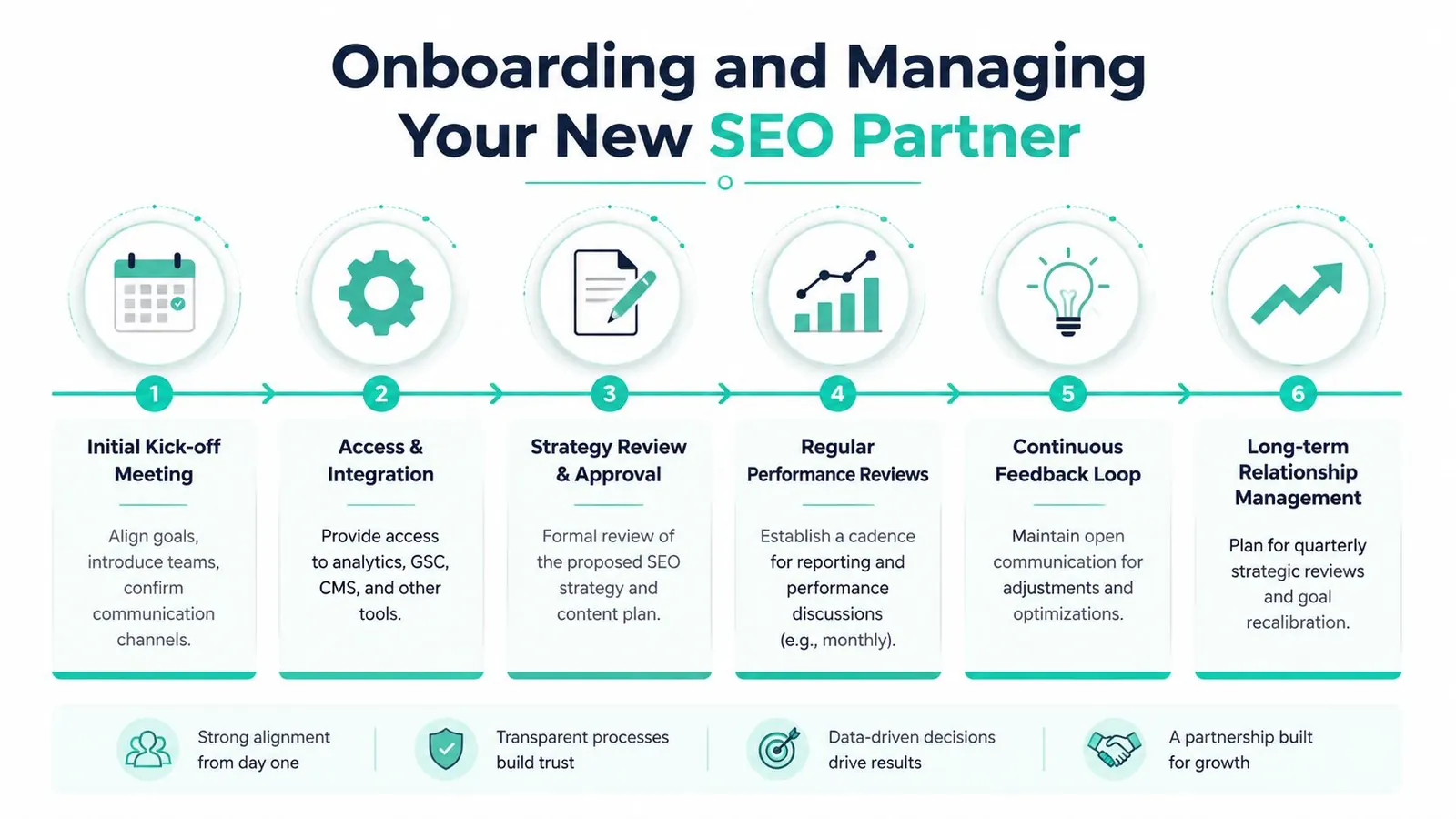
Onboarding and Managing Your New SEO Partner
Hiring the agency is the easy part. Running the relationship well is where firms either gain traction or create drag.
What your firm needs to provide early
The agency can't produce clean work if access is delayed or internal approvals are chaotic.
Give them what they need:
- Platform access to analytics, Google Search Console, your CMS, and your Google Business Profile.
- One internal decision-maker who can approve content and resolve questions quickly.
- Clear intake information so they understand which matters you want, which you don't, and how leads are qualified.
- Brand and compliance guidance covering tone, disclaimers, testimonial rules, and anything specific to your jurisdiction.
If your target market is too small, expectations also need to be realistic. To achieve meaningful ROI from online legal marketing, a law firm's target market should have a population of at least 250,000 people, based on this discussion of digital marketing thresholds.
That doesn't mean smaller markets can't benefit from organic visibility. It means the economics change, and your agency should talk about that openly before the contract is signed.
What the agency should deliver first
The first stretch of work should not feel mysterious. You should know what's happening and why.
A competent onboarding sequence usually includes:
- A kickoff meeting with firm leadership and the account team.
- A baseline audit covering technical issues, local visibility, page quality, and conversion friction.
- A prioritized roadmap so you know what gets fixed first.
- Content and page recommendations tied to service demand, not random keyword lists.
- Measurement setup for calls, forms, and organic consultation signals.
Don't accept “we're still gathering data” as a monthly update with no substantive work attached.
How to manage the relationship without micromanaging it
You don't need to chase every title tag. You do need operating discipline.
Set a reporting cadence. Monthly is common. Make sure each review answers a few basic questions:
- What changed this month
- What was completed
- What moved in search visibility
- What happened to qualified organic leads
- What gets adjusted next
Quarterly strategy reviews matter too. That's where you reassess practice area priorities, market competition, intake quality, and whether the content plan still matches business goals.
The most useful KPI set is usually simple. Qualified consultation requests from organic search. Local pack visibility for core service queries. Performance of priority practice pages. Contribution of organic leads to signed matters, if your intake tracking supports that.
If the agency keeps the relationship grounded in those outcomes, the partnership stays healthy. If every meeting drifts back to abstract metrics, correct it fast.
Choosing a Partner Not Just a Provider
The firms that hire well don't look for the loudest pitch. They look for fit.
A strong SEO company for a law firm understands search, yes. But that's the baseline. It also understands your ethical obligations, your review constraints, your intake realities, and the difference between traffic that flatters a report and search visibility that produces viable matters.
That's why I'd treat this hire the way you'd treat any other important outside advisor. Check judgment. Check communication. Check whether they can explain their work clearly. Check whether they respect the profession they're serving.
The right relationship should feel steady, not theatrical. It should produce accountability, not confusion. It should sound like a partner who's trying to help your firm grow in a way that still sounds like your firm.
That approach fits the Leaping Lemur Media team and philosophy. Partnership over transaction is the right standard for legal marketing. Not because it sounds nice, but because SEO works better when the agency understands your goals, your voice, and the community you serve.
If you want help evaluating or hiring an SEO partner through Leaping Lemur Media, start with a direct conversation about your market, your practice areas, and your intake goals. A good agency relationship should begin with clarity, not a canned pitch.