
A prospective patient searches for your practice after a worrying symptom, an embarrassing dental concern, a confusing legal problem, or a cosmetic treatment they've been researching late at night. They find three local websites. One is packed with keywords but feels cold. Another looks polished but barely answers their questions. Yours has the chance to become the page they trust, if the copy helps them understand what happens next and makes booking feel safe.
That's the job of SEO copywriting for a local practice. You're not writing for an algorithm at the expense of a person. You're creating useful, credible pages that search engines can understand and anxious, high-intent readers can act on. Industry data summarized in current SEO copywriting statistics reports that 69% of marketers invest in SEO, 71% use strategic keywords, and 75% rate SEO as extremely or very effective. Keyword-focused writing has moved far beyond sprinkling phrases into a paragraph. It now combines search intent, local relevance, technical clarity, and patient-first persuasion.
Table of Contents
- The Modern SEO Copywriting Workflow
- Mapping Search Intent for Service Pages
- Building Authority Through Content Depth
- On-Page Optimization for Local Visibility
- Writing With a Patient-First Tone
- Future-Proofing and Measuring Success
The Modern SEO Copywriting Workflow
Most practice owners don't struggle because they lack expertise. They struggle because the website process starts in the wrong place. Someone chooses a keyword, opens a blank document, writes a few paragraphs about the service, and hopes Google and prospective patients figure out the rest.
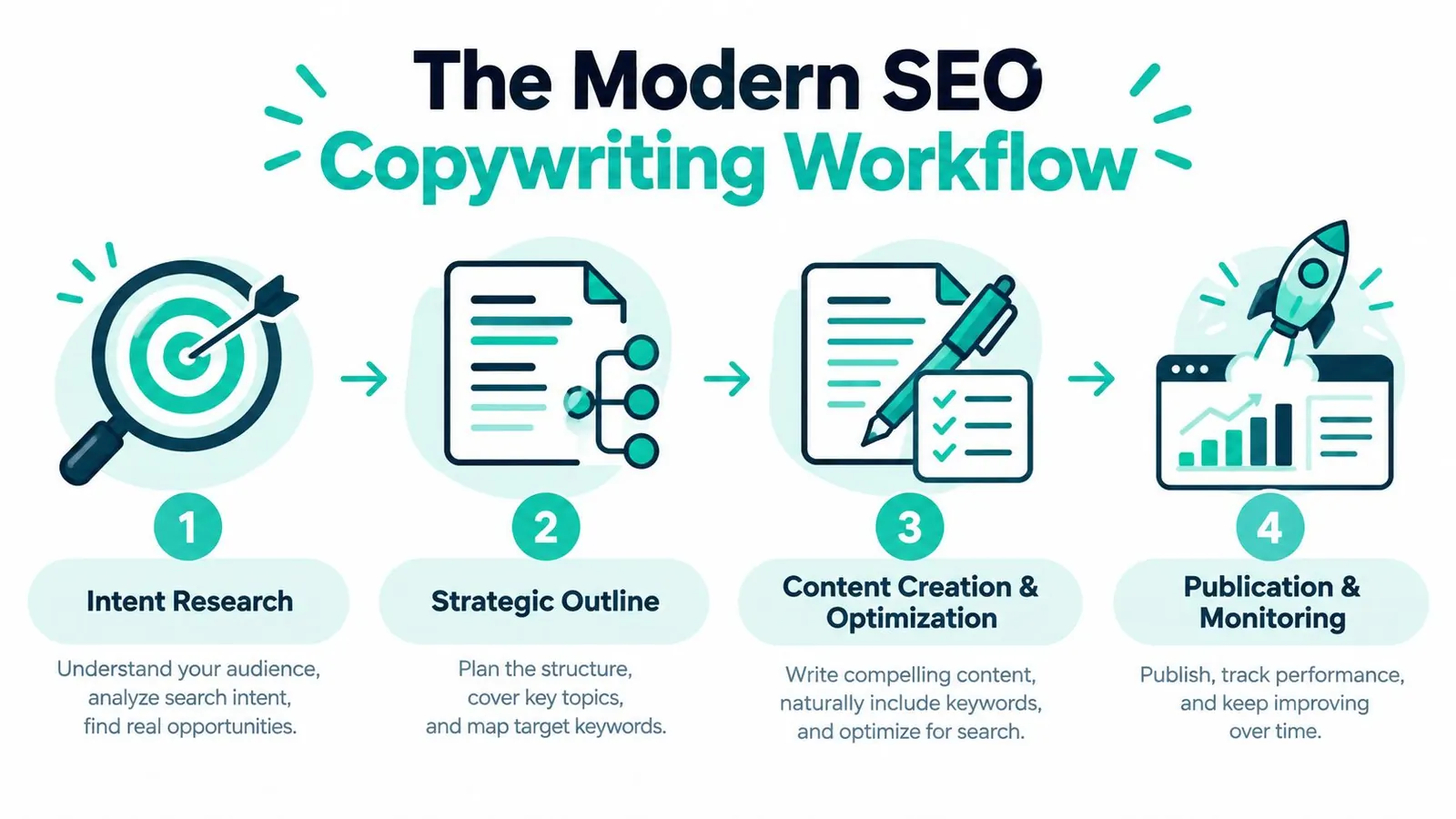
That approach produces pages that sound generic and answer the wrong question. A better process separates strategic decisions from mechanical optimization. The recommended workflow has five steps: define intent and the page promise, analyze the SERP and competitors, create an actionable brief, draft for usefulness, then optimize and test after publication. That sequence is outlined in this SEO copywriting workflow.
Start with the page promise
Before researching keywords, write one sentence that states what the page will help the visitor decide or do. For a dentist, that might be, “Understand whether emergency dental care is appropriate and contact the practice for an assessment.” For a law firm, it might be, “Learn what to do after a workplace injury and how to request an initial consultation.”
The promise keeps the page focused. It also gives you a standard for cutting anything that doesn't help the reader make progress.
Read the local SERP as a visitor
Search the target service and location, then study the pages that appear. Note the questions they answer, the service details they omit, how quickly they present a call to action, and whether the language reflects real patient or client concerns. Look beyond keywords. Pay attention to page structure, trust signals, booking friction, practitioner details, FAQs, and local context.
Build a brief a professional can use
Your brief should identify the audience, intent, page promise, primary questions, proof points, internal links, suggested headings, and the action you want visitors to take. Include actual language from reception calls, reviews, intake forms, and support conversations when you can use it responsibly. That language reveals concerns polished marketing copy often misses.
Draft for usefulness first
Write the answer a nervous visitor needs, not the paragraph a keyword list demands. Explain the service, who it suits, what the process involves, what preparation may be needed, what questions to ask, and what happens after contact. Then refine the title, H1, headings, internal links, and other on-page elements. Publish with a measurement plan for click-through rate and rankings, and use what you learn to improve the page.
Practical rule: Decide what the reader needs to know before you decide how often a keyword appears.
Mapping Search Intent for Service Pages
A service page can target the right phrase and still fail because it serves the wrong intent. Someone searching “root canal treatment near me” may be ready to call. Someone searching “does a root canal hurt” may still be deciding whether treatment is necessary. Both searches matter, but they need different answers and different paths to conversion.
For local medical, dental, legal, and aesthetic practices, separate intent into two practical groups. Anxious research involves uncertainty, risk, symptoms, cost questions, eligibility, recovery, or fear of being judged. Immediate booking intent involves location, availability, a named service, an appointment request, or a need for urgent help. Your copy should acknowledge both without forcing every visitor through the same sales pitch.
Match the opening to the concern
An informational visitor needs clarity near the top of the page. Answer the primary question quickly, then provide depth for readers who want to investigate further. A page about laser eye surgery might begin with who may be suitable, what an assessment determines, and which questions the consultation will address. A page about criminal defense should explain the immediate next step while making clear that individual circumstances require professional advice.
A booking-oriented visitor needs reassurance and direction. Put the practice location, service name, contact route, appointment action, and relevant availability information where people can find them without hunting. The call to action should say what happens after contact, not repeat “Book now.”
Audit competitors for missing intent
Competitor research isn't about copying their headings. It's about identifying the questions their pages leave unanswered. If every local page describes the procedure but none explains preparation, aftercare, suitability, or what an initial consultation involves, that gap gives you a useful editorial opportunity.
Review the page from the perspective of someone who has never used the service. Can they tell whether the practice handles their situation? Do they understand the next step? Do they see evidence of relevant experience? Do they know what information to bring? If the answer is no, your page can earn attention by reducing uncertainty rather than repeating a service definition.
Use Leaping Lemur Media's journal as a model for the kind of educational content that can support core service pages. Helpful articles can answer early research questions, while strong internal links guide readers toward the relevant appointment or consultation page.
Keep the conversion path visible
Don't bury the action below a wall of explanation. Add natural invitations after meaningful answers, such as contacting the practice to discuss suitability or requesting an assessment. The wording should fit the emotional state of the visitor. A person facing an urgent legal issue needs direct next steps. Someone considering an elective treatment may respond better to a low-pressure consultation invitation.
Building Authority Through Content Depth
Short local service pages often feel efficient to the business owner and incomplete to the visitor. A few lines may name the treatment, mention the location, and provide a phone number, but they rarely demonstrate enough understanding to support a high-stakes decision.
Depth builds authority when every detail earns its place. A page helps a prospective patient or client evaluate suitability, understand the process, recognize the practice's expertise, and choose a next step. It doesn't mean padding a page with repetitive keyword variations. It means answering the questions that affect trust.
A 2026 content SEO compilation reports that articles over 2,000 words generate 77% more backlinks than shorter articles, and that long-form pages tend to rank for more long-tail keywords. The same source reports that 62.8% of content marketers saw year-over-year traffic growth between 2024 and 2025. Those figures support a move toward intent-driven content, but they don't justify making every page longer for its own sake.
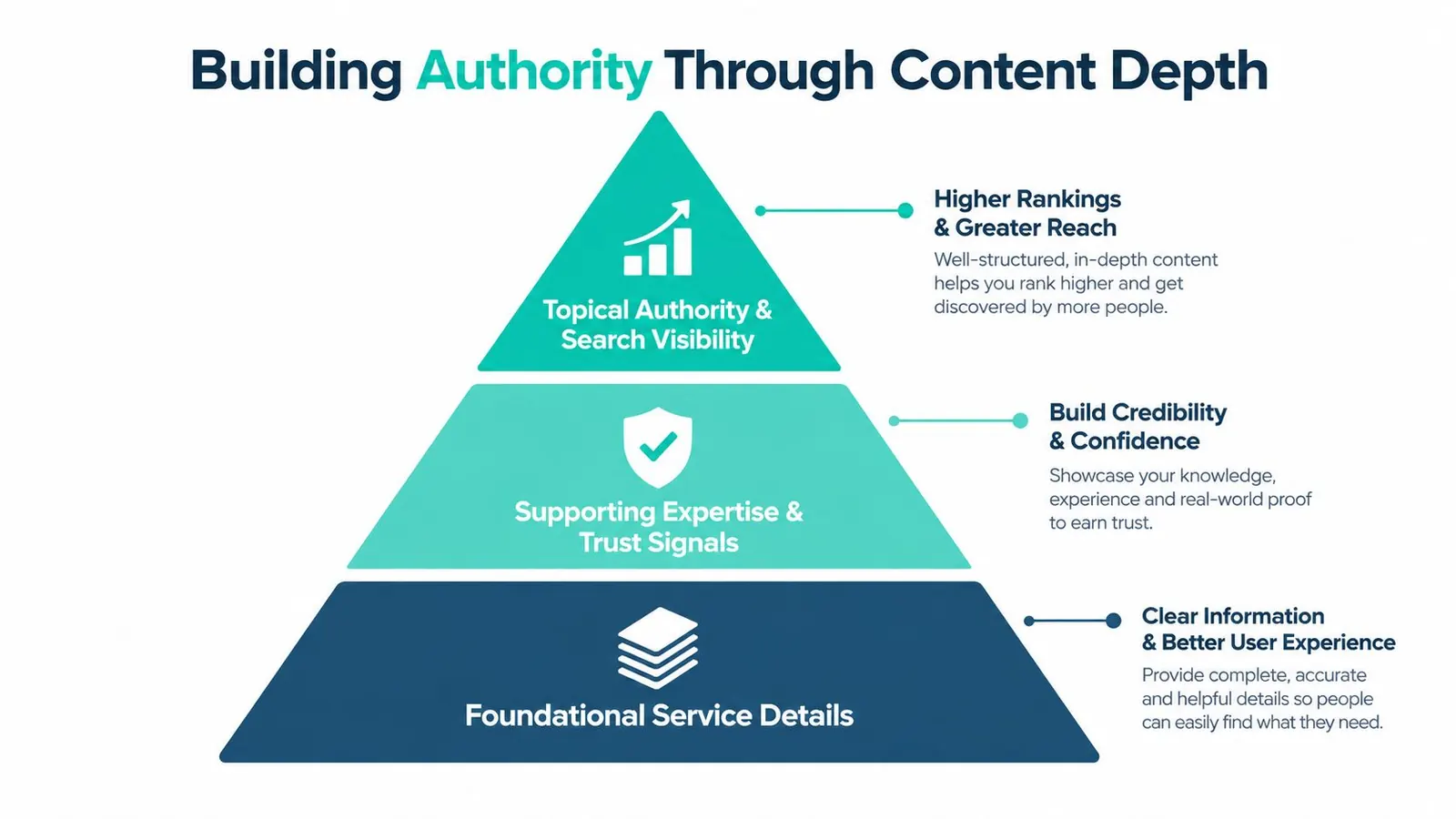
Build from foundational service details
Start with the practical information visitors need:
- Service scope: Explain what the practice does and which problems or goals the service addresses.
- Suitability: Describe who may benefit and when another option or assessment may be more appropriate.
- Process: Walk through consultation, preparation, treatment, follow-up, or case evaluation in plain language.
- Questions and concerns: Address discomfort, timing, recovery, risks, documentation, or next steps without making unsupported promises.
Then add the professional context that makes the explanation distinctive. A clinician can explain how they assess suitability. A solicitor can describe the information needed for an initial review. A medspa can clarify how treatment plans are personalized rather than presenting a one-size-fits-all outcome.
Add proof without making promises
Authority comes from specificity. Introduce the practitioner or legal team, relevant credentials, areas of focus, treatment philosophy, and standards of care. Use testimonials only with appropriate consent and in a way that reflects genuine experiences. Avoid guaranteed outcomes, exaggerated claims, or language that implies every patient or client will have the same result.
Google's helpful, reliable, people-first content guidance emphasizes originality, completeness, value, and external feedback when assessing usefulness. Ask real patients, clients, reception staff, and clinicians where the page feels unclear. Their feedback often identifies missing information faster than another round of keyword research.
Turn depth into a connected resource
A strong service page shouldn't stand alone. Link to relevant educational articles, practitioner information, FAQs, contact details, and related services. Supporting content can answer narrower questions while the main page remains the clearest destination for a high-intent visitor.
You can learn more about the people and philosophy behind the work through Leaping Lemur Media's about page. The same principle applies to your own website. Give visitors a clear route from question, to confidence, to action.
On-Page Optimization for Local Visibility
Once the content answers the right questions, format it so both people and search engines can interpret it quickly. Local SEO copywriting doesn't require mechanical repetition. It requires clear signals about the service, practice, location, audience, and next step.
Start with the title tag. Name the service and location where it makes sense, then give the reader a reason to click. “Emergency Dentist in Bristol | Same-Day Assessment” communicates more than a vague brand-only title. The meta description should expand the promise, address a practical concern, and describe the action available on the page. Search engines may rewrite snippets, but precise source copy still helps frame the result.
Use headings as a decision path
Give the page one clear H1 that reflects the main service. Use H2 headings for major questions or stages, then H3 headings for narrower details. A useful sequence might move from suitability, to what happens, to benefits and considerations, to preparation, to aftercare, to frequently asked questions, and finally to contact information.
Headings should help someone scan on a phone. Don't turn every phrase into a variation of the target keyword. A heading such as “What happens during your first consultation” is more useful than a repetitive heading built only around location modifiers.
Add local and service context naturally
Mention the town, neighborhood, or service area where it helps visitors understand whether the practice is relevant. Include the physical address, phone number, opening information, and directions consistently across the site. Make sure the page reflects the actual service offered at that location. Local relevance comes from genuine context, not a list of nearby place names.
Schema can reinforce that context. Depending on the business, structured data may help describe a LocalBusiness, MedicalBusiness, professional service, location, opening information, or service relationship. Treat schema as supporting infrastructure, not a substitute for accurate visible content. Validate implementation and keep it aligned with what visitors can see.
Consolidate instead of multiplying thin pages
Creating a separate page for every neighborhood and minor query variation often produces near-duplicate copy with little independent value. Google's generative AI optimization guidance warns against creating separate pages for query variations when the main purpose is manipulating rankings, including risks connected with scaled content abuse.
| Element | Best Practice for Practices | Common Mistake |
|---|---|---|
| Title tag | Name the service, relevant location, and clear benefit | Repeating keywords without a useful promise |
| H1 | State the primary service or patient need once | Using multiple competing H1 headings |
| H2 and H3 | Organize questions, process details, and next steps | Turning headings into keyword lists |
| Meta description | Set an accurate expectation and invite action | Making unsupported outcome claims |
| Internal links | Connect service, education, team, and contact pages | Linking every phrase or leaving the page isolated |
| Schema | Describe the real business and service accurately | Adding markup that isn't supported by visible content |
Review the related structure on Leaping Lemur Media's services page when planning how a service hub can connect technical SEO, on-page optimization, and content strategy.
Writing With a Patient-First Tone
Writing for search engines doesn't mean flattening your voice into a string of optimized phrases. A nervous patient can recognize generic copy quickly. So can a business owner looking for a solicitor who understands the stakes of their situation.
Patient-first writing starts with the person's concern, not the practice's preferred terminology. Replace “solutions for a range of dental needs” with a direct explanation of what the team evaluates, who the service may suit, and what the visitor can expect after making contact. In legal copy, explain the immediate practical step before introducing the firm's broader list of capabilities.
Make complex information easier to use
Use active voice and concrete verbs. Keep sentences focused, vary their rhythm, and define necessary technical terms at first use. Short paragraphs create breathing room, especially on mobile screens, but brevity isn't the same as usefulness. A clear explanation may need context, examples, and a careful description of limitations.
Read the copy aloud. If a receptionist wouldn't say it to a patient, revise it. If the sentence sounds designed to impress a search engine rather than answer a concern, remove it.
A patient should finish the page feeling better informed, not managed by a funnel.
Testimonials can support that feeling when they're authentic, relevant, and presented responsibly. Use the customer's real perspective to show what communication, access, or support felt like. Don't edit testimonials into promises, and don't use social proof to avoid explaining the service itself.
Connect reassurance to action
Empathy should lead somewhere practical. After explaining a concern, tell the reader what they can do next. That could be calling the practice, completing an inquiry form, requesting an assessment, or bringing specific information to an appointment. Explain what the team will do after the person reaches out.
Google's people-first guidance places emphasis on whether readers leave satisfied that their needs were met. That standard is more useful than chasing an arbitrary writing style. When visitors understand the service and trust the next step, the copy supports both engagement and conversion without pretending to speak like a robot.
Future-Proofing and Measuring Success
Search results increasingly include AI-generated summaries and zero-click experiences. That changes how practices should structure information, but it doesn't eliminate the need for persuasive pages. If a machine can extract a concise answer from your content, a human still needs a reason to visit your site, trust your team, and make contact.
Write direct answers near the top of relevant pages. Use short question-and-answer blocks for common concerns, then provide the fuller explanation underneath. Define the service clearly, identify who it may suit, explain important limitations, and make the next action obvious. Clear structure helps machines interpret the page and helps people decide whether the practice is right for them.
Recent SEO guidance on AI Overviews and search trends emphasizes front-loaded answers, extractable structure, entity signals, and trust. It also makes an important point: long-form copy works when it's deep, specific, and useful, not when it repeats itself.
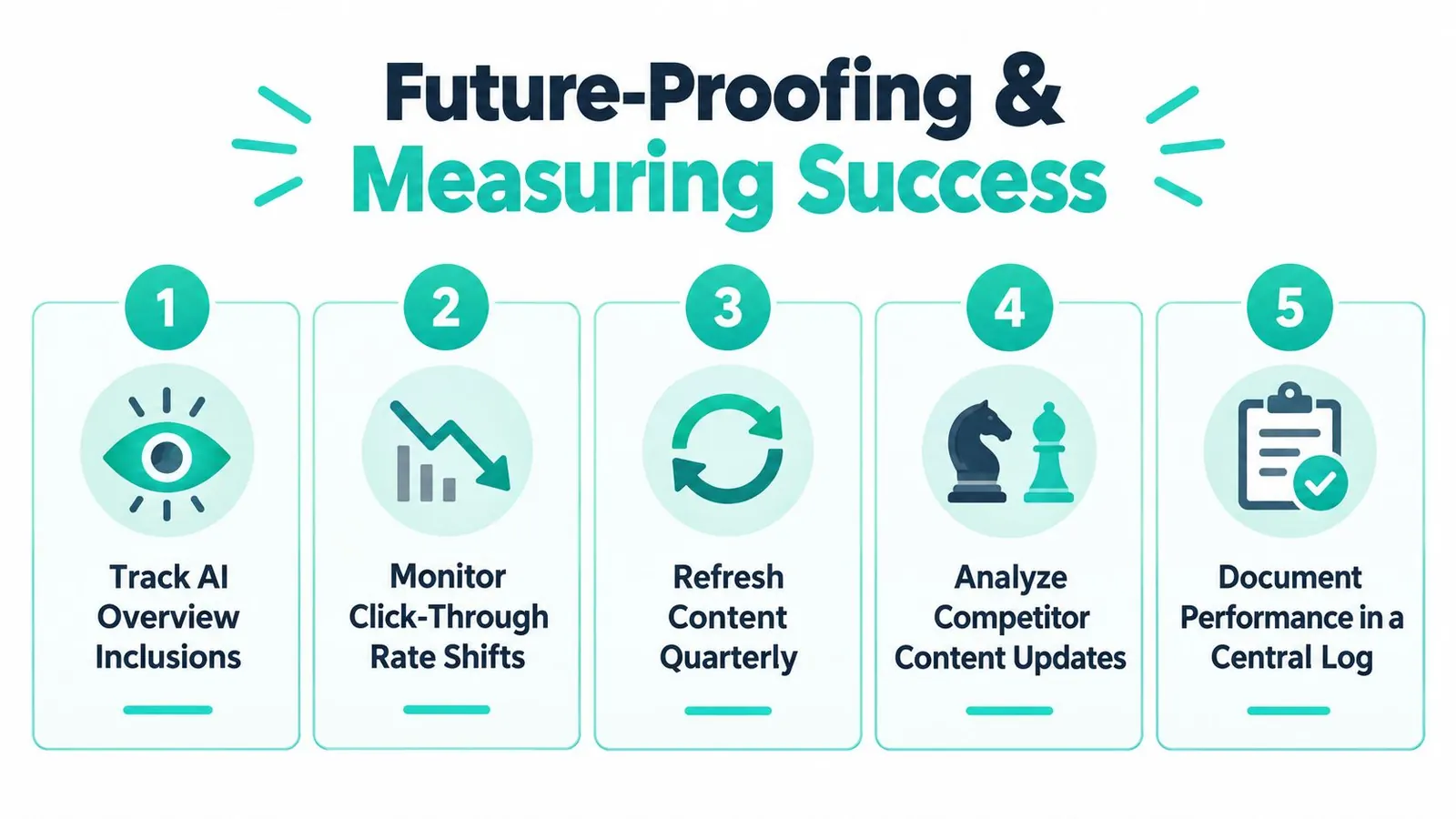
Measure the whole journey
Rankings matter, but they don't tell you whether the page creates business value. Review organic conversions, contact-form submissions, calls, appointment requests, engagement quality, scroll behavior, and the questions people ask after visiting. A page can attract visibility yet fail if the title earns clicks while the content creates doubt.
Use Google Search Console to review queries, impressions, clicks, and click-through-rate changes. Use analytics and call tracking to connect organic visits with inquiries where privacy and consent requirements allow. Compare performance before and after meaningful revisions, rather than changing everything at once and losing the ability to identify what helped.
Refresh with evidence
Create a practical audit routine:
- Check the opening answer: Confirm that the page addresses the main concern quickly.
- Review service accuracy: Update process details, team information, availability, and calls to action.
- Add firsthand insight: Include professional explanations and real questions from patients or clients.
- Study competing pages: Look for new gaps, clearer explanations, or stronger trust signals.
- Inspect internal links: Make sure visitors can move naturally from research to service and contact pages.
- Record the change: Keep a central log of edits, dates, query patterns, and resulting performance.
Content freshness isn't a reason to rewrite pages on a schedule without evidence. Refresh when the service changes, the audience raises new questions, competitors improve their explanations, or performance data reveals friction. Coverage on SEO in 2025 and E-E-A-T also emphasizes experience-driven content, original research, structured authority, and human editing of AI-assisted drafts.
The durable advantage: Make your page easy for a machine to summarize and difficult for a human visitor to distrust.
Google's sitewide helpful-content principles also matter. The site needs a clear purpose, a consistent audience fit, and content that leaves readers satisfied. A practice shouldn't publish disconnected pages to capture every query. Build a coherent resource that reflects what you do, who you serve, and how you help.
Leaping Lemur Media offers SEO and content support that combines technical foundations, on-page optimization, content strategy, useful answers, and link-worthy assets for practices and local businesses. If your service pages need a clearer strategy and a more human conversion path, visit Leaping Lemur Media to discuss how your practice can become easier to find and easier to trust.