
A law firm that treats SEO like a side project usually leaves real revenue on the table. Law firms see an average 526% return on investment from SEO within three years, with organic search driving 52.6% of total website traffic. That changes the conversation. SEO isn't a nice-to-have marketing add-on. It's a growth asset.
For most firms, the bigger mistake isn't just failing to rank. It's chasing visibility without thinking hard enough about ethics, intake quality, and the kind of client pipeline the firm wants. Good SEO for law firms should do two things at once: make your firm easier to find and make your intake stronger once the right prospects arrive.
That means being disciplined about search intent, local trust signals, site structure, internal linking, and conversion paths. It also means avoiding tactics that look aggressive on a report but create weak leads, confused messaging, or compliance risk. The firms that win online don't just attract clicks. They build a system that brings in qualified matters responsibly.
Table of Contents
- Why SEO Is Your Firm's Most Powerful Growth Engine
- Uncover What Your Future Clients Are Searching For
- Dominate the 'Near Me' Search with Local SEO
- Build a Website That Ranks and Converts
- Establish Your Firm as a Trusted Legal Authority
- Optimize Your Site for Client Intake and Growth
- Measure What Matters Connecting SEO to Your Bottom Line
Why SEO Is Your Firm's Most Powerful Growth Engine
Organic search earns a larger share of law firm traffic than any channel that depends on constant spend, and that matters for one reason. It keeps producing opportunities after the initial work is done.
For firm owners, that changes the math.
Referrals, repeat clients, and professional relationships still drive many strong practices. They also come in waves you do not fully control. SEO gives your firm a steadier path to demand that already exists. Someone has a legal problem, starts comparing options, and looks for a lawyer in the exact practice area you handle. If your firm shows up with a credible page and clear next step, search becomes more than visibility. It becomes intake.
That is why I treat SEO as a growth system, not a marketing add-on. Done well, it builds an asset your firm owns: service pages that keep attracting qualified prospects, local visibility that reinforces trust, and content that answers questions before your intake team has to.
SEO compounds while paid visibility rents attention
Paid search has a place. I recommend it often for new practice areas, competitive markets, or firms that need leads while organic pages mature. But ads are rented attention. Once the budget stops, the pipeline tightens.
SEO works differently. A well-built page can rank, bring in consultations, and keep improving as you add proof, sharpen positioning, and learn which matters turn into retained cases. That compounding effect is the primary advantage, especially for firms watching acquisition costs climb.
A broader look at the importance of SEO for online businesses is useful here because the same principle applies to law firms. Search captures active demand. Your job is to earn trust at the moment a prospect is deciding who to contact.
Practical rule: If a prospect is already searching for a lawyer, your priority is credibility, clarity, and a smooth path to intake.
The right SEO program improves case quality, not just traffic
Traffic alone does not help a firm grow. Qualified consultations do.
That distinction gets missed when agencies report rankings without tying them to signed matters. A page that draws visitors looking for general legal information may look successful in a dashboard and still waste staff time. A page built around a specific service, location, and client concern usually performs better where it counts: call quality, consultation rate, and retained revenue.
Law firms also face constraints other industries do not. Every claim on the site has to stay inside bar advertising rules. Testimonials, case results, comparative language, and specialty statements need review. Aggressive SEO tactics can create risk if they overpromise or blur ethical lines. Growth only helps if it is sustainable and compliant.
I cover practical examples of that balance in our law firm marketing insights and SEO articles.
The firms that get the best return usually do three things well:
- They focus on profitable matters. Pages are built around the cases the firm wants more of, not every keyword a tool suggests.
- They align SEO with intake. Forms, phone handling, consultation workflows, and follow-up are treated as part of the same system.
- They improve based on signed cases. They update pages using intake feedback and matter quality, not rankings alone.
Thin location pages, copied content, and inflated promises still show up in legal marketing. They can create short-term movement and long-term problems. Strong SEO for law firms does the opposite. It helps the right prospects find you, gives them confidence to reach out, and supports growth your firm can stand behind.
Uncover What Your Future Clients Are Searching For
Most firms start keyword research the wrong way. They open a tool, chase high-volume phrases, and end up targeting terms that sound impressive but don't match the client matters they want. Good SEO for law firms starts with intent.
Start with client intent, not keyword tools
Think about the person on the other side of the search. Are they scared, comparing options, or ready to hire? A search like "car accident lawyer near me" carries very different urgency from "what is negligence." Both queries can matter. They just belong on different pages and serve different business goals.
The practical way to do this is simple. Pull questions from intake calls, consultation emails, receptionist notes, and attorney conversations. Then group those questions by intent:
- Urgent hiring intent: Searches tied to immediate legal help, local need, and a clear practice area
- Comparison intent: Searches where the prospect is evaluating firm options, experience, or fit
- Research intent: Searches where someone is still learning the basics and may need help later
One website can't treat every searcher the same way.
If you want a steady stream of content ideas grounded in real-world marketing thinking, the articles on the Leaping Lemur Media blog are worth browsing for examples of how service businesses can align messaging with actual client behavior.
Map search terms to the right page type
Once intent is clear, build the right destination for it. Many law firm sites often falter here. They send every query to a homepage, or they write blog posts when the firm really needs a service page.
A simple content map looks like this:
| Search intent | Best page type | What that page should do |
|---|---|---|
| Ready to hire | Practice area or location page | Show fit, trust, and an easy path to contact |
| Comparing firms | Attorney bio, about page, case results page | Reduce uncertainty and build confidence |
| Early research | FAQ, guide, or blog article | Educate clearly and link toward services |
That structure keeps your site useful. It also keeps your content strategy honest. If a phrase suggests someone needs immediate representation, don't bury the answer in a long educational article. Put them on a page that explains the service, the process, and what to do next.
A strong keyword list isn't a spreadsheet achievement. It's a map of what your future clients are worried about, and how close they are to hiring counsel.
What works and what usually wastes time
Here are the trade-offs I see most often:
- Broad keywords bring visibility, but they can dilute intake quality: Ranking for general legal education can help authority, yet it won't replace service pages that target hiring intent.
- Local modifiers often convert better than abstract legal terms: A prospect searching for help in a specific city usually has a clearer next step in mind.
- Question-based content helps trust, but only if it leads somewhere: Educational posts should connect naturally to your core services and consultations.
What doesn't work is publishing content nobody at the firm would ever use in a client conversation. If a topic doesn't help a prospect move toward informed action, it probably doesn't deserve space on your site.
Dominate the 'Near Me' Search with Local SEO
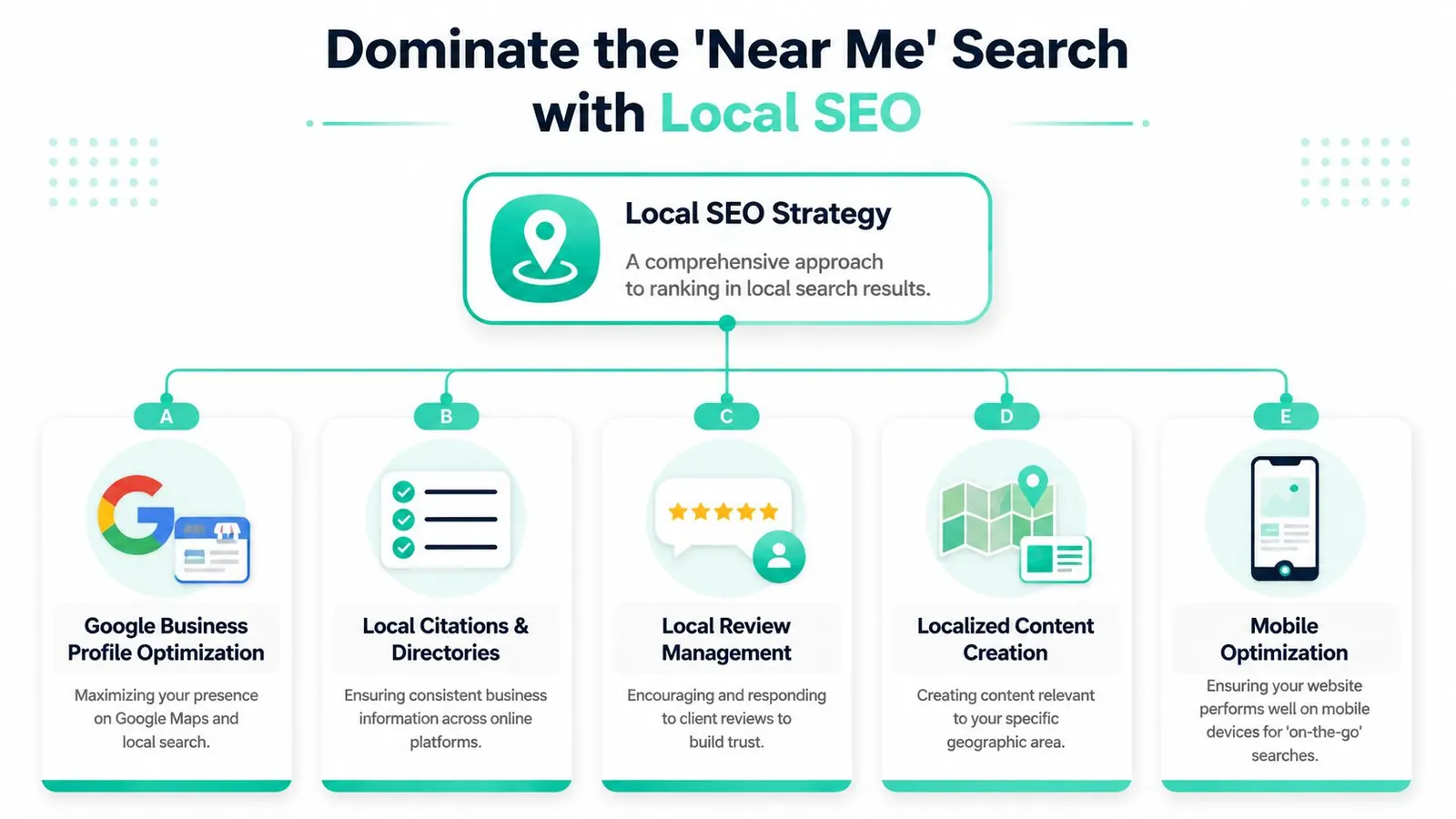
Most legal searches don't end with someone reading ten blog posts. They end with someone choosing a nearby firm that seems credible, responsive, and relevant to the matter at hand. Local SEO is where that decision often happens.
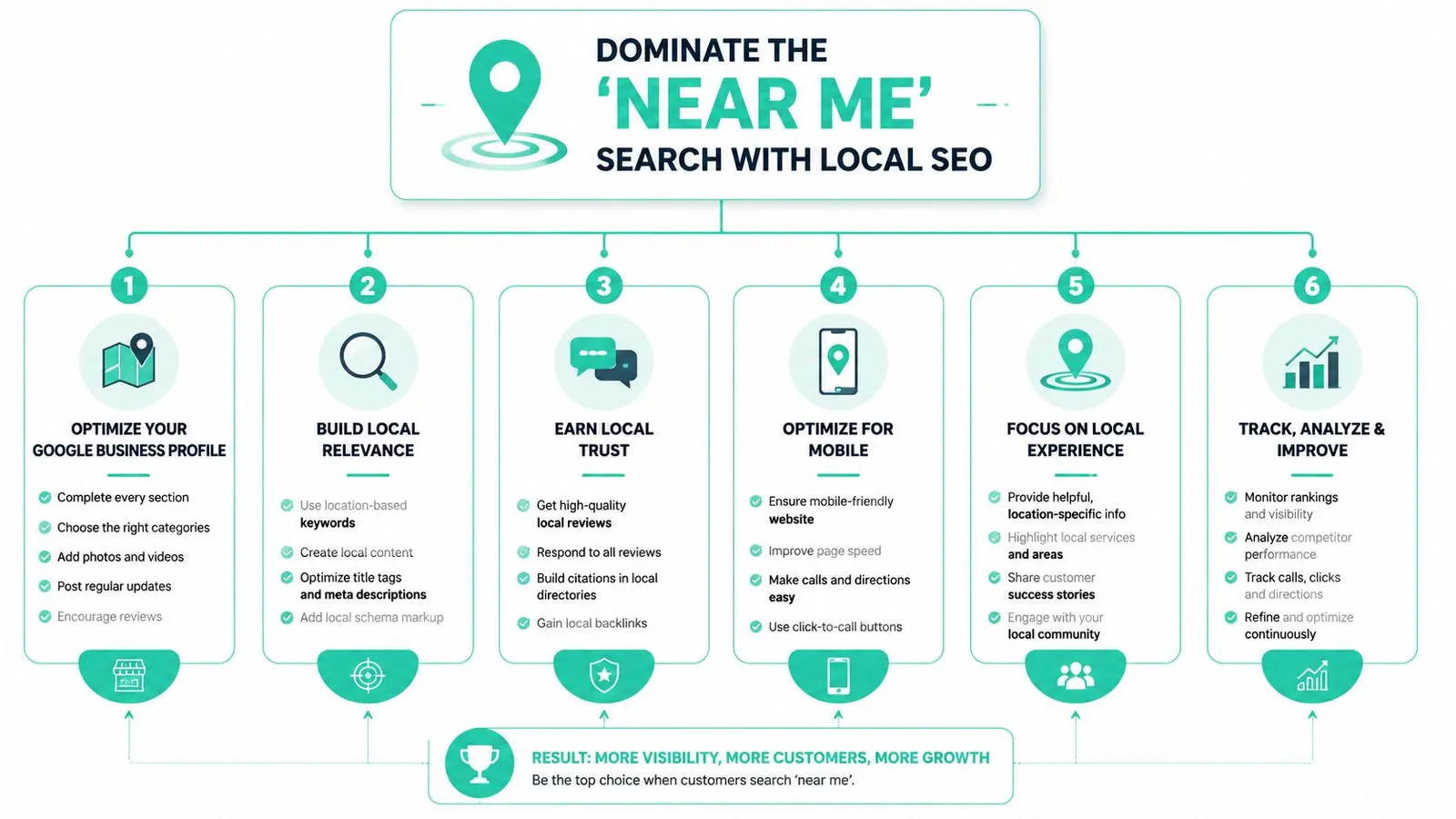
Treat your Google Business Profile like a practice asset
Your Google Business Profile isn't a listing you set once and forget. It's one of the most visible trust layers your firm owns. Prospects use it to judge legitimacy before they ever reach your website.
A useful local setup includes:
- Accurate service details: List practice areas the way real clients understand them, not just the way lawyers label them internally.
- Current office information: Keep address, hours, phone number, and website consistent with the rest of your online presence.
- Real photos: Use professional but authentic images of the office, attorneys, and team. Generic stock visuals rarely build confidence.
- Managed Q&A and reviews: Answer common questions and respond thoughtfully to reviews without discussing confidential matters.
The point isn't to game the listing. The point is to remove doubt.
Reputation now matters more than directory volume
Local SEO has changed. It's no longer mainly about pushing your name into as many directories as possible. Local SEO is shifting from a citation count to reputation and proof, requiring firms to prioritize review velocity and third-party validation such as Super Lawyers rankings over directory volume to rank in AI-generated local results.
That shift creates a better standard for law firms because it aligns with what real prospects care about. They want evidence that other people trusted you, that recognized organizations know your name, and that your local presence feels active rather than abandoned.
Here's a practical comparison:
| Local tactic | Stronger approach | Weaker approach |
|---|---|---|
| Reviews | Ask consistently, respond appropriately, monitor themes | Ask in bursts, ignore responses, chase volume only |
| Third-party proof | Highlight credible recognitions and community standing | Add every badge you can find without context |
| Directory work | Keep major listings accurate | Submit to endless low-value directories |
Local search truth: A firm with a believable reputation usually outperforms a firm with a bloated citation footprint and no visible proof.
Keep local SEO ethical in every market
This is the part too many legal marketing guides skip. Law firms don't have the same freedom as a retail brand or a restaurant. Every local SEO move needs to respect bar rules, advertising constraints, jurisdictional disclosures, and the realities of client confidentiality.
That affects things like review requests, office representations, specialization language, and location targeting. If your firm serves multilingual communities, it also affects bilingual search pages. Those pages can open major opportunity, but they still need to reflect accurate services, proper disclaimers, and messaging that doesn't overpromise.
What tends to work:
- Clear jurisdiction language: Make it obvious where attorneys are licensed and which offices serve which areas.
- Measured review requests: Invite feedback ethically, without pressure or improper incentives.
- Localized pages with substance: Write city or neighborhood pages only when the firm has a real service connection to that area.
What doesn't work is cloning near-identical pages for dozens of cities you barely serve or stuffing place names into every paragraph. Search engines have become better at spotting it, and prospects can feel it too.
Build a Website That Ranks and Converts
A law firm website has two jobs. It has to make search engines understand what the firm does, and it has to make anxious prospects feel they're in the right place. If either side fails, the site underperforms.

Structure pages for humans first and AI retrieval second
Search is changing because AI systems often retrieve fragments instead of evaluating a page as a single block. For AI-driven visibility, every H2 section should be self-contained and answer a specific question within the first one to two sentences, because AI systems cite specific paragraphs rather than whole pages.
That doesn't mean writing robotic content. It means organizing pages so each section has a clear job.
For example, a personal injury page should not wander through broad marketing language before answering basic client concerns. A better structure is direct:
- what cases you handle
- when someone should call
- what happens after contact
- how fees work, if appropriate to explain
- why your firm is a credible choice
That same principle applies to FAQs, attorney bios, and local service pages.
If you're evaluating whether your current site supports both visibility and conversion, comparing it against a specialized marketing services framework for growth-focused businesses can help you spot where brand clarity and performance are falling apart.
Get the fundamentals right on every core page
The basics still matter. Title tags should be clear and concise. Title tags should stay between 55 and 65 characters, and meta descriptions should remain under 155 characters. Those aren't glamorous tasks, but they affect how your pages appear in search and whether prospects click.
A practical page stack usually includes:
Homepage
Your homepage should establish the firm's identity fast. Not every legal service belongs there in equal depth. Its job is to orient the visitor, confirm geography and core services, and direct people to the right deeper page.
Practice area pages
These do the heavy lifting for SEO for law firms. They should explain the legal issue in plain English, show who the page is for, and give the reader a clear next step. Generic filler hurts here. Specific client concerns help.
Attorney bio pages
Bio pages often rank for branded searches and comparison-stage searches. They should show actual qualifications, admissions, relevant experience, and the kind of matters each attorney handles. Thin bios weaken trust.
If a prospect lands on a page and still can't tell whether you handle their matter, where you practice, or how to contact you, the page isn't finished.
Site architecture decides what gets found
A good site doesn't bury important pages under vague menus and disconnected blog posts. It uses a clear hierarchy. Practice areas should connect to subtopics. FAQs should support service pages. Attorney bios should reinforce relevant categories. Navigation should help both users and crawlers move logically.
What works is boring in the best sense. Clean menus. Descriptive URLs. Internal paths that make sense. Fast mobile pages. Clear contact options on every important page.
What doesn't work is trying to impress with clever design while making the site harder to use. Prospects don't reward novelty when they're stressed. They reward clarity.
Establish Your Firm as a Trusted Legal Authority
A lot of law firm SEO advice treats backlinks like the whole game. They matter, but the obsession is misplaced. Authority starts inside your own site.
Internal links decide what your site stands for
The most overlooked lever in legal SEO is often the simplest one. The critical gap in law firm SEO is internal linking strategy, not just content or backlinks. Data from Custom Legal Marketing shows internal links are the "most undervalued part of law firm SEO," essential for telling search engines which pages are the authoritative versions.
That matters because law firm websites naturally create overlap. You may have a core practice area page, several FAQ pages, attorney bios, blog posts, and city pages all touching the same topic. Without a linking plan, search engines get mixed signals about which page should lead.
A stronger internal linking model looks like this:
- Pillar page first: Your main practice area page acts as the authority target.
- Support pages second: FAQs, blog posts, and related resources link back to that main page with natural descriptive anchor text.
- Cross-links where useful: Related services connect when a real client might need both.
This doesn't require fancy software. It requires discipline.
Earn authority without acting like a link broker
Once internal structure is solid, external authority becomes more effective. The best links for law firms usually come from real relationships and real expertise. Think bar associations, local news coverage, community organizations, legal publications, and professional profiles that a prospect would trust.
A good authority checklist includes:
| Strong signal | Why it helps |
|---|---|
| Attorney bios with clear credentials | Reinforces expertise and accountability |
| Editorial mentions from reputable sites | Adds third-party trust |
| Recognized legal profiles and awards | Supports perceived authority when used responsibly |
| Useful resources people cite naturally | Creates links without manipulation |
For a useful perspective on credibility signals beyond rankings, this guide on how to Master E-E-A-T in local search is worth reading. The legal industry lives under heavier trust scrutiny than most local businesses, so authority signals need to be visible and consistent.
Build the page you want to rank first. Then make the rest of your site support it. Too many firms do the reverse.
What doesn't work is treating authority like a procurement exercise. Buying weak placements, chasing irrelevant directories, or publishing shallow guest posts may create activity, but they rarely create durable trust.
Optimize Your Site for Client Intake and Growth
A ranking doesn't pay the bills. A consultation with the right prospect does. That's why SEO for law firms has to connect directly to intake design.
Build pages that reduce hesitation
When a potential client lands on your site, they usually have a short list of immediate questions. Can this firm handle my issue? Can I trust them? How do I contact someone quickly? If your page delays those answers, conversion drops.
High-performing law firm pages usually share a few traits:
- Visible calls to action: Phone number, form, and next-step language should appear without forcing the visitor to hunt.
- Relevant trust signals: Attorney credentials, recognitions, reviews, and practice-specific evidence belong near decision points.
- Clear service framing: The page should make it obvious what type of matter the firm handles and who the page is meant for.
- Mobile ease: Buttons need to be tappable, forms need to be short, and contact options need to work cleanly on a phone.
The mistake I see often is overloading pages with legal exposition while making the contact path feel secondary. Education matters. But on a high-intent page, it should support action, not postpone it.
Tighten the handoff from visitor to intake team
Intake friction kills good traffic. A slow response process, a vague form, or a handoff that drops context can waste the value SEO created upstream.
That's why operational workflow matters as much as page design. Teams that are reworking intake at scale can learn a lot from this breakdown of streamlining client intake for large law firms, especially around how process and technology affect responsiveness.
A practical intake review should ask:
- Can a visitor contact you from every major page without scrolling endlessly?
- Does the form collect enough to route the matter, but not so much that it scares people away?
- Does the thank-you experience confirm what happens next?
- Is someone accountable for speed to lead?
If you want to test your own experience, go through your current contact page on a mobile device as if you were a nervous prospective client. Most firms spot conversion issues quickly when they do that exercise diligently.
The best SEO result is not more traffic. It's more qualified conversations that your team can handle well.
What doesn't work is sending every lead into the same generic form and hoping staff can sort it out later. Better intake starts before the form submission. The page should pre-qualify, reassure, and guide.
Measure What Matters Connecting SEO to Your Bottom Line
If your SEO report is full of charts but doesn't help you make decisions, it's not doing its job. Law firm owners don't need more dashboards. They need clarity.
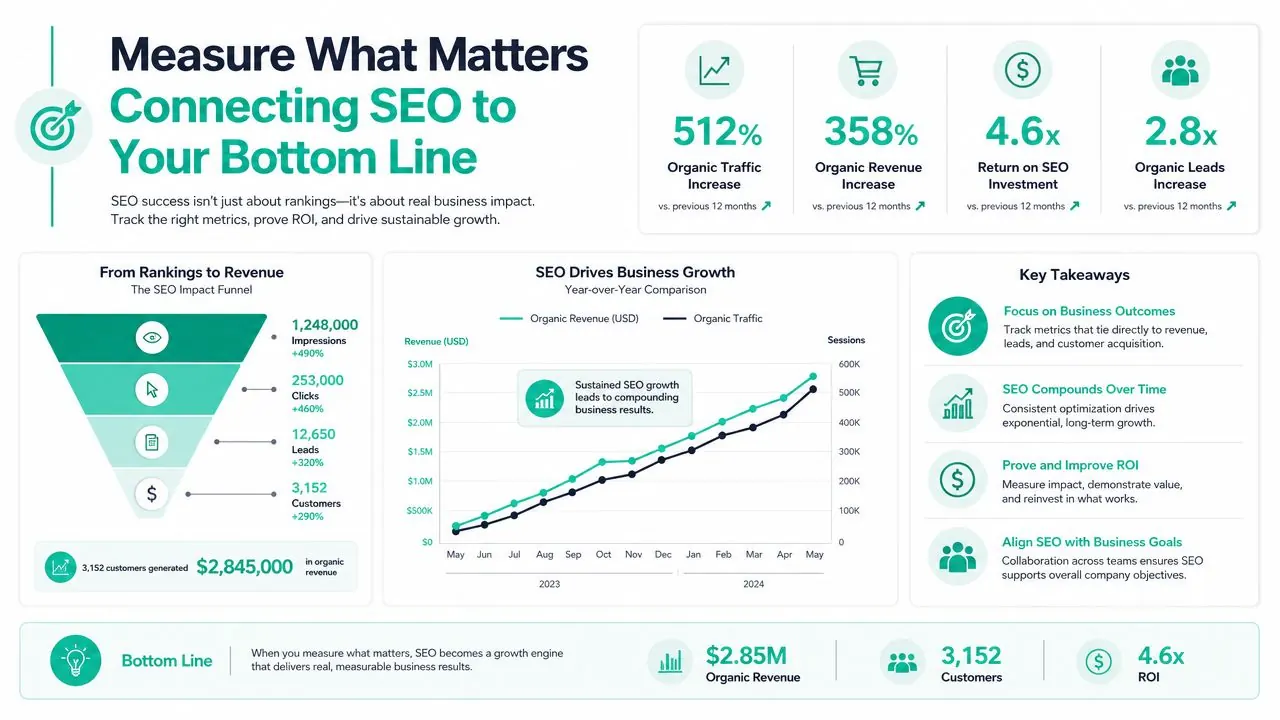
Ignore vanity metrics and track business outcomes
The most useful benchmark in this conversation is client acquisition. SEO leads to approximately 44% of all clients for law firms, compared with 32% from traditional media and referrals. That makes SEO worth measuring like a business system, not a branding exercise.
The core question isn't "Did traffic go up?" It's "Did the right matters come in from organic search?"
A firm-level scorecard should focus on:
- Organic leads generated: How many real inquiries came from search
- Qualified leads: Which of those inquiries fit your target practice areas and case profile
- Lead-to-consultation movement: Whether intake is converting search demand into conversations
- Client acquisition from organic search: The actual business result
Traffic still matters, but only as context. Rankings matter, but only when they correspond to the services you want. Visibility without intake quality can create a lot of motion and very little growth.
Use a monthly scorecard you can read quickly
A good monthly SEO review should fit on one screen. It doesn't need to be fancy. It needs to answer practical questions.
Here's a useful structure:
| Metric | What to ask |
|---|---|
| Organic leads | Did we generate more real inquiries from search this month? |
| Lead quality | Were these the kinds of matters we actually want? |
| Top landing pages | Which pages brought in the most valuable visits? |
| Conversion path issues | Where are prospects dropping off before contacting us? |
| Priority actions | What are the next few fixes or content improvements? |
This keeps everyone honest. It also makes agency conversations better. Instead of debating jargon, you can ask direct questions about page performance, intake quality, and next priorities.
What works is tying reporting to decisions. Update underperforming pages. Improve calls to action where good traffic isn't converting. Expand topics that attract high-quality cases. Strengthen local reputation where visibility is lagging.
What doesn't work is celebrating impressions while the intake team says the leads are weak.
If your firm wants a marketing partner that thinks beyond traffic and focuses on being found, trusted, and chosen, Leaping Lemur Media is worth a look. Their approach is rooted in partnership, clear positioning, and growth that reflects who your practice is.