Dental Practice SEO: Your Guide to More Patients in 2026
You can run a very good practice and still lose patients before they ever call. That's the frustrating part of dental marketing today. The care is strong, the team is kind, the office looks great, but the practice is hard to find when someone nearby searches for a dentist, compares options, and tries to book. […]
LElemurJune 21, 202618 min read
In this piece
You can run a very good practice and still lose patients before they ever call. That's the frustrating part of dental marketing today. The care is strong, the team is kind, the office looks great, but the practice is hard to find when someone nearby searches for a dentist, compares options, and tries to book.
That gap shows up every day in real patient behavior. 71% of patients research potential dentists before booking an appointment, while only 26% of dental practices offer online booking, according to these dental marketing statistics. In plain terms, people are shopping online first, then many practices make the next step harder than it should be.
Dental practice SEO fixes that disconnect. It helps your practice show up when someone searches for the exact care you provide, in the area you serve, with enough trust signals and clarity to turn interest into an appointment. If your website, Google Business Profile, reviews, and service pages work together, SEO becomes less about “traffic” and more about filling the schedule with the right new patients.
A lot of dentists know they need this, but they're stuck on one question. Where should we start? That's the right question. Most practices don't need more random tactics. They need priorities, sequence, and a plan that matches the way patients choose a dentist.
If you're trying to build a practice that feels visible, trusted, and easy to choose, the first step is understanding where your online presence stands today. A good partner should help you see that clearly, whether you're handling strategy internally or reviewing support from a team like Leaping Lemur Media.
A dentist can spend years building clinical skill and still lose the digital first impression in seconds.
A patient wakes up with a cracked molar, or decides it's finally time to replace a missing tooth. They don't start by driving around town. They search. They compare map listings, scan reviews, click service pages, and decide who seems credible, nearby, and easy to contact. If your practice doesn't show up well, or the site feels thin, outdated, or hard to use, that patient often moves on without ever reaching the front desk.
That's why dental practice SEO matters at the practice level, not just the marketing level. It closes the distance between the care you provide and the search behavior patients already use. A strong online presence doesn't just “increase visibility.” It puts your office in the path of people who are actively looking for crowns, implants, emergency care, family dentistry, or cosmetic treatment in your area.
The online waiting room is real
Think of your Google presence and website as a second reception area. Patients arrive there before they meet your team. They look for signs that answer basic questions fast.
Do you offer the service I need
Are you close to me
Can I trust this office
Can I book without friction
When any one of those breaks, the patient journey breaks with it. A practice can rank for broad terms and still underperform if the appointment path is clunky or the service pages are vague.
Practical rule: SEO for a dental office only works when discovery, trust, and booking are connected.
Good dentistry needs good discoverability
Many dentists still think of SEO as a technical side project. In practice, it behaves more like patient access infrastructure. If someone can't find your office, can't tell whether you handle their concern, or can't take the next step easily, marketing and operations start working against each other.
That's why the smartest approach isn't “do everything.” It's to build the right pieces in the right order. Start with what helps patients find you. Then fix what helps them trust you. Then improve what helps them book.
Why SEO Is Your Practice's Most Valuable Asset
A practice can buy clicks this month and still have an empty hygiene column next month if the underlying search presence is weak. The offices that grow more predictably usually build something they keep: strong local visibility, service pages that match real patient searches, a healthy review profile, and a website that makes booking easy.
That is why SEO becomes an asset, not just a marketing task. Each improvement adds another entry point for the right patient to find your office without starting from zero every month. A polished Google Business Profile can keep bringing in emergency calls. A well-written implants page can keep attracting high-value treatment searches. Reviews can keep improving both click-through and trust long after they are posted.
For a busy dental office, that changes the math. Every new patient does not need to come from fresh ad spend. SEO gives the practice a base layer of demand generation that can support production goals, reduce reliance on constant campaign adjustments, and make marketing costs easier to control.
SEO rewards steady improvements
Dental SEO works like owning a well-placed office sign on the busiest road in town. You still have to maintain it, and results do not appear overnight, but the visibility keeps paying back.
Channel
How it behaves
Trade-off
Paid search
Generates visibility while campaigns are funded and managed
Faster results, higher ongoing cost, less durable
SEO
Builds visibility through local presence, service relevance, reviews, and site performance
Slower ramp, stronger long-term return, less dependent on monthly spend
Good practices use both. Ads can fill a short-term gap, support a new service line, or help a second location gain traction. SEO is what gives the practice a stronger foundation so patient acquisition does not reset every time budgets tighten or cost per click rises.
Search performance and trust work together
A first-page ranking helps only if the patient likes what they see. In dentistry, that decision happens fast. Patients compare review volume, recent feedback, photos, office details, and whether the page clearly answers their concern.
That is why reputation work belongs inside SEO, not beside it. If the listing gets the impression but the reviews look thin or outdated, the click goes elsewhere. If the website gets the click but the service page feels generic, the call never happens. Twizzlo's insights on online reviews are useful here because review generation is not just about social proof. It directly affects whether search visibility turns into booked appointments.
The value of dental practice SEO is practical. It helps the right patients find your office, trust what they see, and take the next step. For most practices, that makes SEO one of the few marketing investments that can improve both patient flow and efficiency over time.
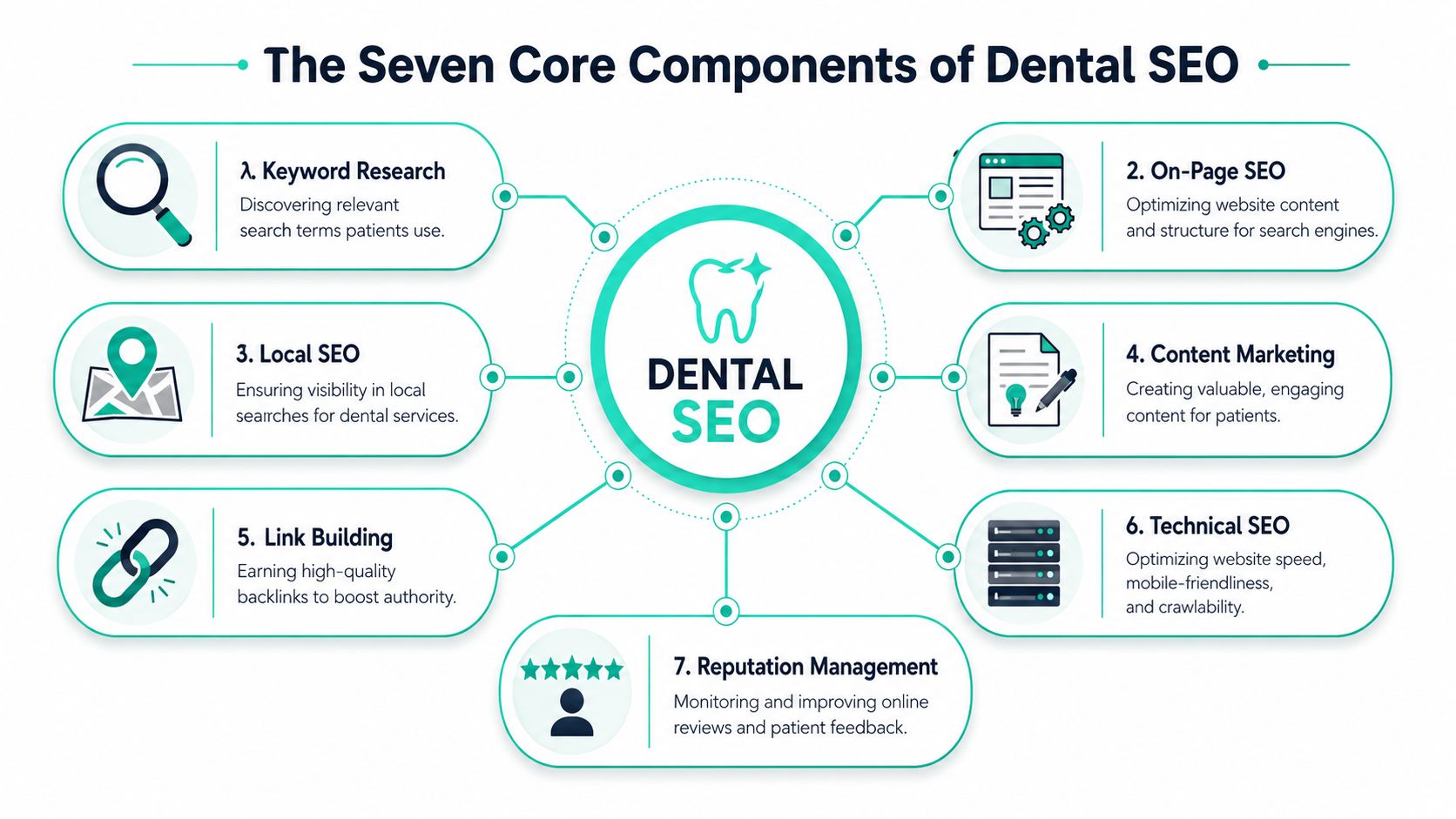
The Seven Core Components of Dental SEO
Dental practice SEO gets confusing when it's presented like a checklist of disconnected tasks. It's easier to manage when you see it as one patient acquisition system with seven connected parts.
Local SEO puts you on the shortlist
Local SEO is what helps your practice appear when someone searches for a dentist in a specific area. This includes your Google Business Profile, local citations, service areas, categories, office hours, photos, and location relevance.
For most practices, this is the first battleground. Patients often search with city names, neighborhoods, or “near me” intent. If your local signals are messy, everything else has to work harder.
A practical local setup includes:
Complete business details that match everywhere your practice appears online
Clear service listings so Google understands what treatments you provide
Location-specific pages for the communities or service areas you serve
Fresh profile activity such as updates, photos, and review responses
Technical SEO keeps the site usable
Technical SEO is the plumbing. Patients don't notice it when it works. They absolutely notice when it doesn't.
If pages load slowly, forms break on mobile, or the site feels insecure, your rankings and conversions both suffer. Verified guidance in your brief notes that a delay beyond 2.5 seconds in First Contentful Paint can result in a 32% drop in user engagement and a 20% decline in local search rankings. For dental sites, oversized office photos, before-and-after galleries, and bloated page builders are common culprits.
The fixes are often straightforward:
Compress images so treatment pages don't drag
Use mobile-friendly layouts because patients search and book from phones
Secure the site with HTTPS
Test booking and contact forms regularly instead of assuming they work
On-page SEO clarifies what you actually do
On-page SEO is where many dental websites underperform. They say too little, or they try to say everything on one generic “services” page.
A patient searching for dental implants isn't looking for a vague paragraph about overall care offerings. They want a page that explains implants, candidacy, process, benefits, and how to book. The same goes for veneers, sedation dentistry, pediatric care, emergency treatment, and Invisalign.
Strong on-page SEO means each important service has its own focused page, written for both search engines and actual humans.
Content marketing answers patient questions
Good content does a simple job. It answers the questions patients ask before they're ready to commit.
That might include blog posts, FAQs, or treatment guides around topics like tooth pain, whitening options, implant recovery, or what to expect from a first pediatric visit. Content isn't useful because it makes your site look active. It's useful because it captures question-based searches and reduces hesitation.
If a patient is nervous, confused, or comparing options, content should make the next step easier.
Link building supports authority
Links from other relevant websites act like reputation references. Search engines use them as part of the trust picture.
For a dental practice, useful links often come from local chambers, community organizations, sponsorship pages, dental associations, local media mentions, or reputable healthcare directories. The point isn't to chase random backlinks. It's to earn links that make sense for your geography and brand.
Reviews shape trust before the first call
Reviews are part conversion tool, part local SEO signal, part reputation management system. Patients use them to reduce uncertainty. They want proof that your team communicates well, runs on time, treats people kindly, and delivers good care.
If your office needs a practical review process, Twizzlo's insights on online reviews give useful guidance on making patient feedback easier to collect consistently.
Schema markup helps search engines understand your practice
Schema is code that labels your content so search engines can interpret it correctly. Think of it as putting tabs on a patient chart. The information may already be there, but labels make it easier to process fast and accurately.
For dental practice SEO, this matters more than many offices realize. Your verified brief states that using Schema.org Dentist and Service types is critical, and that gaps such as omitting the hasService property can cause a 30-40% reduction in local ranking probability for voice and AI queries. That's not a cosmetic tweak. It affects whether search engines clearly understand your practice entity and services.
Here's where each component fits:
Component
Main job
Real-world effect
Local SEO
Establishes location relevance
Helps nearby patients find you
Technical SEO
Improves speed, usability, and crawlability
Reduces friction before booking
On-page SEO
Matches pages to patient intent
Increases relevance for specific services
Content
Answers questions and builds confidence
Supports earlier-stage patient research
Link building
Reinforces authority
Strengthens trust in your domain
Reviews
Provide social proof
Improves click-through and patient confidence
Schema
Clarifies data for search engines
Supports rich results and AI understanding
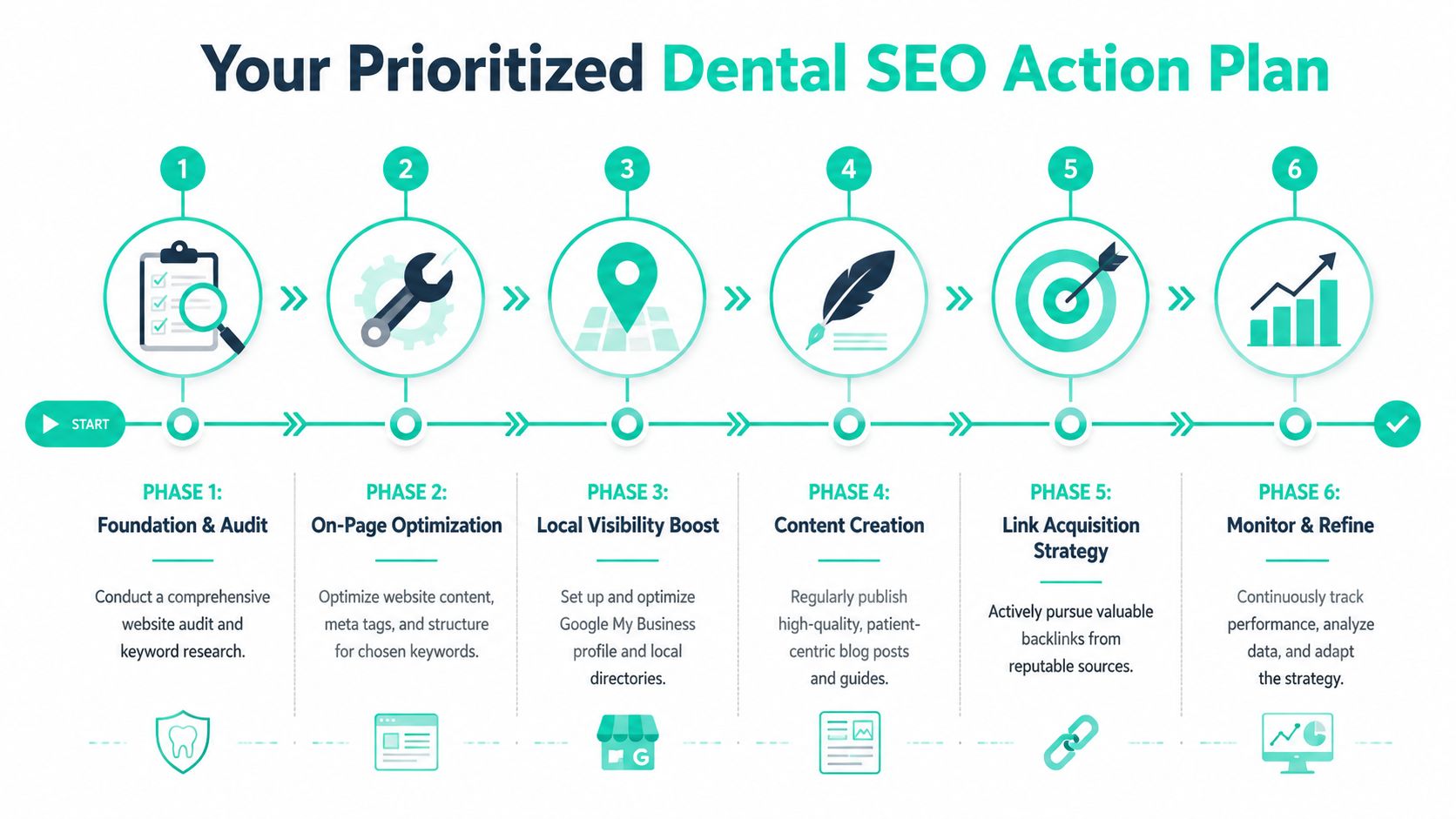
Your Prioritized Dental SEO Action Plan
Most practices don't need more ideas. They need order. The right roadmap starts with what removes the biggest barriers to patient acquisition, then expands into trust-building and authority.
Phase 1 foundation and fast fixes
Start with the assets patients see first and the issues that subtly block conversions.
One industry guide reports that businesses with complete Google Business Profiles are 70% more likely to attract location visits, and it specifically points to accurate service listings, weekly posting, and active messaging as part of profile quality in this local SEO guide for dental practices. For a dental office, that makes GBP one of the highest-priority actions.
Your first phase should usually include:
Audit your Google Business Profile. Fix categories, hours, services, business description, photos, and appointment links.
Check NAP consistency. Your name, address, and phone need to match across the website and key listings.
Repair technical basics. Improve page speed, mobile usability, and form function.
Build or refine core service pages. Focus first on the treatments that drive the most value or demand.
If you work with outside support, compare the plan against providers that specialize in boosting dental practice visibility so you can judge whether the proposed sequence matches patient intent. If you need implementation help, one option is reviewing SEO and local search services that cover local visibility, technical fixes, and lead generation under one strategy.
Phase 2 momentum and patient intent
Once the foundation is stable, build the content and trust signals that turn more impressions into inquiries.
Many practices should prioritize a manageable rhythm instead of a publishing spree. A few strong service-supporting pages and FAQs beat a pile of thin blog posts every time.
Priorities in this phase:
Add supporting content around high-intent services and common patient concerns
Create location-relevant landing pages where appropriate
Set up a review request process that staff can follow consistently
Strengthen internal links so treatment pages support each other logically
A good roadmap doesn't ask your team to do everything at once. It removes the biggest bottleneck first.
Phase 3 long-term authority and expansion
After the basics are working, broaden your footprint.
This phase includes earning local backlinks, expanding into adjacent service topics, refining schema markup, and improving weaker pages that rank but don't convert well. It's also the point where you can look at specialty opportunities such as emergency dentistry, implants, cosmetic dentistry, or multi-location visibility if that fits your practice model.
The mistake to avoid here is skipping ahead. Link building won't rescue a slow, unclear, underdeveloped website. Advanced strategy only pays off once the practice has a solid local and technical base.
Measuring What Matters for Practice Growth
A ranking report can look impressive and still tell you almost nothing about business performance. That's where many dental SEO programs go off track. They celebrate visibility and avoid the harder question. Did organic search produce booked patients?
A broader industry guide on dental SEO points out that this is a common gap, and that true success should be judged by new patient appointments generated from organic search in RevenueWell's discussion of SEO and organic practice growth. That's the right standard.
Vanity metrics vs patient acquisition metrics
Traffic has value, but traffic alone doesn't pay for hygiene checks, crown prep time, or front desk staffing. You want metrics tied to patient action.
The most useful measures usually include:
Phone calls from organic search tracked with clear attribution
Appointment request submissions from organic landing pages
Direction requests and map interactions from your Google presence
New patient bookings linked back to organic first-touch or assisted-touch activity
Performance by service line so you know whether implants, cosmetic cases, or family dentistry pages are generating actual inquiries
A spike in blog traffic from broad informational keywords may look healthy on paper. If it doesn't create calls or requests, it's not a growth metric.
What to ask your marketing team every month
Ask questions that force the conversation toward business outcomes.
Better question
Why it matters
Which organic pages generated appointment intent
Shows whether traffic aligns with patient demand
How many calls and forms came from organic visitors
Connects SEO to lead generation
Which services drove inquiries
Helps you prioritize profitable service lines
Where do patients drop off before booking
Reveals conversion problems, not just ranking issues
Track the path from search to scheduled appointment. If you can't see that path, you're only measuring attention.
In practice, this means using analytics correctly, setting up form goals, reviewing call data, and making sure front desk intake asks how patients found the office in a consistent way. SEO should be measured like an operational system, not a vanity campaign.
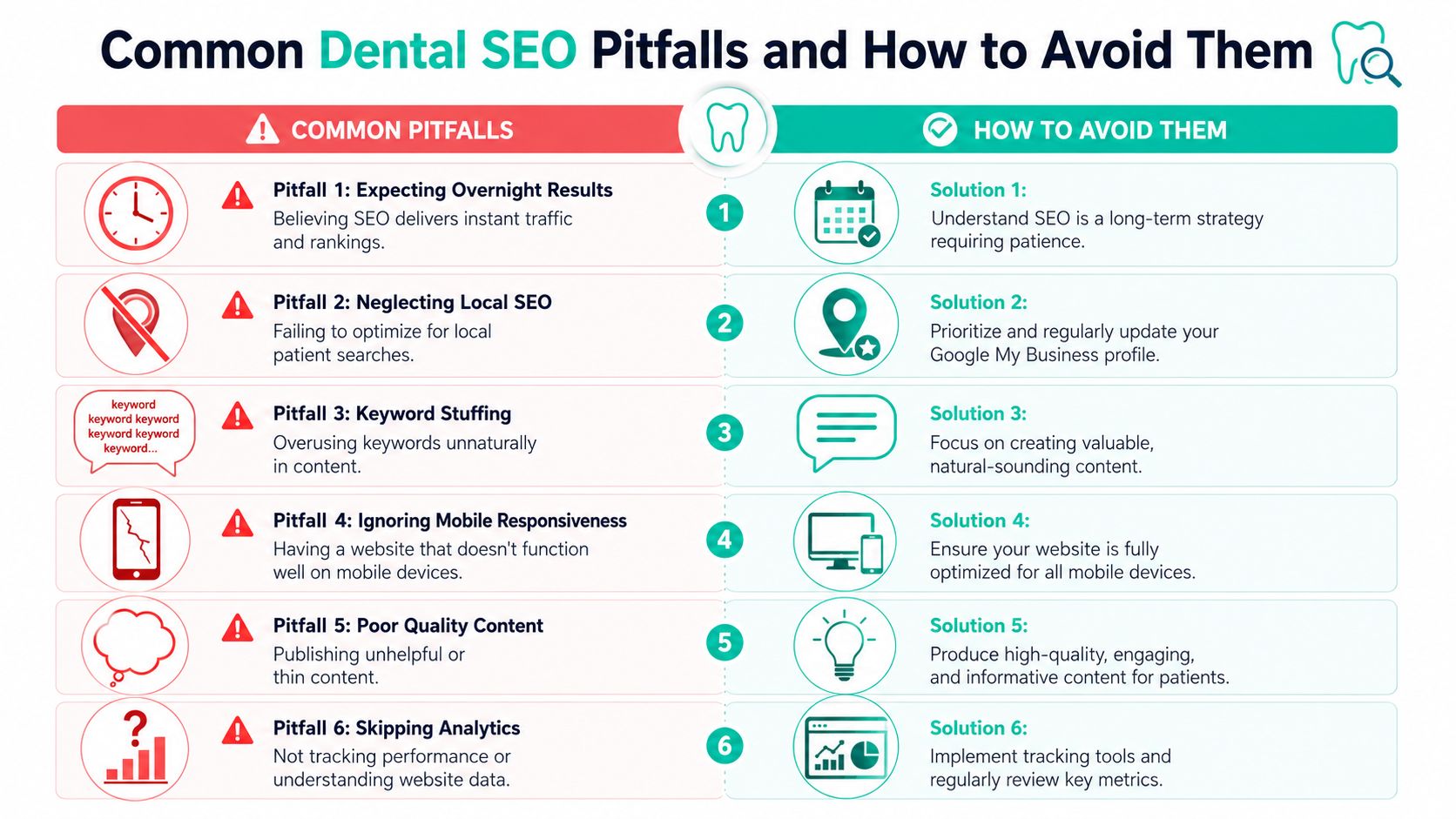
Common Dental SEO Pitfalls and How to Avoid Them
A common failure pattern looks like this. The doctor approves a new website, the office manager assumes the agency is handling everything else, the front desk keeps answering calls as usual, and six months later nobody can say which pages brought in new patients. SEO rarely breaks because of one dramatic error. It breaks because ownership is blurry.
The biggest pitfalls I see in dental practices are operational, not just technical. They waste budget, slow patient acquisition, and make good marketing look ineffective.
No one owns the local patient journey. One person updates office hours, another changes insurance information, and nobody checks whether the website, Google Business Profile, and appointment forms still match. Patients hit conflicting details and leave.
The practice delegates SEO without giving the vendor real practice input. An outside team can build pages, but they still need your treatment priorities, scheduling constraints, financing options, and answers to common patient objections. Without that input, the site attracts traffic that does not convert into the cases you want.
High-value services are buried behind generic navigation. If implants, Invisalign, or cosmetic dentistry drive growth, they should not be three clicks deep under a broad "services" tab with thin copy. Patients and search engines both respond better to clear, stand-alone treatment paths.
The front desk is left out of the SEO system. If the team does not ask consistent intake questions, log lead sources, and notice which calls mention specific treatments, the practice loses the feedback loop that tells you what is working.
Website changes happen without checking conversion impact. A redesign, new plugin, chat widget, or form tool can break mobile booking, hide phone numbers, or create friction right before a patient requests an appointment.
The content plan follows what is easy to publish instead of what is easiest to monetize. Educational posts have a place, but a practice usually gets more value from strengthening its money pages, FAQs, financing information, and before-and-after pathways.
The fix is a simple chain of accountability.
Assign one person to own listing accuracy and appointment-path checks. Give your marketing team monthly input on priority services, seasonal demand, and schedule availability. Have the front desk report what callers ask before they book. Review your top treatment pages the same way you would review an operator's schedule. If a page gets visibility but does not produce calls or forms, it needs better messaging, proof, or a clearer next step.
This approach is less exciting than chasing a new tactic. It is also what fills chairs.
It usually takes time because you're building trust, relevance, and visibility together. Some fixes, like improving your Google Business Profile or repairing broken appointment paths, can help sooner. Broader gains from service pages, content, links, and authority tend to build gradually.
Should a dentist do SEO in-house
A practice owner can absolutely handle parts of it, especially review generation, service accuracy, photo updates, and basic content input. The harder parts are technical SEO, strategy, schema, tracking, and consistent execution. Most busy offices do better when the doctor and team own the message while a specialist handles the infrastructure.
What should I focus on first
Start with the things that affect discovery and booking directly. That usually means your Google Business Profile, website speed, mobile usability, core service pages, and clear conversion paths.
Is blogging enough for dental SEO
No. Blogging helps when it supports patient questions and connects to treatment pages. It doesn't replace local SEO, technical performance, review management, or service-page quality.
How do I learn what good dental SEO work looks like
Study plans, audits, and examples that tie strategy back to patient acquisition rather than vague ranking talk. If you want more practical guidance on marketing systems and organic growth, the Leaping Lemur Media blog is one place to keep learning.
If your practice needs a clearer path from search visibility to booked appointments, Leaping Lemur Media offers marketing support built around local search, SEO, and lead generation for service-based practices. The value isn't in doing more tactics. It's in aligning the right ones with how patients find and choose care.