Choosing a Healthcare Marketing Agency: A 2026 Guide
Your schedule is full. Your team is busy. New patients still come in. Yet marketing feels like a constant source of low-grade stress. One agency says you need more Google Ads. Another pushes SEO. A third promises “done-for-you growth” but can't explain how they'll protect patient privacy, measure booked appointments, or handle reputation issues when […]
LElemurJune 20, 202614 min read
In this piece
Your schedule is full. Your team is busy. New patients still come in. Yet marketing feels like a constant source of low-grade stress.
One agency says you need more Google Ads. Another pushes SEO. A third promises “done-for-you growth” but can't explain how they'll protect patient privacy, measure booked appointments, or handle reputation issues when a physician profile is incomplete. That's the moment most practice owners realize they're not shopping for a vendor. They're trying to choose a partner they can trust with growth and reputation at the same time.
That decision matters more now because healthcare marketing isn't a side category anymore. A 2026 market summary values the global healthcare digital marketing market at $6.4 billion and says it's growing at 18% annually, while effective outreach often requires eight or more coordinated touchpoints across channels before a healthcare buyer commits, according to SearchLab's healthcare marketing statistics summary. In plain terms, this field got bigger, more specialized, and less forgiving.
If you're trying to grow patient volume without turning your front desk into a call-center experiment, a good starting point is practical operational advice like Simbie AI's patient volume tips. It helps clarify a basic truth: marketing only works when the patient experience behind it is ready.
Your Practice Is Thriving Why Does Marketing Feel So Hard
A lot of owners feel almost guilty admitting this. They know their practice is doing well, but they also know growth feels fragile. Referrals can slow down. A competitor opens nearby. Search results change. Suddenly the marketing problem lands on the physician-owner, office manager, or director who already has a full-time job.
That's why the agency search gets messy fast. You start with one discovery call and end up with five proposals that all sound similar. Everyone claims they understand healthcare. Almost nobody explains the patient journey in a way that matches what happens in your office.
A healthcare marketing agency earns trust by showing how a stranger becomes a scheduled patient, then a kept appointment, then a loyal patient. Traffic alone doesn't prove that.
The practices that choose well usually stop asking, “Who can run ads?” and start asking, “Who can understand our business model, our patient mix, and our operational limits?” That shift changes everything.
The real burden isn't marketing tasks
The hard part isn't writing a blog or launching a campaign. The hard part is coordinating everything that has to line up:
Front desk readiness: If calls go unanswered or online booking is clunky, even strong marketing underperforms.
Provider positioning: Patients compare physicians, read profiles, and look for signals that feel credible.
Compliance judgment: Healthcare messaging can't be treated like retail copywriting.
Measurement discipline: A practice needs more than click reports. It needs visibility into booked appointments and downstream value.
That's why generic agencies often disappoint good practices. They sell activity. Healthcare requires judgment.
Why the wrong hire gets expensive quickly
When an agency misses the mark, the damage usually isn't dramatic at first. It's slower than that. Your team spends time approving content that doesn't sound right. Paid traffic goes to weak landing pages. Reviews are ignored. Reporting arrives full of impressions and cost charts, but nobody can answer the basic question: are we attracting the right patients?
A smart practice owner should treat agency selection the same way they'd treat hiring a key operator. If the person touches reputation, growth, patient acquisition, and data handling, they need scrutiny.
What a Great Healthcare Marketing Agency Actually Does
Most agencies describe themselves with a list of channels. SEO, PPC, social, email, web design. That's not enough. A strong healthcare marketing agency connects those channels into one patient acquisition system.
It builds a patient journey not just campaigns
Here's the blunt truth. Many healthcare groups still overspend on awareness and underspend on conversion. One industry summary says hospital marketers allocate 85% of their budget to Google Ads, while the average click-through rate for health-related Google Ads is only 6.11%. The same source says 67% of patients who view a physician's Healthgrades profile schedule an appointment within a week, according to Healthgrades healthcare marketing statistics. That gap tells you what capable agencies already know. Visibility matters, but trust-rich assets often decide the appointment.
So what should an agency be doing?
Improve discoverability where intent is strongest Local SEO, map visibility, service pages, and physician profile optimization matter because patients often start with a specific need, not a broad brand search.
Fix the conversion path Appointment requests, online scheduling, phone routing, provider bios, and landing pages need to work together. If they don't, more traffic just creates more waste.
Support reputation and profile management Patients compare clinicians. Incomplete profiles, weak review management, or inconsistent directory information diminish confidence.
Create content that reduces hesitation Good content answers practical questions in plain language. It helps a nervous prospective patient feel informed enough to take the next step.
If you're comparing service models, it helps to review what different firms include in their healthcare and local growth service mix. The point isn't to buy every service. It's to see whether the agency treats marketing as a connected system or a stack of disconnected tasks.
It protects trust while improving conversion
Healthcare buyers don't behave like shoppers buying shoes. They're often anxious, skeptical, pressed for time, or dealing with something personal. A great agency respects that reality.
That means it should handle:
HIPAA-aware workflows: Lead forms, tracking tools, CRM handoffs, and reporting all need careful setup.
Provider-specific messaging: The copy for a medspa, dentist, ophthalmologist, and specialist group shouldn't sound interchangeable.
Re-engagement and nurture: Some patients book immediately. Others need reminders, educational content, or reassurance.
Multi-location consistency: If you have several offices or service lines, the agency should help you measure performance at the location and provider level.
Practical rule: If an agency talks mostly about clicks and hardly at all about provider profiles, scheduling friction, call handling, reviews, and show rates, they don't understand healthcare deeply enough.
A real partner doesn't chase vanity metrics. It removes friction from the first search to the kept appointment.
The Vetting Process How to Evaluate Potential Partners
Most practices make the same mistake during agency interviews. They let the agency control the conversation. The sales team walks through a deck, shows polished creative, mentions “results,” and leaves without answering the questions that matter.
Take control early.
Start with questions that force specificity
Ask questions that require process, not slogans.
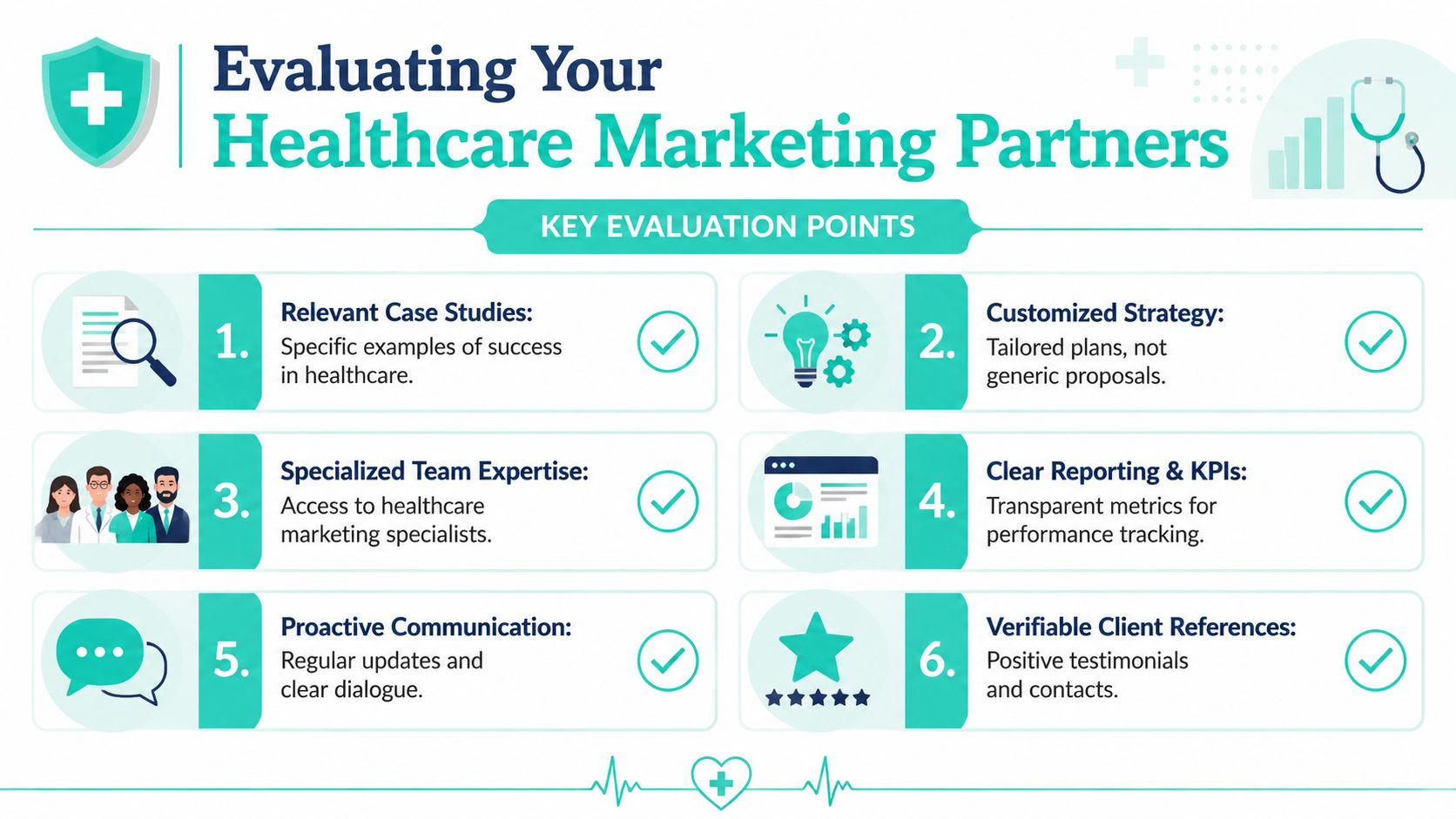
What do you audit before recommending strategy? A serious agency should review current performance, existing conversion paths, competitors, and channel history before prescribing solutions.
How do you align goals, budget, and timelines up front? One agency methodology emphasizes formal Goal-Setting Workshops, and says failure to run them leads to a 40% higher rate of budget misalignment and timeline slippage, according to Accelerated Digital Media's guide to goal setting in healthcare marketing.
What business outcomes do you report on? If they can't discuss appointment flow, lead quality, and downstream value, keep looking.
Who will do the work? You need the names and roles of the account lead, strategist, writer, designer, paid media manager, and technical support people.
Look for strategic maturity not polished sales talk
The strongest agencies diagnose first. They don't rush to channels. They want baseline data, historical performance, competitor context, and operational constraints.
That same data-led auditing source reports an average healthcare conversion rate of 3.2%, while high-performing brands using a granular auditing approach can reach 21.2%. The important lesson isn't that your practice will hit that number. It's that disciplined analysis can create a very different outcome from generic campaign management.
A mature vetting conversation should include these topics:
Evaluation Area
Weak Answer
Strong Answer
Strategy
“We usually start with ads.”
“We audit current KPIs, channel performance, and conversion bottlenecks first.”
Reporting
“We send monthly dashboards.”
“We tie reporting to appointments, quality, and operational follow-through.”
HIPAA awareness
“We've worked with doctors before.”
“We map data flows, access, approvals, and compliance touchpoints.”
Fit
“We work with everyone.”
“Here's where we fit, and here's where we don't.”
If you want a sense of how an agency presents its team, philosophy, and operating style before you even book a call, review its agency background and approach. You're not looking for polish alone. You're looking for whether the firm sounds like a strategic operator or a volume seller.
Test whether they understand trust across communities
Many otherwise competent agencies fail. They know platforms, but they don't know people.
A practice serving multilingual, multicultural, or historically underserved communities needs messaging that feels credible, respectful, and accurate. An agency that only knows performance marketing may produce compliant copy that still feels tone-deaf. That hurts response and reputation.
Ask directly:
How do you adapt messaging for different communities without stereotyping?
How do you validate language choices and cultural assumptions?
How do you balance community relevance with regulatory accuracy?
Have you handled campaigns where trust barriers were as important as channel performance?
The agency that asks thoughtful questions about your patients, your referral patterns, and your community context is usually safer than the agency that opens with ad spend recommendations.
Red Flags and Green Flags You Cannot Ignore
You don't need a spreadsheet to spot trouble. Most bad-fit agencies reveal themselves quickly if you know what to watch for.
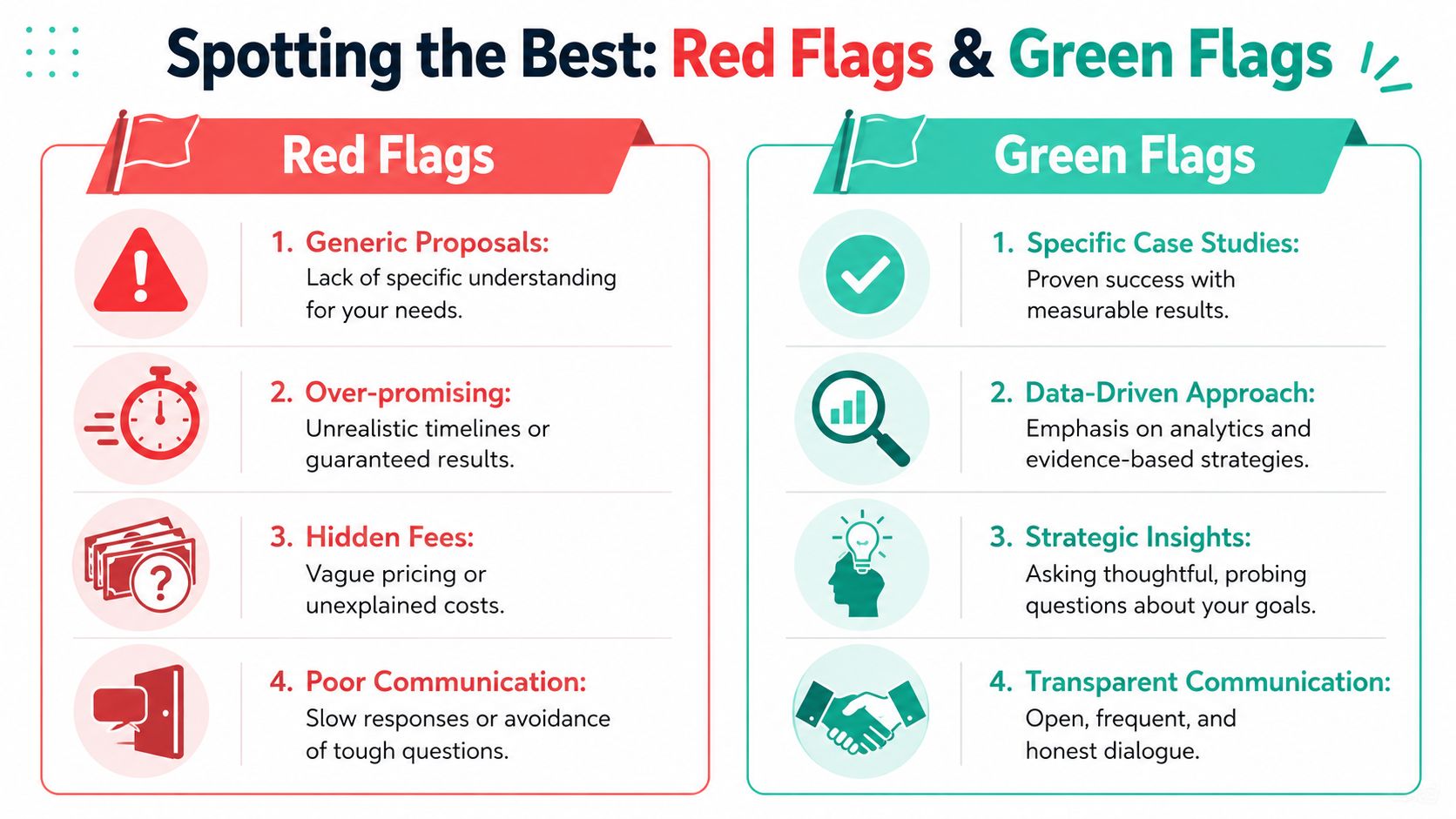
Red flags that usually predict a bad engagement
Some signals should end the conversation immediately.
Guaranteed rankings or instant results No credible agency can promise exact ranking positions or fast patient growth without first seeing your market, website, operations, and competition.
Template proposals with no diagnosis If the proposal looks prebuilt, it probably is. Your specialty, geography, payer mix, and service-line priorities matter.
Weak answers on compliance If they stay vague about data handling, tracking, approvals, or patient privacy, assume risk.
Vanity-heavy reporting When reporting focuses on impressions, reach, and traffic but avoids booked appointments and quality indicators, the agency is protecting itself.
No curiosity about your front desk or intake process Marketing performance and operational performance are tied together. An agency that ignores call handling and scheduling friction will misread the results.
Green flags that signal a real partner
The good agencies feel different in conversation. They don't posture. They investigate.
They ask hard questions early They want to know which providers you need to grow, what appointment types matter most, and where the patient handoff breaks.
They talk about trust, not only promotion That matters even more if your practice serves audiences with lower baseline trust in healthcare systems. One industry discussion argues that combining culturally competent messaging with regulatory accuracy is a strategic necessity for reaching diverse communities, as noted by Prezent's discussion of healthcare marketing agencies.
They're comfortable saying no A strong agency will tell you when a channel isn't the right first move, when your website needs work before paid traffic, or when internal bottlenecks will limit results.
They make accountability visible You know who owns strategy, who owns execution, how meetings run, and how decisions get documented.
Good agencies don't just protect your budget. They protect your reputation from rushed, generic, or tone-deaf marketing.
Understanding Pricing and Demanding the Right KPIs
The wrong pricing conversation starts with “What's your monthly fee?” The right one starts with “What are we buying, how will value be measured, and what internal work will our team still need to do?”
Pricing only matters in context
Most healthcare practices will see one of three pricing structures:
Monthly retainer Best when you need ongoing strategy, campaign management, reporting, content, and optimization. This is usually the cleanest model for an active growth program.
Project-based work Useful for a website rebuild, brand messaging, launch campaign, or analytics cleanup. It's fine for a defined scope, but weak as a substitute for ongoing strategic management.
Hybrid arrangement This combines a retainer with one-off projects. It's common when a practice needs ongoing growth support plus occasional larger initiatives.
If you want a plain-English overview of how agencies commonly structure fees, marketing agency pricing models is a useful reference before you compare proposals. It helps you separate legitimate scope differences from confusing pricing language.
What you should not do is choose the cheapest proposal without understanding what's excluded. Low fees often hide weak strategy, limited reporting, junior staffing, or constant add-on charges.
KPIs to demand from day one
A healthcare marketing agency should be measured on business outcomes, not just activity. One healthcare strategy source says successful agencies aim for an LTV:CAC ratio exceeding 3x for primary care and 5x for specialty care, and that appointment show rates should exceed 60-70% for paid search. The same source warns that optimizing only for initial acquisition can skew ROI, according to Improvado's healthcare marketing strategy framework.
That's the standard I recommend. Don't stop at lead counts.
Metric Category
Vanity Metric Avoid Over-relying On
Business Metric Demand This Instead
Awareness
Traffic volume
Booked appointments
Paid media
Clicks
Cost per booked appointment
Lead generation
Form fills
Qualified patient inquiries
Website
Bounce rate alone
Conversion by service line or provider
Call activity
Total calls
Calls that result in scheduling action
Revenue quality
Cost per lead
LTV:CAC and revenue per acquisition
Patient follow-through
Lead count
Appointment show rate
A capable agency should also help you define a measurement model that reflects real healthcare behavior. That includes reviews, calls, forms, provider pages, offline referrals, and follow-through after scheduling. If they can't explain how they'll judge success beyond “more leads,” they're not ready for a serious healthcare account.
Bottom line: The metric that matters is the one closest to actual patient value. Everything else is supporting evidence.
There's one more practical point. Don't optimize yourself into bad patients. An agency can lower acquisition costs by broadening targeting, but if those patients no-show, choose low-value services, or never return, the economics break.
Onboarding Your New Agency for a Strong Start
Signing the agreement doesn't solve anything by itself. The first stretch of the relationship usually determines whether the agency becomes a trusted extension of your team or another outside vendor you have to manage too closely.
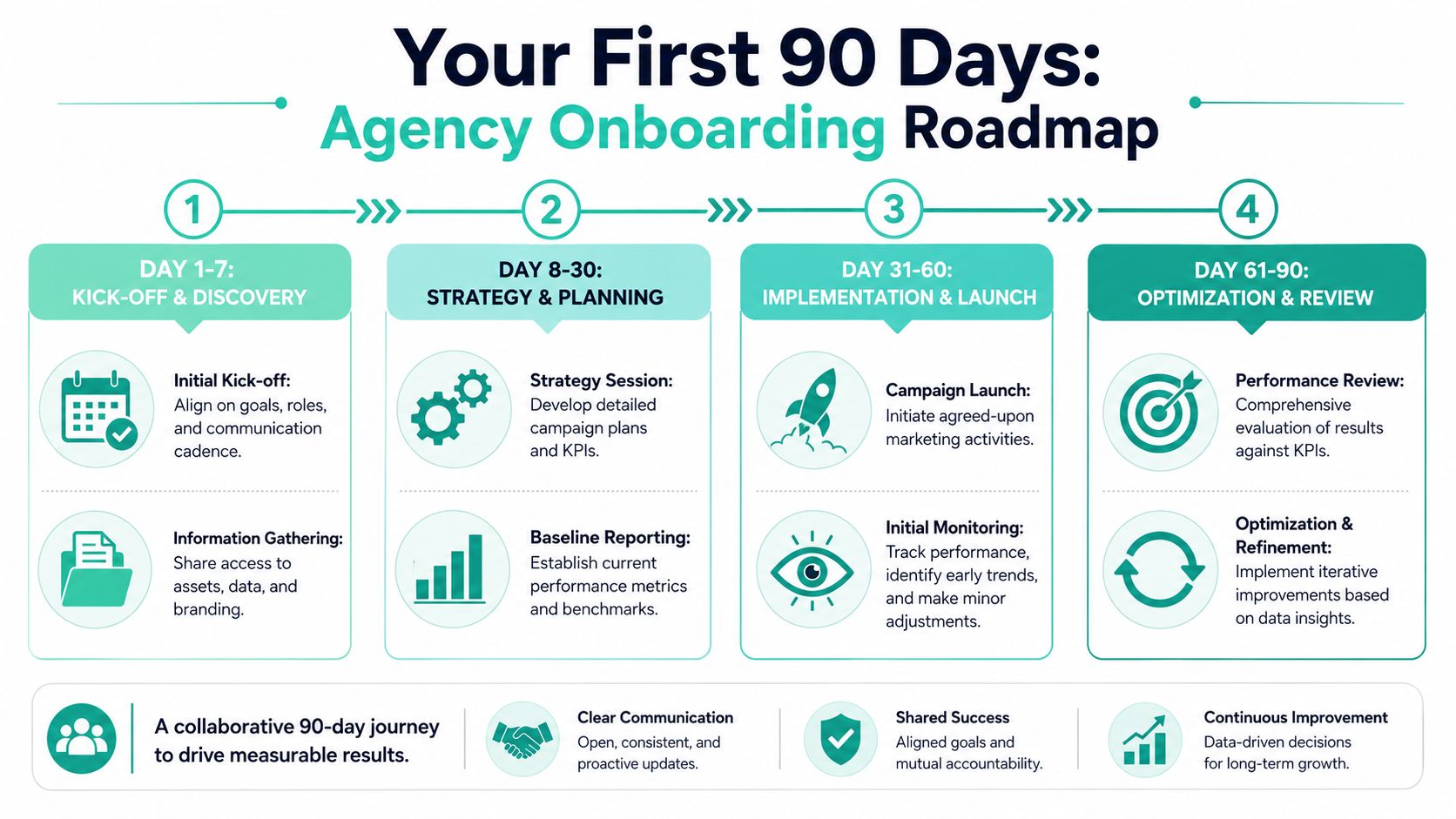
What the first 90 days should look like
A strong onboarding process is structured, collaborative, and slightly demanding. That's good. It means the agency is trying to understand the business thoroughly.
During the opening months, expect:
Kickoff and discovery Clear goals, points of contact, approval paths, and meeting cadence should be set early.
Access and technical setup The agency will need analytics, website access, ad platform access, directory access, brand files, and current collateral.
Baseline measurement Before major changes start, they should document current performance so everyone knows what improvement means.
Initial execution and review rhythm You want early action, but not random action. First campaigns should reflect agreed priorities and reporting should be easy to interpret.
What your practice needs to prepare
Onboarding goes faster when the practice is organized. Have these ready:
Brand and provider materials: Logos, headshots, bios, service descriptions, and approved messaging.
Operational information: Scheduling process, office hours, call routing details, and any intake pain points.
Existing marketing assets: Website credentials, analytics access, ad accounts, CRM or lead management tools, and directory logins.
Decision structure: One main point of contact and a realistic approval process.
If your team wants examples of how agencies think through education and planning during active engagements, an agency insights blog can be useful reading before kickoff. It helps internal stakeholders understand the pace and logic of marketing work, which reduces avoidable friction.
A good onboarding process should leave you feeling informed, not dazzled. You should know what's happening, who owns it, and what success will look like when the dust settles.
If you want an agency relationship that feels like a partnership instead of a black box, take a close look at Leaping Lemur Media. Their positioning centers on long-term partnership, intentional strategy, and marketing that reflects how a practice wants to show up in its community. For practice owners who care about trust, clarity, and measurable growth, that's the right place to start the conversation.