Most conversion copywriting advice still assumes visitors arrive ready to be pushed. That works poorly for dentists, eye doctors, medspa owners, lawyers, and other local businesses where people compare options, worry about risk, and often land on a page with mixed intent. In those situations, the copy that wins usually isn't the loudest. It's the clearest.
Conversion copywriting for trust-sensitive businesses works less like pressure and more like expectation-matching. The first screen has one job, answer “Is this for me?” before the reader has to decode the offer, compare competitors, or wonder whether the page understands their situation. That's why the same urgency-heavy advice that can help a cheap impulse buy often falls flat for healthcare and legal audiences, where credibility and risk reduction matter more than urgency.
Why Most Conversion Copywriting Advice Fails Local Businesses
A lot of mainstream conversion copywriting advice is built around a simple assumption, visitors are already close to saying yes. That's why the advice leans so hard on urgency, scarcity, and big, direct CTAs. For a local business with cautious buyers, that can feel like someone trying to close a deal before they've even earned the right to be in the room.
Mixed intent changes the job of the page
Homepage traffic rarely arrives with one clean motive. A person may be researching symptoms, checking insurance compatibility, comparing clinics, or just trying to confirm that the practice feels legitimate. CRO-focused guidance repeatedly points out that copy should match the reader's context and traffic source, and that discovery research should uncover objections and anxieties, not just surface-level pain points, which is why the same page can't speak to every visitor the same way. That's the gap in a lot of generic advice, it talks about persuasion, but not enough about reducing friction fast. The practical question isn't “How do we make them feel pressure?” It's “How do we make them feel understood quickly enough to keep reading?”
Practical rule: if the visitor has to decode who you help, what you do, and why it's relevant, the copy is already losing.
For dental, eye care, medspa, legal, and small-business sites, the first screen has to do more than sell. It has to filter, reassure, and orient. If the page starts with a clever slogan or a hypey promise, it often creates more work for the reader. If it starts with a plain, specific statement of who the service is for and what problem it solves, the page feels easier to trust.
Trust-sensitive buyers react differently to pressure
In healthcare and legal settings, urgency can backfire because the buyer isn't trying to win a race. They're trying to lower perceived risk enough to take the next step. That's why urgency-first copy often underperforms in high-consideration local services, while trust-building language can move the conversation forward without making people feel rushed. The strongest pages treat conversion copywriting as a calm, clear guide, not a pushy closer.
The better lens is expectation-matching. A reader should know, almost immediately, whether the page fits their situation, what kind of result the practice helps people get, and what the next step looks like. That's not softer copy, it's more precise copy. And for trust-sensitive buyers, precision is often what creates momentum.
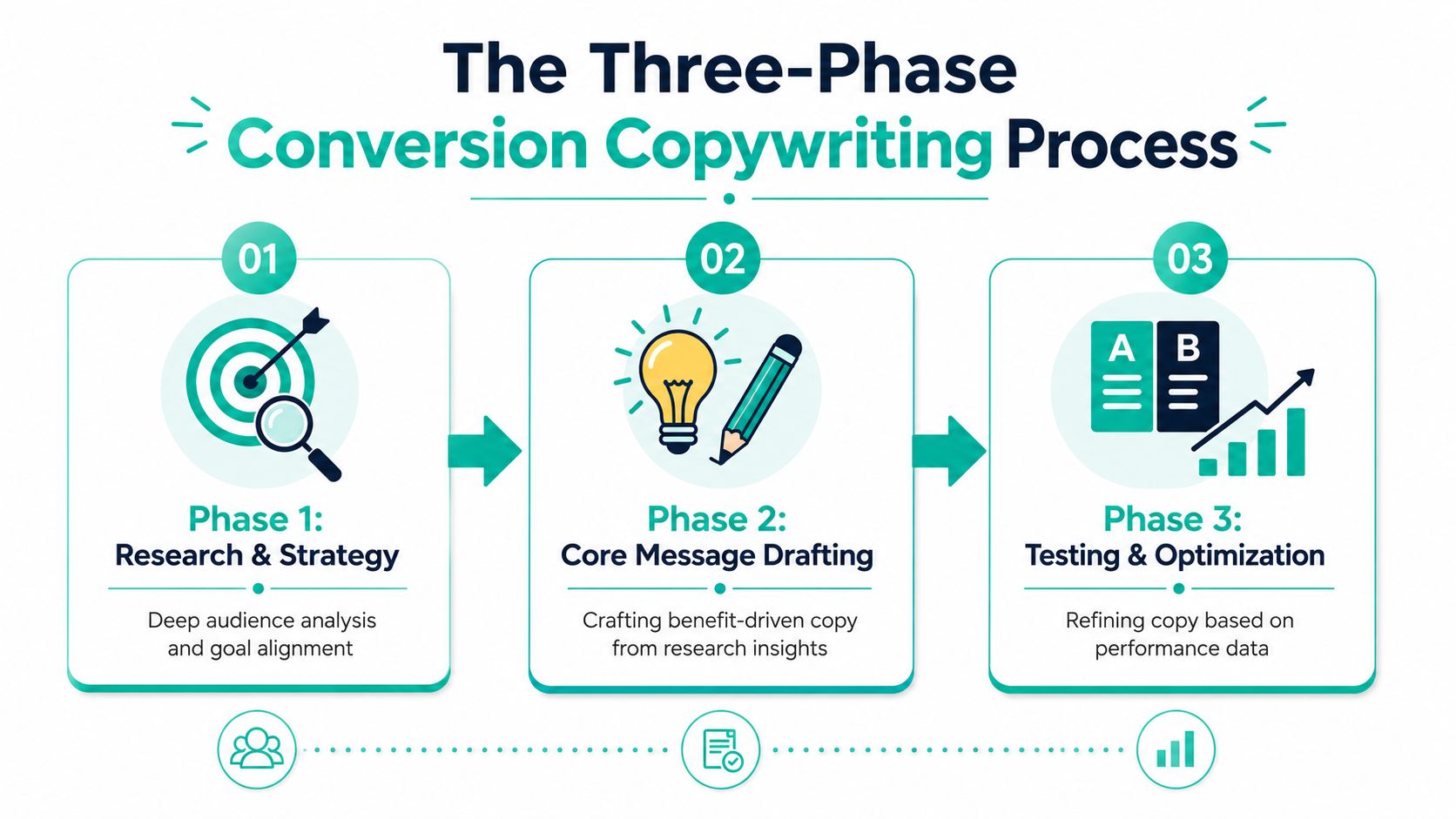
The Three-Phase Conversion Copywriting Process
Professional conversion copywriting follows a sequence, and skipping a phase usually shows up in the final page. The process is research and strategy, writing and wireframing, then testing and editing. That separation matters because it keeps the work grounded in customer language instead of brand assumptions.
Research and strategy come first
The research phase is where the voice of the customer gets collected. That means reviews, intake calls, sales conversations, search queries, objections, and the exact phrases people use when they describe the problem. Good research doesn't just gather praise, it surfaces what people are worried about, what they've tried already, and what might stop them from taking action.
A useful resource on the broader mechanics of this work is what is direct response copywriting. It helps frame the difference between writing for attention and writing for action, which is useful when local businesses need copy that moves a hesitant reader forward.
Writing and wireframing turn research into page structure
Once the message is clear, the draft has to be built from the customer's language, not the agency's favorite branding phrases. That's where wireframing matters. Before full design lock-in, the copy should be reviewed in its page layout so the promise, proof, and call to action all appear in the right order.
The best local-service pages don't sound “creative” first. They sound recognizable.
For a dentist, that might mean opening with the service, the audience, and the reassurance. For a medspa, it might mean leading with the outcome and the low-friction next step. For a law firm, it might mean putting risk reduction and consultation clarity ahead of any emotional flourish.
Testing and editing close the loop
The last phase is where assumptions get challenged. Preview emails, usability checks, and quick feedback loops all help expose weak spots before launch. If people misunderstand the offer, the copy needs revision. If they hesitate at the CTA, the language or sequence may be the issue. Conversion copywriting becomes much stronger when it treats testing as part of writing, not an afterthought.
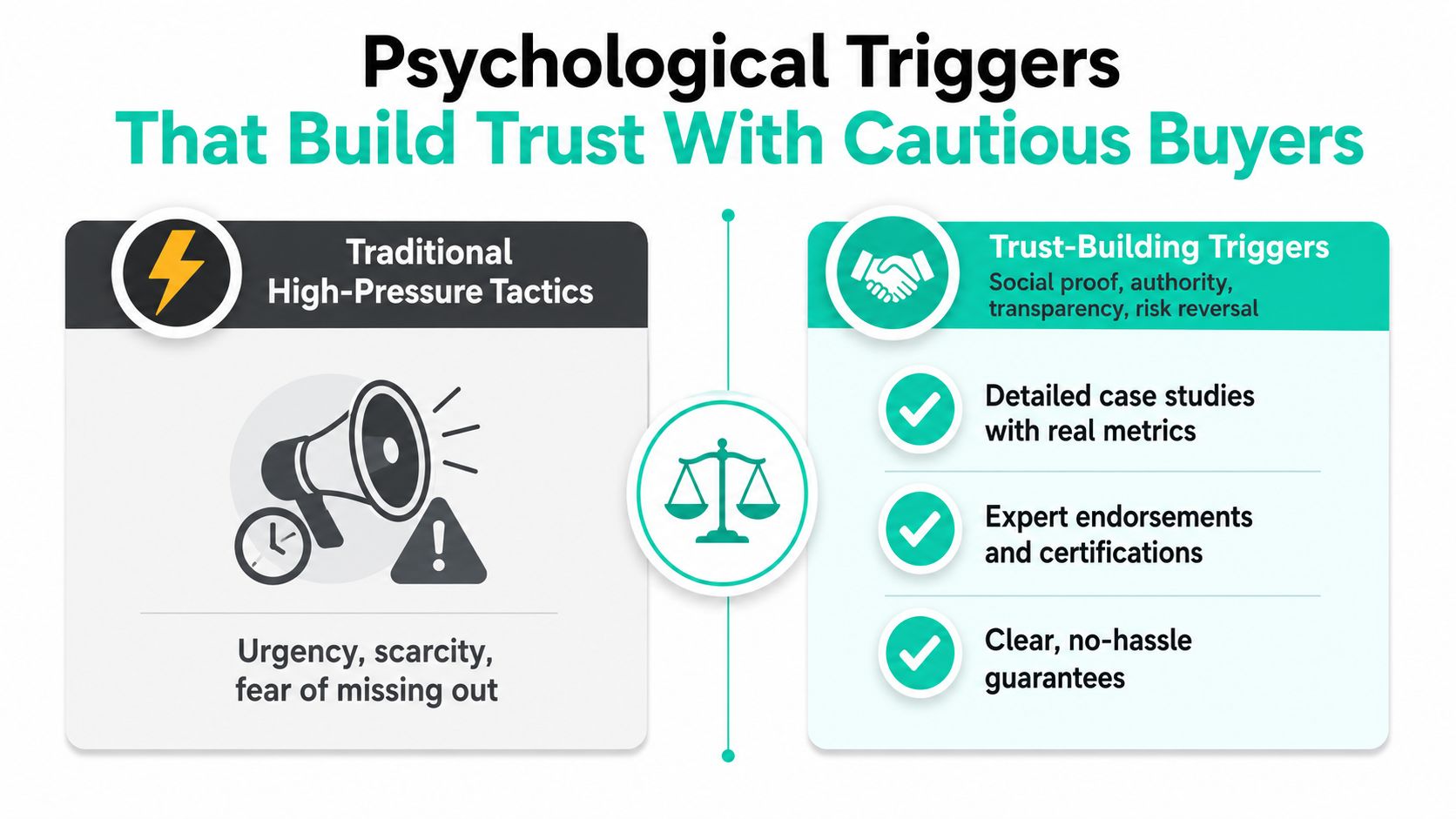
Psychological Triggers That Build Trust With Cautious Buyers
High-pressure tactics get talked about constantly, but trust-sensitive buyers usually need a different set of signals. In healthcare, legal services, and premium local service businesses, the strongest psychological triggers are the ones that lower risk and strengthen belief. Social proof, authority, transparency, and risk reversal tend to work better than forcing urgency where none exists.
What cautious buyers actually need
A skeptical visitor usually isn't asking, “Can you pressure me harder?” They're asking, “Can I trust you with this problem?” That changes the copy. Instead of pushing urgency, the page should answer the unspoken objections fast, things like competence, safety, privacy, outcomes, and whether the practice handles people like them.
Specific testimonial guidance from impactful testimonial tips is useful here because testimonials work best when they sound concrete and situational, not generic and decorative. A vague “great experience” quote doesn't do much. A testimonial that reflects a real concern, then resolves it, can do much more.
Proof has to match the level of risk
Not all proof is equal. A star rating may help at the top of the page, but a higher-consideration visitor often wants deeper reassurance. That can come from a credential, a real process explanation, a recognizable service standard, or a testimonial that shows the buyer they're in the right hands.
The practical trade-off is simple. More pressure can create more clicks in some markets, but in trust-sensitive ones it can reduce willingness to inquire. Strong copy doesn't pretend the buyer has no fear. It acknowledges the fear, then shows why acting is safe enough.
Use authority without sounding inflated
Authority works best when it's grounded in specifics. Credentials, memberships, years in practice, or a clearly described process often beat broad claims about being “leading” or “trusted.” The tone should be calm and factual. That combination tends to feel more credible than hype, especially when the audience is already cautious.
Conversion Copywriting Frameworks and Templates You Can Adapt
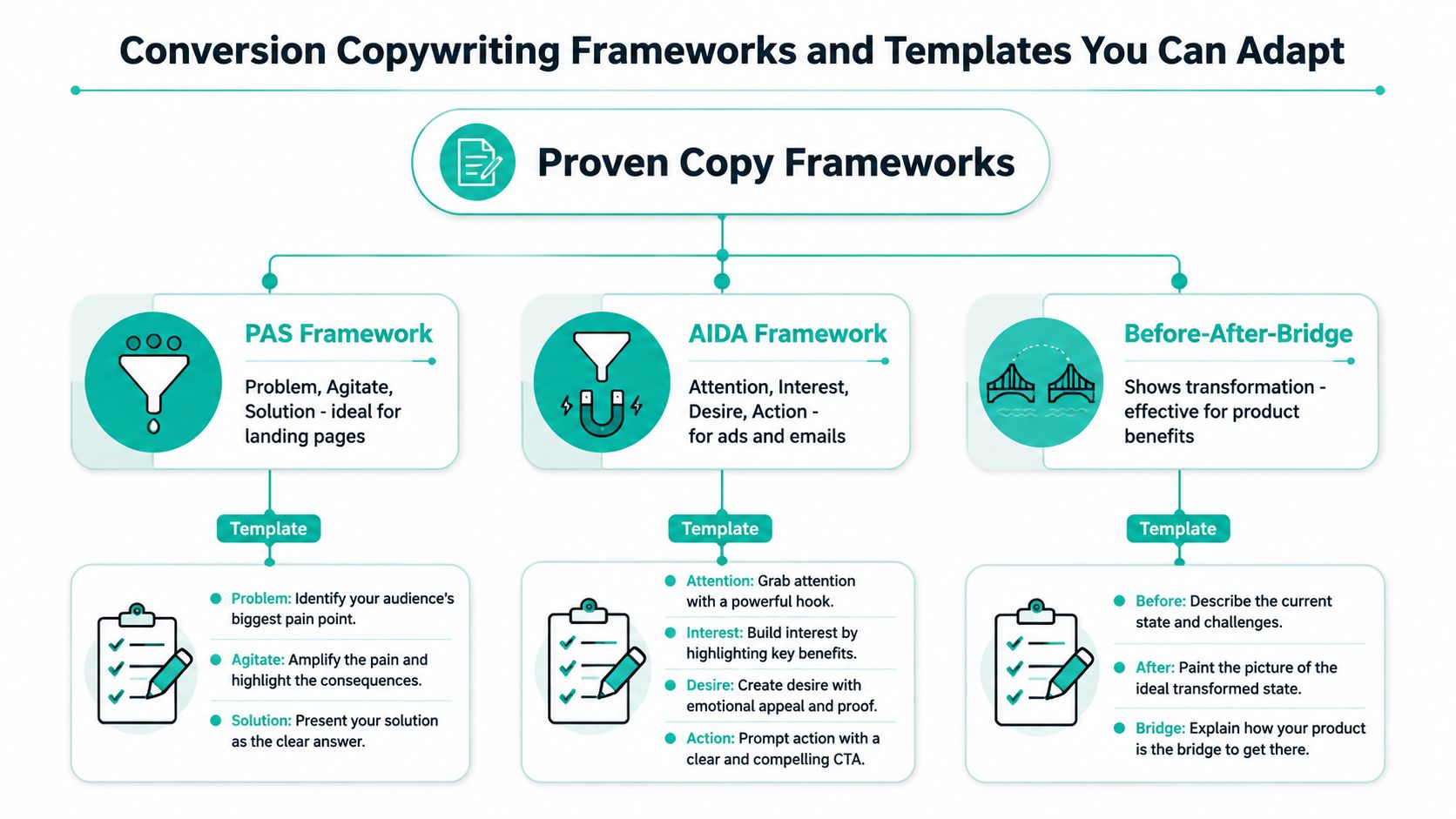
Frameworks help because they stop the page from wandering. The right structure depends on the page type and the level of intent behind the visit. PAS, AIDA, and Before-After-Bridge are all useful, but they work best when you choose them deliberately instead of forcing one template onto every situation.
PAS works well when the problem is already clear
PAS, Problem-Agitate-Solution, is a strong fit for landing pages where the reader already knows the issue and just needs to believe the practice understands it. A dental landing page might open with the problem of avoiding treatment because of anxiety, then describe what that hesitation costs in comfort or health, then show the appointment path. The key is not dramatizing the pain too much, it's showing recognition.
AIDA helps when attention needs to be earned
AIDA, Attention-Interest-Desire-Action, is useful for ads and email nurture because it guides the reader through a more gradual shift. The opening has to earn attention, the middle has to maintain interest, the desire stage should make the outcome feel concrete, and the action stage should be easy to follow. For a medspa or eye care practice, that sequence can keep the copy from jumping too quickly into the hard ask.
Before-After-Bridge is useful for transformation pages
Before-After-Bridge works well when the service delivers a visible change. Before shows the current frustration, after shows what life feels like once the problem is solved, and the bridge explains how the practice gets the reader there. This can be especially effective for consult pages because it gives the visitor a simple mental picture of the transition.
If you're building a local-service website and need to tie the structure to the broader marketing system, the service overview at Leaping Lemur Media's services is a useful reference point for how conversion-focused websites and content fit together.
Conversion Copy Examples Across Pages and Patient Journeys
A homepage and a landing page should rarely sound alike. The homepage has to serve multiple intents, while a landing page should stay focused on one offer. That's where traffic source matters. Someone coming from a branded search or referral already has more context than someone scrolling in from social media or clicking a cold ad.
Homepage copy has to triage intent
A homepage for a dental or eye care practice should help visitors self-select. That means showing the core services, the audience, and the trust markers quickly. The page isn't trying to explain everything at once, it's helping people find the right next path. A vague homepage forces visitors to do the sorting work themselves, and that's where momentum gets lost.
Landing pages need one promise and one path
A dedicated service page for teeth whitening, LASIK, or a consultation request should stay tighter. It can open with the service, clarify who it's for, and show the next step without distraction. If the visitor arrived with clear intent, the copy should honor that and keep the page simple.
For ad-driven traffic, Facebook ad copy best practices are worth studying because paid social copy has to do the first layer of filtering before the landing page even loads. If the ad and the page don't agree, the reader feels friction immediately.
Email nurture is a different kind of conversation
Email gives you more room to answer objections one at a time. A first message can establish the problem and the outcome. A second can show proof. A third can handle anxiety around cost, timing, or what the consultation involves. That kind of sequencing respects how cautious buyers decide.
The internal journal at Leaping Lemur Media's journal is the kind of place where this page-to-page thinking belongs, because the practical distinction between homepage, landing page, and email copy is what usually determines whether the reader keeps moving.
How Specificity Builds Credibility and Drives Conversions
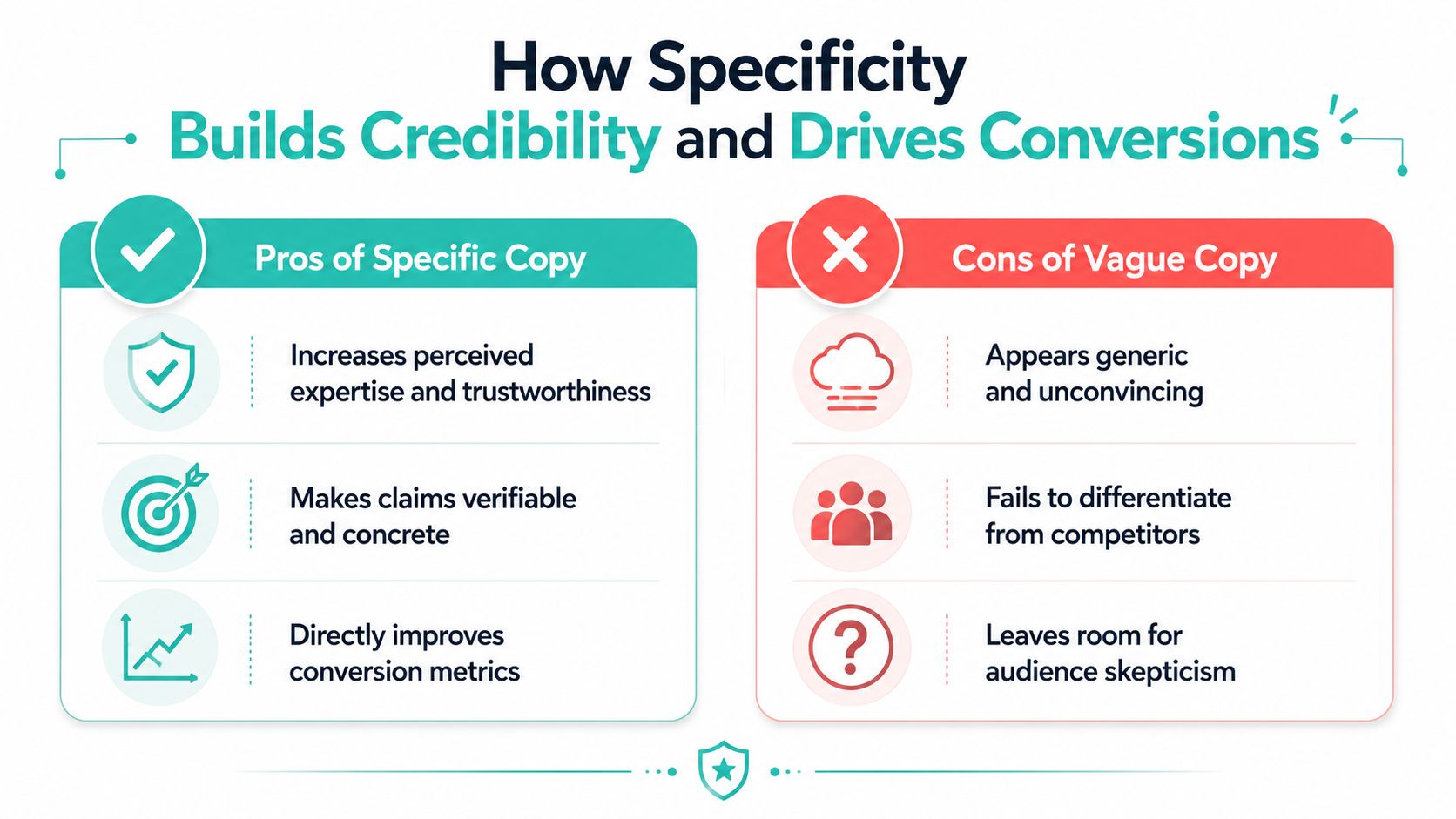
Specificity is one of the clearest credibility signals in conversion copywriting, especially for cautious buyers who are comparing a few similar options and looking for reasons to trust one practice over another. Vague promises can sound polished, but they rarely help a reader decide. Precise claims feel more grounded because they describe something concrete the business does, rather than a blanket promise that could fit anyone.
Precision changes how the claim lands
A vague line like “we help patients feel better” says almost nothing. A more specific line says what kind of help, for whom, and in what context. That matters in healthcare and local services because people are already filtering for fit, tone, and credibility before they ever book.
Specificity also matches expectations. If a dental practice says it offers same-day emergency care, or a clinic explains what happens during the first visit, the reader can picture the experience and judge whether it fits what they need. That does more than improve clarity, it lowers the sense that the page is hiding something.
Practical rule: if a claim can't be checked against reality, it usually won't build trust for long.
Specific claims need specific proof
Precise language still has to be backed by something real. ConversionBench notes that precise claims feel more credible than vague claims, and that odd or non-round numbers often read as more believable than neat, round figures because they seem less staged. The point is not to stuff copy with numbers, it is to avoid sounding like you are making things up.
A claim about a lift in results means more when the reader can see where it came from. If the source is missing, the copy invites doubt. That is a bad trade in trust-sensitive markets, because one shaky sentence can make the rest of the page feel less reliable.
Before and after language matters
A generic claim often sounds like this, “Our service improves results.” A specific, credible version sounds more like this, “Patients say the consult is easier to follow because the next steps are explained up front.” The second version is stronger because it describes a concrete change in experience, not just a promise.
That same standard applies to how a practice describes itself. Leaping Lemur Media's about page is a useful reference point if you want to see how a service-facing brand can sound clear and grounded without tipping into empty bragging.
Testing and Validating Your Conversion Copy With Real Data
Good conversion copywriting gets tested before anyone assumes it is working. CopyHackers recommends validation methods like a 5 Second Test, user-testing tools, and preview emails before launch, then revising the copy, design, or other elements based on what those checks reveal. That sequence matters because the copy should face real human reaction before the page is locked in, especially in healthcare and local service pages where cautious buyers are looking for fit, not pressure.
Start with the highest-friction element
Headlines, above-the-fold clarity, and CTAs are usually the first places to check. If the headline confuses people, the rest of the page has a harder job. If the CTA feels vague, the visitor may understand the offer and still hesitate.
A small wording change can expose a larger message problem. A practice page that sounds polished but still leaves visitors unsure about what happens next is not suffering from a button-color issue. It needs clearer expectation-matching, because trust-sensitive buyers read uncertainty as risk.
Test the message, not just the button color
A/B testing should compare meaningful differences. That can include the headline, the value proposition, the CTA language, the layout, or the visual hierarchy. The goal is to learn which version helps people understand the offer and move forward with less friction.
The fastest way to waste testing time is to change something tiny when the actual problem is the message.
Copy for cautious buyers should be tested for fit, not just clicks. In a local practice setting, urgency often backfires if the underlying concern is whether the service sounds honest, clear, and worth the visit. Testing has to show whether the page answers the visitor's unspoken questions before it asks for action.
Use the right feedback loop for the page
Preview emails can catch obvious confusion before launch. Usability checks can reveal where the eye stops or where the offer feels unclear. A/B tests can then confirm whether the revised copy drives more action. That sequence keeps the process practical and avoids guessing.
The point is to match the method to the decision. Early feedback helps you spot language that sounds broad, vague, or too salesy. Live testing then shows whether the revised copy gives cautious buyers enough clarity to take the next step without feeling pushed.
For practices that need this kind of conversion-focused execution across messaging, web, and content, Leaping Lemur Media offers services built around turning traffic into leads, customers, and revenue while keeping the message aligned with who the practice really is.
Your Conversion Copy Audit Checklist
A strong audit starts with the first screen. Ask whether the page immediately tells the right visitor, in plain language, that the offer fits their situation. If the answer is fuzzy, the copy needs clearer expectation-matching before it needs more persuasion.
Check the first screen: Does it answer who the page is for, what the service is, and why it matters now?
Review the research inputs: Did the copy pull from real customer language, objections, and questions, or just from brand positioning?
Match the trigger to the industry: Does the page lean on trust, proof, and risk reduction where pressure would feel forced?
Inspect the proof: Are testimonials, credentials, or claims specific enough to feel real and defensible?
Test the action step: Is the CTA easy to understand, low-friction, and aligned with the visitor's likely intent?
Validate before you publish: Has the copy been checked with preview feedback, usability input, or a quick test method?
The best pages move through those checks in the same order every time: research, message, proof, then validation. That sequence keeps conversion copywriting grounded in how cautious buyers decide, not how marketers wish they decided.
If your practice needs copy that sounds like you, builds trust quickly, and turns mixed-intent traffic into real inquiries, Leaping Lemur Media can help shape the message and the page around that goal. Visit Leaping Lemur Media to explore how conversion-focused strategy, web, and content support can fit your practice.