How to Improve Online Reputation for Local Practices
LLSeptember 1, 202614 min read
A prospective patient searches your practice name before they ever call. They see a few old reviews, an unanswered complaint, and a directory listing with the wrong phone number. Across town, a competitor with a slightly less polished service page looks more trustworthy because its feedback is recent and its replies feel human.
That moment is where reputation becomes revenue. How to improve online reputation isn't limited to collecting more five-star reviews. It requires a repeatable system for auditing what people see, generating honest feedback, responding with judgment, correcting listings, managing incidents, and measuring whether trust is improving.
For dentists, eye doctors, medspas, law firms, and other local practices, the first consultation often happens on a search results page. A prospective patient compares your review activity, photos, services, location, and public responses before deciding whether your office feels safe, competent, and worth contacting.
That behavior reflects a major change in how trust is formed. 88% of consumers trust online reviews as much as personal recommendations, 97% read reviews when evaluating a local business, and 41% say they always read them. Review-reading behavior rose 12 points from 29% in 2025, according to Digital Applied's 2026 consumer trust summary.
A review profile now functions like a public referral network. It doesn't replace excellent care or strong legal work, but it gives strangers evidence about how your team communicates, handles disappointment, and treats people after the appointment ends.
Reputation is an operating habit
A one-time cleanup can remove obvious errors, but it won't keep your practice credible. Reviews age, staff members change, listings drift, and a single unresolved complaint can become the first thing a searcher notices. Reputation management works better as a recurring operating habit owned by specific people, with clear response standards and a monthly review.
The practical sequence is straightforward:
Audit the visible record: Search your practice, providers, locations, and core services as a new customer would.
Repair the foundation: Correct listings, improve customer handoffs, and address recurring service issues.
Create a natural feedback loop: Ask satisfied customers at appropriate moments without scripting their opinions.
Respond with restraint: Write for future readers, protect confidentiality, and move sensitive conversations offline.
For a broader overview of service business reputation strategies, compare approaches that connect review management with customer experience and local visibility. Your own brand story and community role should remain the center of the work, which is why reviewing the perspective behind Leaping Lemur Media's approach can also help clarify what your practice wants to communicate.
Audit Where You Stand Today
Before asking for another review, see exactly what a stranger sees. Open an incognito browser, search the practice name, search the lead provider's name, and search the main services combined with the city. Don't rely on the profile you manage most often. Customers may encounter an old directory page, a social profile, or a review platform you rarely visit.
Read the page like a customer
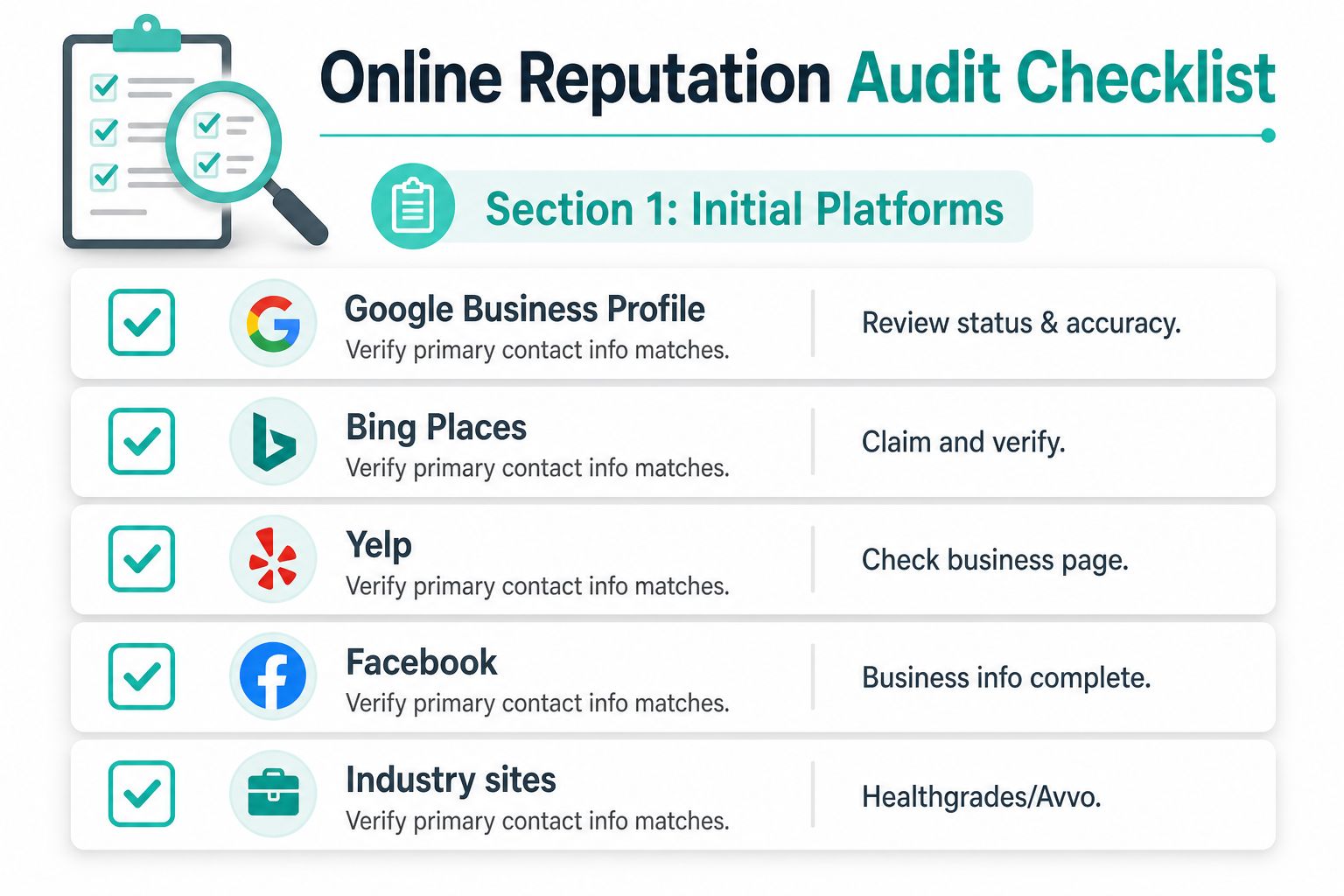
Start with the major discovery points:
Google Business Profile: Check the primary category, services, hours, phone number, address, photos, booking link, questions, and review replies.
Bing Places: Confirm that the profile is claimed, verified, and consistent with your current practice details.
Yelp and Facebook: Look for incomplete descriptions, outdated photos, duplicate pages, and messages that never received an answer.
Industry directories: Dentists and eye doctors may appear on Healthgrades-style sites, while law firms often surface on Avvo-style directories. Review every provider profile, not just the firm or office page.
Search results: Inspect the first page for branded searches, location searches, and service searches. Note which pages you control and which ones you don't.
Review dates and context, not only the average rating. 73% of consumers only trust reviews written within the last month. Reviews from 30 to 90 days are trusted by 64%, reviews from 90 to 365 days by 41%, and reviews older than one year by just 19%, according to WiserReview's review-trust roundup. A strong historical rating can still look neglected if the latest feedback is old.
Score the gaps before fixing them
Use a simple internal scorecard with categories for accuracy, freshness, responsiveness, sentiment, and search control. Mark each as strong, needs attention, or urgent. Then compare your results with two or three nearby competitors.
Look for patterns rather than isolated embarrassment. Are several people confused by parking instructions? Do reviews repeatedly mention slow callbacks? Does the competitor answer every criticism while your team answers only praise? Finish with three priorities, such as correcting the phone number, responding to unresolved complaints, and fixing a service issue that keeps generating similar feedback.
That shortlist prevents the common mistake of polishing a profile while leaving the customer experience unchanged.
Build a Review Generation System That Feels Natural
Review generation should follow the customer journey, not a calendar chosen by marketing. The best moment is usually close to a successful service milestone, while the experience is still clear. For a dental practice, that could follow a completed visit where the patient expresses satisfaction. For a law firm, it might follow a meaningful case milestone, provided the request respects confidentiality and professional rules.
Use one clear, low-pressure ask
Give the customer a direct link and permission to be honest. Don't tell them what rating to choose, don't offer language they must copy, and don't make the request feel like a condition of service.
A simple message can work:
After a successful appointment: “Thank you for visiting [Practice]. If you have a moment, we'd appreciate an honest review of your experience. You can share it here: [review link]. Your feedback helps our team improve.”
For a law firm:
After a case milestone: “Thank you for trusting our team during this stage of your matter. If you're comfortable sharing feedback, you can leave an honest review here: [review link]. Please don't include confidential details.”
Choose the channel that matches the relationship. Text can suit a practice that already communicates by text, while email may be better for a law firm handling sensitive matters. A QR code at checkout can help a medspa invite feedback without interrupting the conversation.
Route concerns before they become public
Front-desk staff shouldn't screen people for praise or block criticism. They should create a service-recovery path. Ask a neutral question such as, “How did everything feel today?” If someone raises a concern, record it in the appropriate internal system, assign an owner, and follow up privately. Invite public feedback consistently, not only from people who appear delighted.
A review program also needs a follow-up rule. Send one polite reminder if there's no action, then stop. One independent analysis associated every 10 new reviews with a 2.8% conversion lift and every 0.1-star rating increase with a 4.4% lift, while 96% of consumers read reviews before a first-time purchase and 73% trust only reviews from the last month, as reported by Street Fight's review conversion analysis.
Volume without freshness, authenticity, or response quality creates a brittle profile. Teams looking for practical content workflows can also browse the Leaping Lemur Media journal for ideas that connect customer experience with communication.
Respond to Every Review Like a Professional
A public reply has two audiences. The first is the reviewer, but the more important audience may be the many people deciding whether to contact you. They want to see whether your team is attentive, calm, and capable of handling an imperfect experience.
45.1% of consumers check for company responses to reviews, 33% trust a brand more when negative reviews receive public replies, and only 20.5% are willing to trust businesses with 100% positive reviews, according to a 2026 Forbes Council survey. A reply doesn't erase criticism. It shows how the practice behaves when criticism arrives.
Write for the next reader
Keep replies specific enough to sound human, but general enough to protect privacy. Don't confirm that someone was a patient, reveal treatment details, discuss a legal matter, or argue over a timeline in public.
Review Situation
Response Goal
Template Framework
Glowing five-star review
Thank the person and reinforce the experience
“Thank you for sharing this, [Name]. We're glad our team made [general service quality] feel straightforward. We'll share your kind words with the team.”
Mixed three-star review
Acknowledge the positive and address the shortfall
“Thank you for the thoughtful feedback, [Name]. We're pleased that [positive point] helped, and we're sorry [specific concern] fell short. We'd appreciate the chance to learn more privately at [contact route].”
Angry one-star review
Lower the temperature and offer a clear next step
“We're sorry this experience left you frustrated. We take concerns about [general issue] seriously and would like to understand what happened. Please contact [role or office] at [private contact route] so we can review it with you.”
Set a response standard
Assign review monitoring to a person, not a vague team inbox. Use a response SLA that matches your staffing and risk level, then escalate medical, legal, safety, discrimination, privacy, or harassment concerns to the right leader before posting.
Never copy and paste the same generic response across every platform. A short reply that references the actual concern is more credible than a long paragraph full of corporate language. If the reviewer responds angrily, don't conduct a debate in the thread. Restate the private contact path once, preserve the record, and let the public exchange end.
Public reply rule: Explain your standard of care, not the customer's private story.
Strengthen Local SEO and Control Your Search Results
Reputation and local search reinforce each other, but reviews aren't the entire search presence. Your practice also needs accurate listings, useful pages, consistent provider information, and a steady stream of legitimate content that helps searchers understand what you do.
Start with the channels customers trust
Platform choice should follow customer behavior, not the number of profiles your team can create. 71% of consumers trust Google reviews, followed by Trustpilot at 58%, TripAdvisor at 54%, Amazon at 49%, Yelp at 38% among U.S. under-35 respondents, and Facebook recommendations at 31%, according to BGR Review's consumer-trust survey.
For a local dentist or eye doctor, Google may deserve the most operational attention because it connects discovery, maps, hours, photos, and reviews. A law firm might also need careful work on legal directories, while a medspa should maintain the channels its local audience uses. Claiming every possible listing can spread a small team too thin.
Correct the basics first:
Name, address, and phone: Use the same core information across the website and directories.
Categories and services: Match categories to the actual practice, then describe services in plain language.
Hours and booking paths: Update holiday hours, appointment links, and location details promptly.
Images and updates: Show the current environment, team, and services without making misleading promises.
Build assets that deserve to rank
Create service pages that answer real questions, provider bios that establish experience without inflated claims, and location pages that help people decide whether the office is convenient. Publish useful explanations about preparation, recovery, costs where appropriate, and what a first visit involves. For a law firm, that might mean educational pages that explain process and next steps without promising outcomes.
Local involvement can create authentic search assets too. Community sponsorships, local news contributions, event participation, and expert commentary can produce mentions that your practice doesn't fully control but can support. Content should never be manufactured solely to bury a complaint. It should make the page-one results more complete and more useful.
For teams focused on patient discovery, resources on how to attract local patients with SEO can provide a useful comparison of local search priorities. A practice may also need coordinated messaging, content, and design support, which are among the services outlined by Leaping Lemur Media.
Handle Negative Reviews and Reputation Crises Without Panic
A bad review is not automatically a crisis. Treating every criticism like an emergency can lead to rushed replies, questionable removal requests, or a flood of unnatural review asks that makes the profile look less credible.
Triage the incident
Use this sequence when a negative review appears:
Verify the situation. Check whether the reviewer appears to be a real customer and whether the complaint can be matched to an internal event. Don't expose private details while investigating.
Respond once publicly. Acknowledge the frustration, apologize for the experience where appropriate, and avoid arguing over facts in the thread.
Move the discussion privately. Provide a named contact or direct route to someone who can investigate.
Resolve the underlying issue. Look beyond the rating. A billing error, scheduling failure, unclear expectation, or staff interaction may require operational change.
Report genuine policy violations. If the review appears fabricated, abusive, or unrelated, submit evidence through the platform's reporting process. Don't claim fraud only because the review is unfavorable.
A medspa may receive a one-star complaint after a scheduling mix-up, followed by several accounts repeating the same accusation. The owner shouldn't mobilize staff to defend the brand in every comment. The better response is to preserve screenshots, verify appointment records, publish one calm statement, contact affected customers directly, correct the scheduling problem, and monitor whether the conversation is spreading beyond the original platform.
Know when to escalate
A genuine crisis may involve a news story, a viral complaint, a safety allegation, a sudden rating collapse, or repeated reports of the same failure. At that point, pause ordinary promotional activity if it would appear tone-deaf, appoint one spokesperson, involve legal or compliance advisors where needed, and prepare consistent updates for current customers.
68% of consumers are more likely to trust a business that shows both positive and negative reviews, while about 80.2% say reviews have influenced them not to purchase a product or service, according to World Metrics' online reputation data. The aim isn't to create a spotless record. It's to demonstrate that the practice recognizes problems and responds responsibly.
Measure What Matters and Keep Momentum
A star rating gives you a quick signal, not a complete diagnosis. Track review volume, average rating, response rate, customer inquiries, and search visibility together, because a practice can improve one metric while losing ground elsewhere. This measurement approach also addresses the AI-era blind spot identified in the State of ORM 2026 report, where consumers are increasingly skeptical of ratings without context.
Use a monthly dashboard
Record the current review count, average rating, newest review date, percentage of reviews receiving replies, branded search observations, and inquiries that mention reviews or search results. Add a short qualitative note about recurring complaints and compliments. Don't chase a dramatic overnight change. Look for healthier patterns, such as newer feedback, more complete responses, fewer repeated service complaints, and better alignment between listings.
If people discuss your practice outside review platforms, learn how to track brand mentions so you can spot conversations that a standard review dashboard may miss.
A practical 90-day rhythm
Days 1 to 30: Complete the audit, correct priority listings, assign review ownership, and create response templates.
Days 31 to 60: Launch the post-service review workflow, train the front desk on service recovery, and publish or refresh useful service pages.
Days 61 to 90: Compare the dashboard with the baseline, review recurring complaints with staff, strengthen the channels customers use, and document a crisis escalation plan.
Small, consistent actions compound because they improve both what customers experience and what future customers can verify.
Leaping Lemur Media can help your practice connect reputation management with local SEO, content, social response workflows, and a brand presence that sounds like you. Visit Leaping Lemur Media to discuss a practical plan for earning trust and showing up clearly in your community.