Only 4% of new law firm business is won on price, while 66% comes from reputation and trust, including existing clients, recommendations, and the perceived character of the firm, according to Lawnet's summary of client selection research. That should change how you think about law firm brand positioning.
Your brand isn't your logo, website colors, or tagline. It's the reason a specific client believes your firm understands their problem, can reduce their risk, and is safer to hire than the alternatives. In 2026, that reason must be clear to human buyers, referral sources, review readers, and AI systems summarizing legal options.
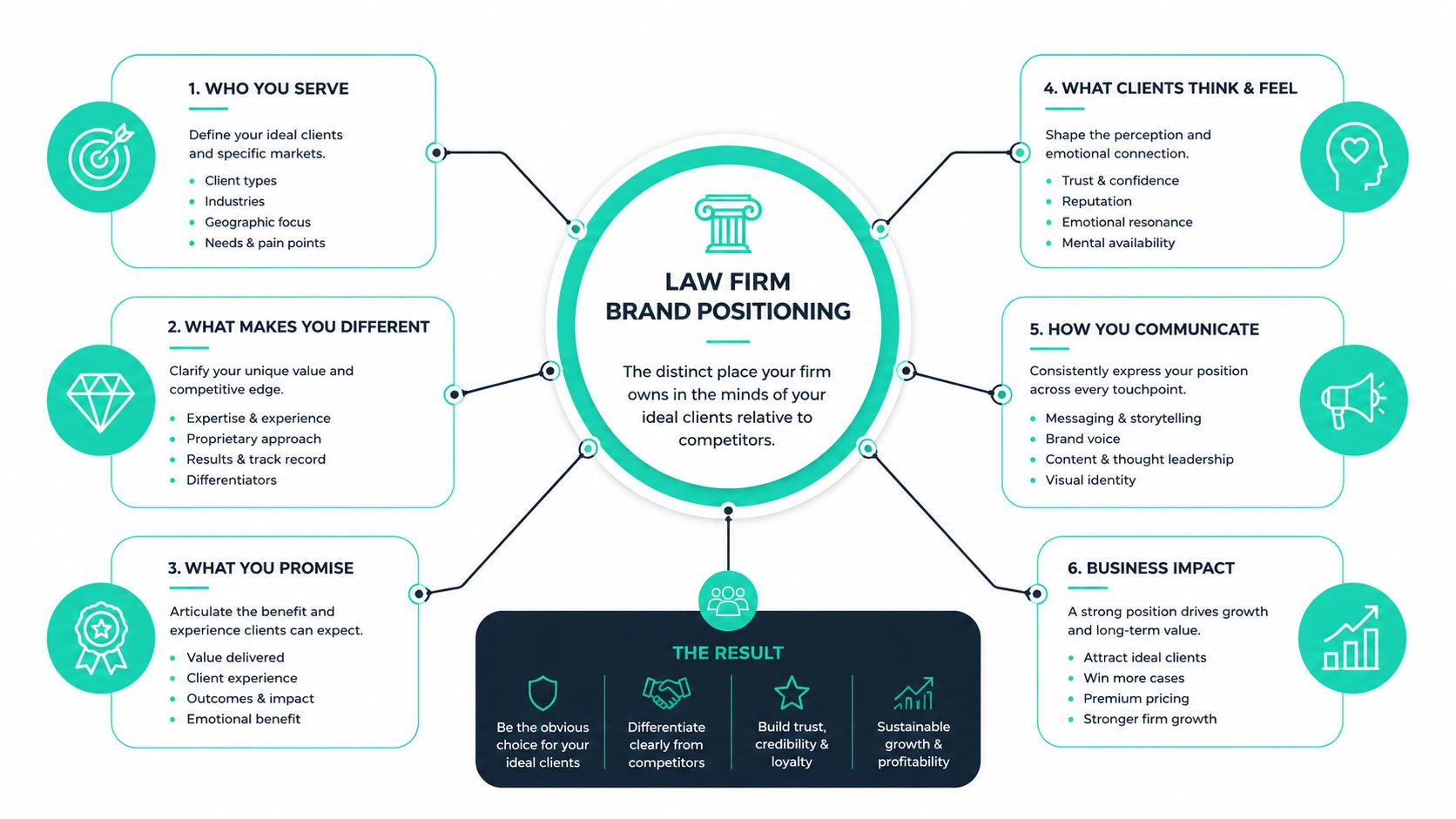
Law firm brand positioning is the deliberate definition of why a specific client should choose your firm. It turns expertise, reputation, clarity, and client experience into one recognizable market signal.
The commercial case is straightforward. In the UK Legal Services Consumer Panel's 2025 tracker, 90% of consumers said regulation would increase trust in a legal professional, 89% said specialization would, and 88% said clear explanations would. The same tracker found that 75% trust lawyers generally to tell the truth. The Solicitors Regulation Authority's summary of the tracker shows why positioning can't stop at visual polish. Buyers want evidence that you're credible, specialized, and able to communicate without making a stressful situation harder.
A positioned firm connects four elements:
A high-stakes client problem, such as a restrictive-covenant dispute threatening a company's sales team.
A focused capability, such as management-side employment litigation for technology businesses.
Proof, including relevant experience, credentials, reviews, published insight, and a credible process.
A recognizable way of working, such as rapid response, commercial advice, plain-English explanations, or predictable access.
Practical rule: If your position doesn't help a prospect recognize their own problem, it isn't doing enough work.
“Full-service law firm committed to excellence” fails because almost any firm can say it. “Rapid, business-focused employment counsel for growing technology companies” gives a buyer a reason to continue. The second statement identifies the audience, problem context, service focus, and operating style. The rest of the website should then prove it.
Your homepage, lawyer biographies, practice pages, reviews, proposals, intake scripts, and social profiles should reinforce the same position. The Living Ratings of Law Firms 2025 evidence shows the gap many firms still have to close: 48% stated brand positioning on the homepage, 55% included brand or core values, and only 34% used a distinctive visual language. More important, just 12% offered high-quality lawyer bios and 15% had an engaging people landing page. Strong positioning therefore starts with substance, then uses design to make that substance easier to recognize.
Firms that want a practical overview of the trust signals behind a credible identity can build trust with law firm branding. Your own review should also include whether the firm's public message matches the experience delivered after a prospect submits an inquiry. The approach outlined by Leaping Lemur Media is useful here, because positioning should connect who you are, whom you serve, and how your firm shows up.
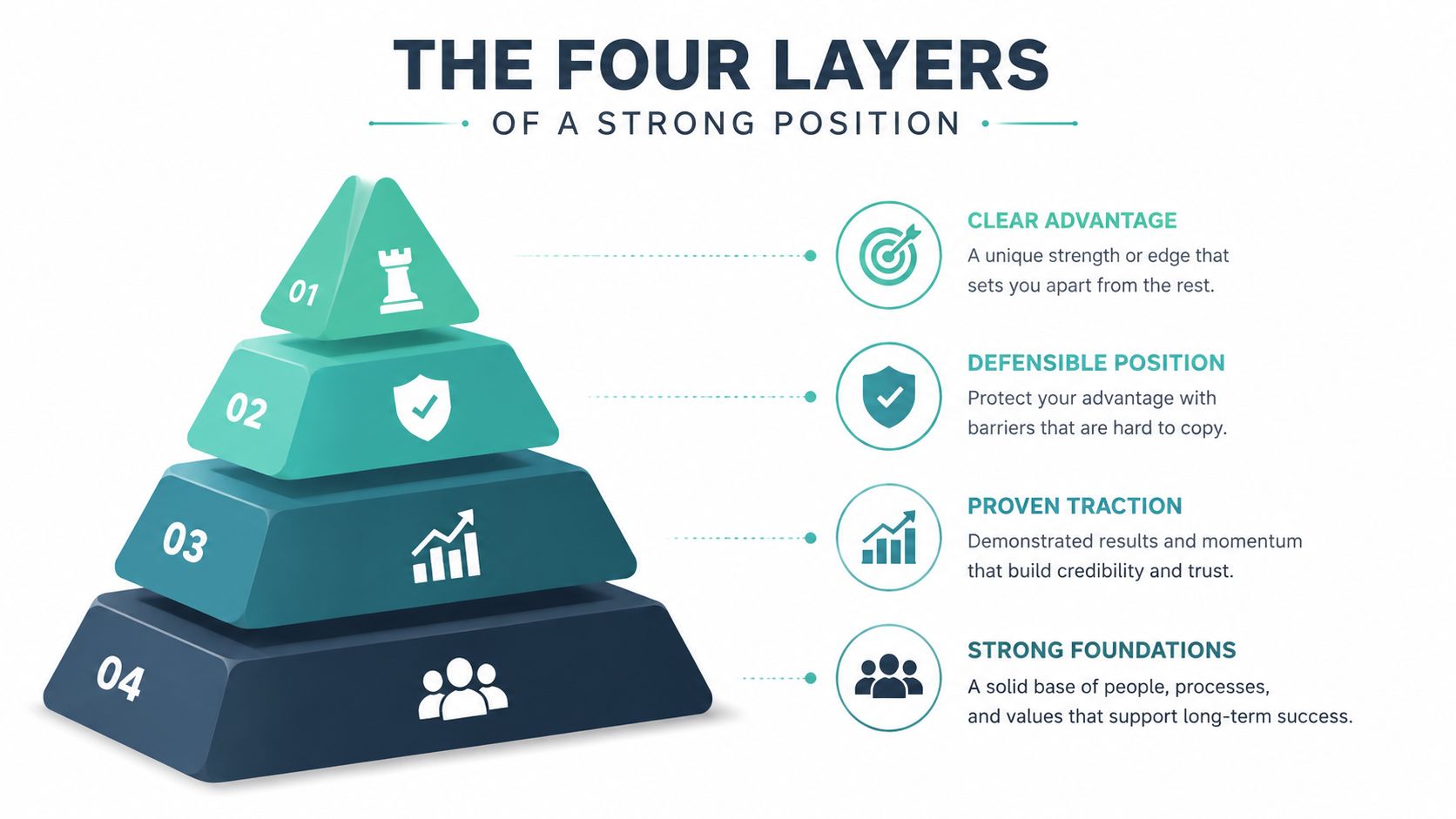
The Four Layers of a Strong Position
A defensible law firm position rests on audience, specialization, proof, and voice. Remove one layer and recognition weakens, regardless of how polished the website looks. In 2026, that structure matters even more as AI-driven discovery increasingly connects legal buyers with firms through described expertise, client evidence, and consistent signals rather than visual design alone.
A firm that owns a position builds it the way Northstar Counsel did, starting with a narrow audience and stacking each layer on top. The hypothetical firm serves middle-market logistics companies, focusing on owners and operators facing employment disputes. Its specialization is management-side employment and restrictive-covenant litigation. Its proof includes transportation-industry experience, emergency-injunction work, and reviews describing rapid response. Its voice is direct, commercially literate, and calm under pressure.
Each layer strengthens the next.
Audience comes before adjectives
Northstar is addressing operators who need counsel when an employee departure, hiring restriction, or confidential-information issue threatens the business. That choice controls the examples, terminology, calls to action, and referral relationships the firm should prioritize.
“Business litigation” names a category. “Management-side restrictive-covenant litigation for logistics companies” establishes a market position. The Canadian Bar Association's differentiation framework says an effective position should be valuable, credible, sustainable, compelling, hard to copy, and narrowly focused. It also warns that an unbelievable claim can damage a brand more than silence.
Altman Weil's differentiation model identifies industry expertise, technical legal expertise, service delivery capability, client relationship management, and cost or value as possible dimensions. Use that test to identify the capability buyers value. Confident wording is not differentiation.
Proof turns a promise into a reason to hire
Northstar's proof is industry familiarity, relevant matter experience, and reviews describing its response style. Place each proof point beside the claim it supports. Awards hidden in an archive do little for a buyer or an AI system evaluating whether the position is credible.
Voice makes the position recognizable
A calm, commercially literate voice fits operators managing business risk. A theatrical or overly aggressive voice would undermine that promise. For guidance on maintaining consistent language across channels, see RedactAI on brand consistency.
Drop proof and the position becomes a slogan. Drop the audience and employment counsel becomes generic. Drop voice and the firm sounds interchangeable. Test every proposed position against all four layers before publishing it.
Choosing Your Positioning Vector
Most firms should choose one primary positioning vector and use the others as supporting qualifiers. Trying to lead with practice area, industry, geography, client type, and service model at the same time usually produces a sentence no one remembers.
Positioning vector
Best suited for
Primary risk
Practice area
Firms with concentrated technical expertise
Competitors can use the same category language
Industry
Firms with deep sector knowledge and recurring industry matters
The claim feels unsupported if the team lacks sector-specific proof
Geography
Firms whose value depends on local courts, regulators, or relationships
A shared geographic boundary rarely creates enough distinction
Client type
Firms serving a clearly defined buyer, such as founders or employers
The audience may be clear while the legal capability remains vague
Service model
Firms with a real process advantage, such as fixed-fee or rapid-response support
The promise fails if intake and delivery can't consistently support it
A boutique employee-benefits firm serving multistate employers may lead with practice area, then add its client type and regulatory complexity. A construction firm that understands project delivery, contract administration, and contractor relationships may lead with industry. A local criminal defense practice may rely on geography when courthouse familiarity and regional procedure matter.
Service model positioning deserves scrutiny. “Accessible counsel” means little unless the firm can explain how clients access counsel, who responds, and what happens after intake. “Fixed-fee advice for early-stage companies” is stronger only when the scope, exclusions, and delivery process are real.
Ask three questions:
Where does the firm have disproportionate evidence?
Which buyers feel the problem most acutely?
Which claims would competitors struggle to copy quickly?
The Canadian Bar Association's framework supports this narrow approach. A position needs credibility and sustainability, not just appeal. A firm with many matters across a small group of industries may own an industry position. A lawyer with unusual technical depth may lead with practice area. A firm competing on predictability should build around service delivery, but only if operations can prove the promise.
Use the vector that makes your strongest evidence easiest to understand. The others should clarify it, not compete with it.
Positioning Statement Examples by Practice Area
A good positioning statement isn't a slogan. It's a compact decision tool. Each word should identify a buyer, sharpen the problem, establish the capability, or signal a credible experience.
Boutique employment firm
“For growing technology companies facing sensitive employee disputes, Brightline Employment Law provides fast, management-side counsel grounded in practical business advice.”
“Growing technology companies” identifies the buyer and industry.
“Sensitive employee disputes” names the context without pretending every employment matter is identical.
“Fast” signals the service model, but the firm must be able to support it operationally.
“Practical business advice” sets the voice and expected experience.
Remove the audience and the statement becomes generic employment marketing. Remove “management-side” and the firm loses a valuable expertise signal. Remove the service promise and the position becomes technically accurate but less memorable.
Mid-market M&A practice
“We guide privately held industrial businesses through complex acquisitions with disciplined diligence, clear negotiation, and partner-led execution.”
“Privately held industrial businesses” narrows the market. “Complex acquisitions” identifies the matter type. “Disciplined diligence” and “clear negotiation” describe the approach, while “partner-led execution” gives the buyer a service expectation that can be tested during intake and the transaction.
This statement doesn't claim superior outcomes or invent a transaction record. The proof should appear elsewhere, through relevant deal experience, attorney biographies, client feedback where permitted, and explanations of how the team works.
Family law practice
“We help parents through high-conflict divorce and custody matters with clear guidance, steady advocacy, and a process that keeps decisions understandable.”
The audience is parents. The specialization is high-conflict divorce and custody. “Clear guidance” and “steady advocacy” shape the voice, while the final phrase addresses a client fear: feeling lost inside a complicated process.
The reusable structure is:
For [specific client] facing [specific problem], [firm name] delivers [specific outcome] backed by [proof], with [distinctive approach].
Draft several versions, then test them against actual inquiries and referral conversations. Resources such as Leaping Lemur Media's journal can help your team think about the connection between positioning, content, and audience understanding. Keep the final statement honest. Under legal advertising rules, a memorable claim still needs to be accurate and nonmisleading.
Common Positioning Mistakes Law Firms Make
Most firms don't have a visibility problem first. They have a meaning problem. Prospects see the firm, but can't tell why it belongs on their shortlist.
Weak Position
Why It Fails
Stronger Alternative
“We provide excellent service”
Every firm can say it, and the claim supplies no evidence
Describe the service behavior, such as direct partner access or plain-English matter updates
“A respected firm serving clients for generations”
Age and size may build context, but they don't identify relevance
Connect experience to a defined client problem and practice capability
“Aggressive advocates and trusted advisors”
Familiar legal clichés blur together
Name the matter type, client group, and distinctive method
“We handle all your legal needs”
Broad coverage makes expertise difficult to recognize
Choose a priority audience and lead with the service it needs most
Keyword-stuffed practice copy
Search terms don't explain why a buyer should trust the firm
Write for a defined client, then organize pages around real questions
The five failures behind generic copy
Unproved quality claims are the easiest to remove. Replace “excellent service” with observable behavior: who answers inquiries, how the team explains risk, and what clients can expect during the matter. If you say clients value responsiveness, support that message with permissible reviews or a clearly described process.
Age and size claims can help a buyer understand scale, but they aren't differentiation by themselves. A large firm can still sound interchangeable with every other large firm. Lead with the capability that scale makes possible, not scale alone.
Competitor mimicry creates category sameness. If three firms use “strategic,” “results-driven,” and “client-focused,” adding those words to your homepage won't make you distinctive. Study competitors to identify gaps, not phrases to copy.
Everything-for-everyone positioning forces every buyer to decode your relevance. A firm can retain broad capability while presenting a focused front door.
Keyword stuffing confuses search optimization with positioning. AI systems and human buyers both need coherent patterns, not repeated practice-area labels.
The litmus test is simple: Could the position appear on a competitor's website after swapping the firm name? If yes, keep working.
How Positioning Shows Up in AI Search and Reviews
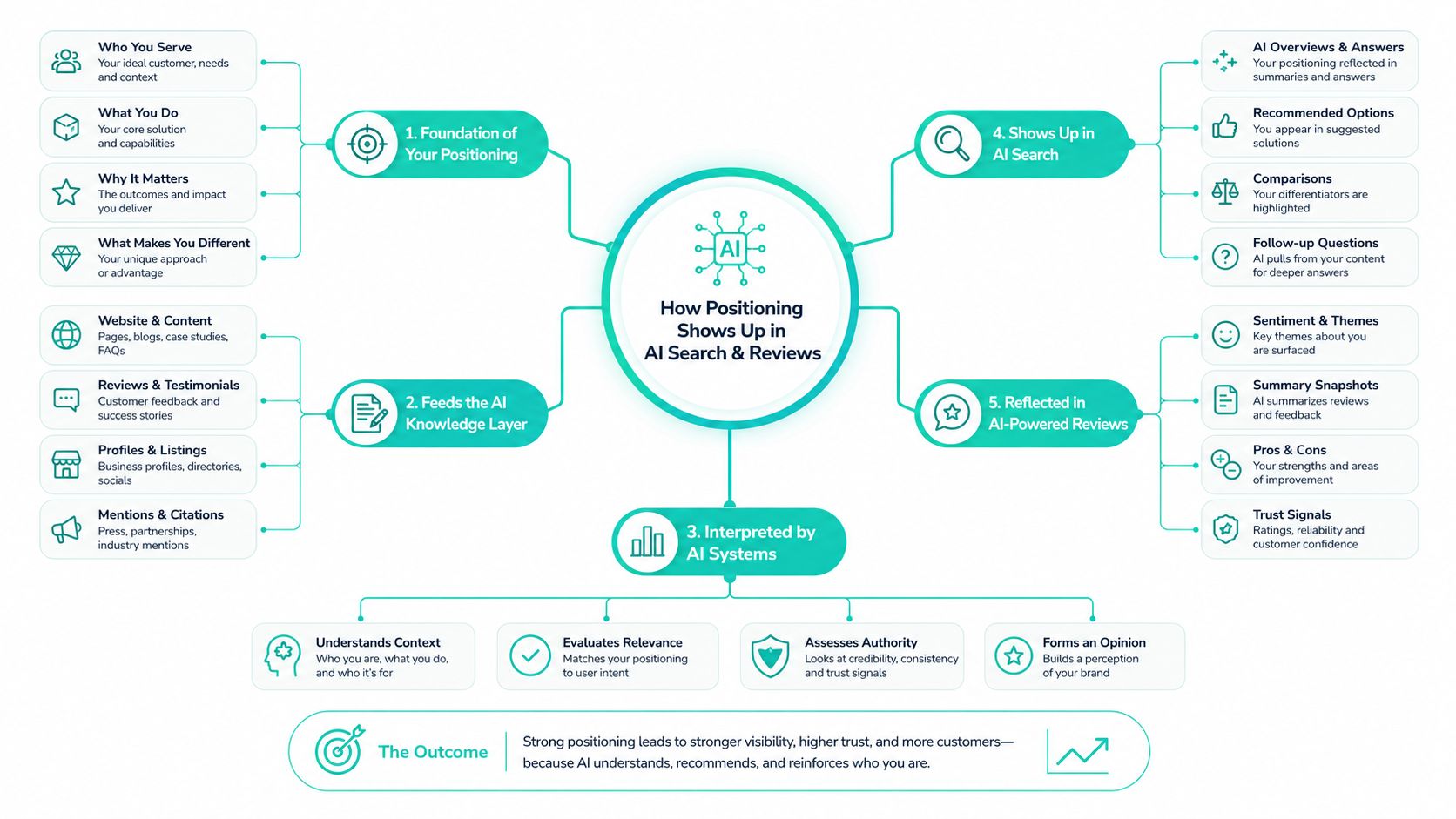
AI-mediated discovery changes what a law firm must make legible. A prospect may ask ChatGPT, Perplexity, or Google's AI-powered search for a lawyer with experience in a particular matter, industry, or location. The system then forms an answer from available signals, including attorney biographies, practice descriptions, reviews, published content, and external references.
A generic firm leaves those signals disconnected. One page says “business law,” another says “litigation,” a biography lists every possible service, and reviews praise kindness without mentioning the problems the firm solves. An AI summary may then describe the firm accurately but generically, which is a visibility failure even if the firm appears in the answer.
Audit the story machines can find
Start with target questions, not just keywords. Ask how AI systems describe your firm when a buyer searches for a lawyer serving your intended client type, handling your priority matter, or offering your chosen service model. Record what appears, what gets omitted, and which competitors receive clearer descriptions.
Then inspect the inputs:
Attorney bios: Do they identify relevant matter types, industries, and experience in language a buyer understands?
Practice pages: Do they explain the client problem, decision risks, process, and evidence?
Reviews: Do permitted reviews describe the firm's expertise, communication, and handling of similar matters?
External mentions: Do professional profiles, directories, publications, and referral sources use consistent language?
Thought leadership: Do attorneys repeatedly explain the issues associated with the position they want to own?
This isn't a request to manipulate AI systems. It's a demand for consistency and evidence. A firm that wants to be recognized for healthcare regulatory work needs authoritative pages, bios, and commentary that make that connection explicit.
For a deeper treatment of definitive AI search for law firms, focus on the underlying principle rather than chasing a new acronym. Make expertise specific, repeat the same legitimate associations across trustworthy sources, and keep every claim reviewable.
Leaping Lemur Media's services can support this kind of coordinated work across brand strategy, messaging, content, and search visibility. The operational implication is clear: in 2026, positioning is also a training-data decision. Every public description contributes to the pattern that people and AI systems use to understand your firm.
Measuring Whether Your Position Is Working
Most firms don't measure positioning. They redesign the website, change the colors, and revisit the brand later without identifying whether the failure was audience, proof, message, intake, or delivery.
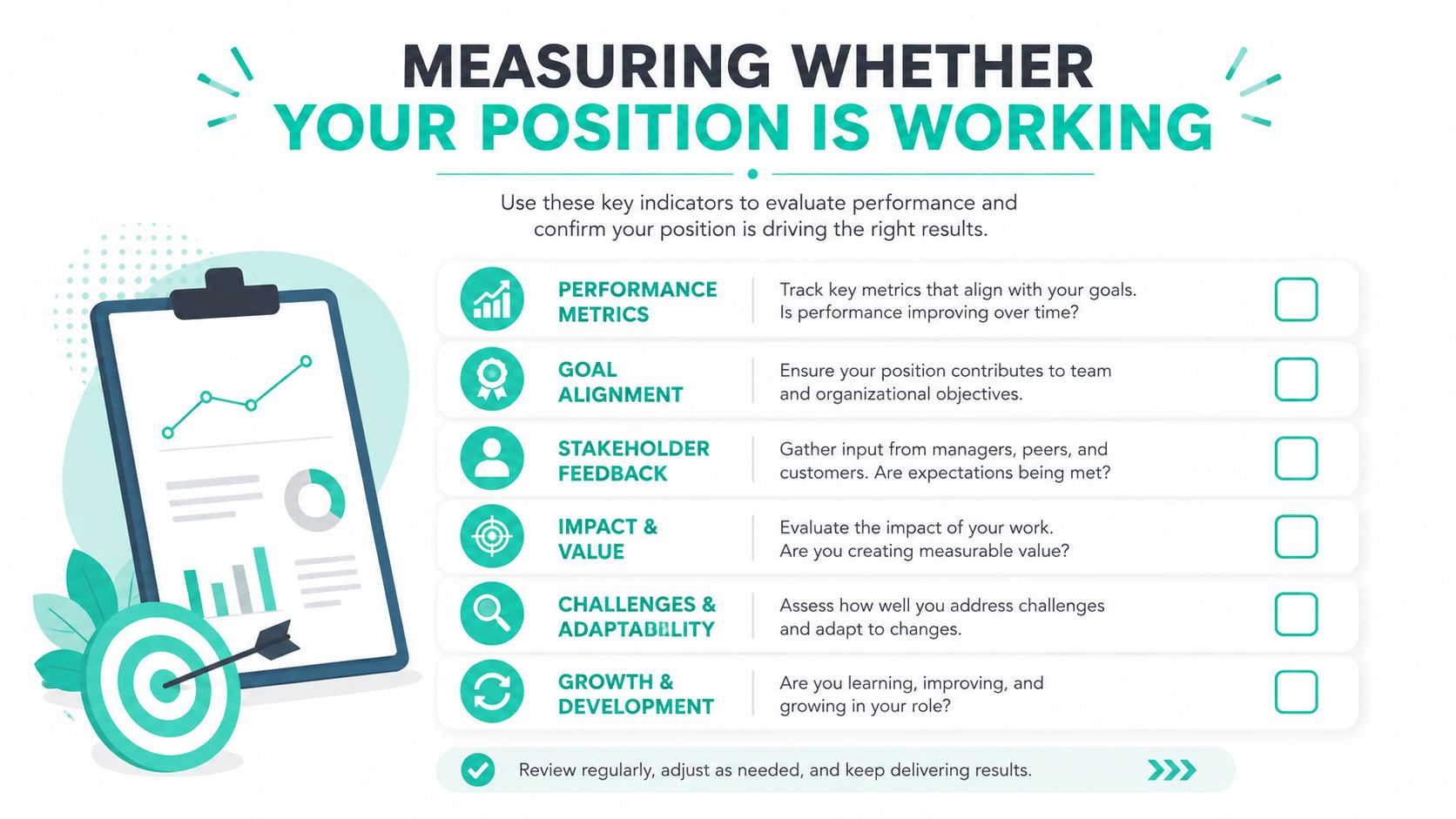
Measure behavior instead of aesthetic approval. A position is working when the right people recognize it, repeat it, and act on it.
Use a practical scorecard
Referral mix: Review your CRM and intake records for the types of clients and matters entering through referrals. Movement toward the audience named in your position is a meaningful signal. Review the mix monthly, and record both the source and the reason the referring person chose the firm.
Consultation conversion: Compare qualified inquiries with booked consultations and retained matters. Pull the data from your intake system, then review it monthly by landing page, referral source, practice area, and stated client problem. If the intended audience is visiting but not booking, your message may be clear while your proof or intake experience is weak.
Review velocity and topical alignment: Monitor new Google and Avvo reviews for recurring language about the capabilities you want associated with the firm. Review monthly, subject to applicable ethics rules and platform policies. Don't pressure clients to use particular wording. Look for authentic patterns that show whether the delivered experience matches the position.
AI-overview citations: Run a defined set of target queries on a regular schedule and record whether your firm appears, how it is described, and which pages or sources are cited. Review quarterly because AI-generated results can vary. Treat absence as a diagnostic signal, not proof that a tactic has failed.
Before changing the position, ask: Which signal is weakest right now, recognition, trust, qualified intake, or delivery consistency? Fix that layer first. A new tagline won't solve an intake problem, and more traffic won't solve an unconvincing proof problem.
Leaping Lemur Media offers brand strategy, positioning, messaging, content, and search support that helps law firms clarify who they serve and why clients should choose them. Visit Leaping Lemur Media to discuss a defensible position you can put into practice this quarter.