
The most popular advice about small business marketing packages is also the least useful: pick Starter, Growth, or Scale, then trust the agency to make the tier work. That model makes the sales conversation easy, but it often ignores the questions that determine whether marketing will produce qualified leads, usable data, and a sustainable relationship.
A package should match your growth stage, cash flow, service economics, local competition, and ability to follow up with leads. A dentist, medspa, eye doctor, and law firm may all need SEO and paid search, but they don't need the same message, conversion path, compliance review, or reporting. The buying decision happens after the sales call, when you're reading the proposal and deciding whether the promise is specific enough to test.
Table of Contents
- Why Most Small Business Marketing Packages Fail Before Month Six
- The Core Components Inside Every Small Business Marketing Package
- How Pricing Models Work Under the Hood
- Comparing Common Package Tiers and What They Really Get You
- Eight Red Flags That Predict You Will Leave Within a Year
- A Decision Checklist for Dentists, Medspas, Eye Doctors, and Law Firms
- Your 90-Day Package Evaluation Framework
Why Most Small Business Marketing Packages Fail Before Month Six
The familiar three-tier package is built around an agency's sales process, not necessarily your business. “Starter” means fewer deliverables, “Growth” adds channels, and “Dominator” adds activity. Those labels say little about whether the offer matches your current demand, internal capacity, or revenue target.
A polished proposal can still be a poor investment. A law firm may purchase content before fixing intake tracking. A dentist may pay for social media while local search and appointment conversion remain weak. A medspa may receive frequent posts without a clear offer, booking path, or way to measure consultations.
The retention problem appears in outsourcing data. 52% of SMB owners say they outsource at least some marketing, while 40% of SMBs that outsource to an agency churn, and more than half of that churn happens within 6–12 months (MarketingProfs data on agency churn). These figures point to a practical problem: many small businesses buy packages they cannot evaluate, operate, or afford at their current stage.
The proposal is where the mistake becomes expensive
After the sales call, an owner often remembers the promised outcome rather than the conditions behind it. “More patients” or “more cases” sounds specific until the proposal identifies the responsible channel, defines a qualified lead, assigns tracking ownership, and sets a review date.
A year-long contract makes a vague plan harder to correct. The agency can stay busy completing deliverables while the owner waits for results that were never defined. By the time dissatisfaction is clear, the relationship may be nearing the six-to-twelve-month exit window reflected in the cited data.
The decision moment is the proposal review. Test it before signing.
Practical rule: Never approve a package because the deliverable list looks full. Approve it only when the proposal connects each activity to a measurable business action.
Ask for a 90-day test plan. It should state the starting baseline, the actions the agency will complete, the conversion event being tracked, and the evidence that would justify continuing. A dentist might track booked appointments, a medspa consultations, and a law firm qualified intake calls. The exact action depends on the business, but the proposal must name it.
The final question is simple: What would prove this package is working before renewal becomes the default? If the agency cannot answer in plain language, the tier is organized around production volume instead of your growth stage.
The Core Components Inside Every Small Business Marketing Package
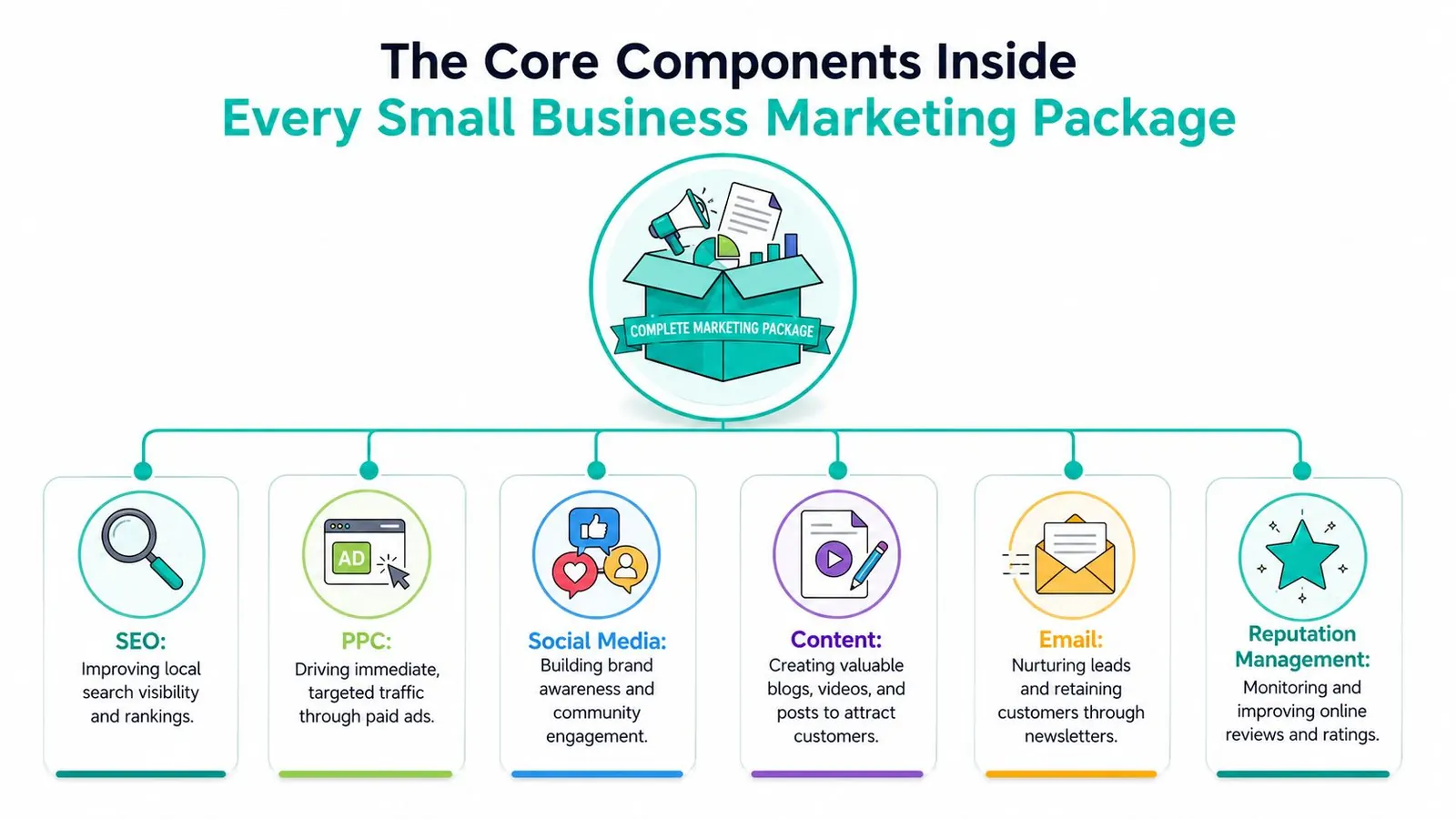
A credible package usually combines visibility, demand capture, trust, conversion, and retention. The individual services matter, but their job matters more. A blog post, review response, or ad variation has value only when it supports the path from discovery to inquiry, consultation, appointment, or signed case.
Start with local visibility
SEO should improve how a local business appears for relevant services. For a dentist, that may mean service pages, location signals, technical health, and a Google Business Profile that supports appointment intent. For a medspa, it may involve treatment pages, practitioner credibility, location relevance, and content that answers questions before a consultation.
Technical SEO and on-page optimization are less visible than a published article, but they're often more important. A proposal should identify what will be reviewed, corrected, and prioritized instead of promising “ongoing SEO” without a defined work plan. Owners who want to handle initial research internally can also review these best free SEO tools for startups.
PPC captures existing demand more quickly than organic search, but it only works when the offer, landing page, call tracking, and follow-up process make sense. A dentist might promote emergency appointments, while a medspa might need separate campaigns for consultations and specific treatments. One generic campaign structure rarely serves both well.
Treat content and social as trust infrastructure
Content can include blogs, videos, FAQs, treatment explanations, attorney insights, and social posts. The useful question isn't how many pieces the package promises. Ask whether the content addresses real objections and gives prospects a reason to take the next step.
Social media can reinforce familiarity and community presence, but it shouldn't be used to disguise the absence of a lead strategy. Reputation management is more concrete. Review monitoring, response workflows, and escalation rules help a local practice protect trust, especially when the response needs approval from a clinician, owner, or attorney.
Email belongs in the package when the business has leads, past customers, or patients worth re-engaging. A dental practice may use it for recall communication, while a medspa may nurture consultation prospects. The agency should explain the audience, message, consent process, and action being requested.
Finally, insist on conversion tracking and reporting. Published content and social activity are visible deliverables. Attribution, call tracking, form tracking, and lead-quality review are the underlying work that tells you whether those deliverables matter. You can review the broader service mix at Leaping Lemur Media's services page while comparing any provider against the same operational standard.
How Pricing Models Work Under the Hood
A low monthly fee can hide a weak proposal. Review the payment structure only after you identify what the agency will execute, measure, and improve during the first 90 days. Most proposals use a flat monthly retainer, a percentage of ad spend, or a hybrid combining a fixed fee with variable media management. None is automatically fair. The risk is paying for vague activity instead of work tied to business outcomes.
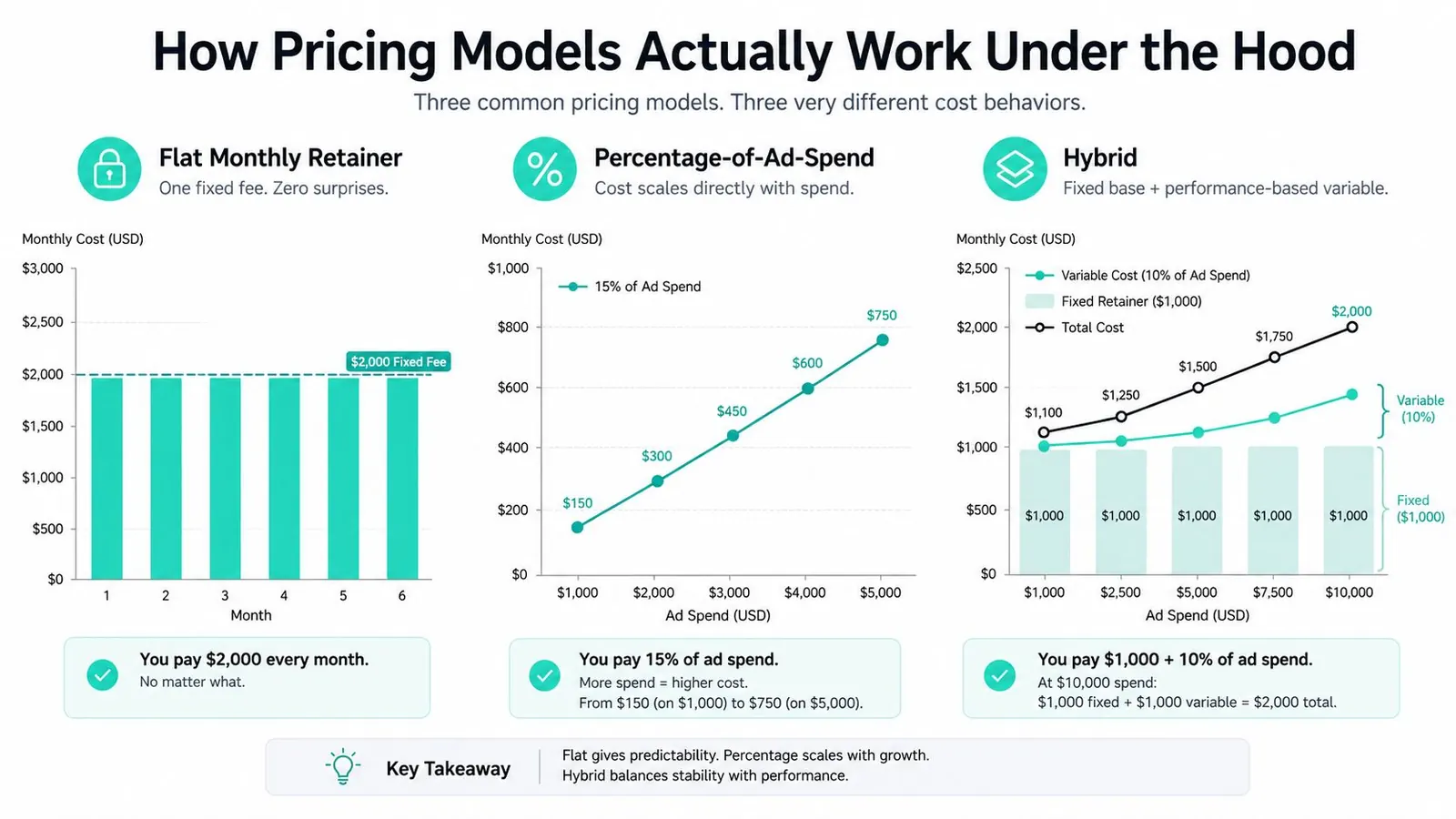
A flat retainer makes cash flow predictable. Choose it when the scope is specific and the package clearly assigns strategy, execution, reporting, and optimization. Reject proposals where “unlimited revisions,” “ongoing optimization,” or “monthly support” stand in for deliverables. Ask what gets completed, by whom, and when you will see it.
A percentage-of-ad-spend model rises with the media budget. It can fit campaigns that require more management as channel activity expands. It can also reward higher spending without proving better returns. Ask for the minimum fee, the treatment of paused campaigns, and separate charges for creative, landing pages, and tracking.
Reverse-engineer the proposal
Suppose a package costs $1,500 per month and includes paid advertising. If only $400 goes toward ad spend, the remaining $1,100 covers management, creative, reporting, overhead, or other services. That allocation may be reasonable, but the proposal must show it plainly. Otherwise, you may believe you are buying media when you are buying a broader service bundle.
Use the budget context to test affordability. Small businesses commonly allocate roughly 7% to 8% of annual gross revenue to marketing, while faster-growing newer businesses may spend up to 12%, according to small business marketing budget benchmarks. A 2023 survey cited an average spend of about $534 per month, or roughly $6,400 per year, showing how limited recurring budgets can be. Recent reporting places the median SMB at 7.9% of gross revenue, with the smallest firms under $500K spending around 10.4%, and larger SMBs above $10M spending closer to 5.8%.
Treat these figures as context, not a spending rule. Separate fixed operating costs, such as hosting and CRM software, from active spend on ads, content, and strategy, as recommended in this small business marketing budget guide.
Track cost per lead, cost per qualified lead, and cost per acquisition by channel. A proposal that reports only impressions, clicks, or completed tasks cannot prove the package is economically sound. Use the first 90 days to test whether the fee, media allocation, and lead quality support continued investment.
Comparing Common Package Tiers and What They Really Get You
Tier names are useful for organizing a proposal, but they aren't evidence of fit. The right package is the smallest scope that can address your current bottleneck and generate enough information to make the next investment decision.
| Tier | Monthly Investment | Core Channels | Typical Deliverables | Best For |
|---|---|---|---|---|
| Entry | Lower recurring investment | Local SEO, listings, reputation basics | Foundational audit, priority fixes, limited content, simple reporting | Established local businesses needing a reliable foundation |
| Growth | Moderate recurring investment | SEO, PPC, landing pages, content, reputation | Active campaign management, conversion tracking, regular optimization, clearer lead reporting | Practices with a validated offer and capacity to handle more inquiries |
| Scale | Higher recurring investment | Multiple paid and organic channels, lifecycle marketing, conversion work | Deeper testing, expanded content, channel coordination, detailed performance reviews | Businesses with strong operations, clear economics, and broader growth goals |
The table is intentionally qualitative. A responsible agency should price the work after reviewing your market, website, service mix, internal response time, and tracking setup. A large deliverable count doesn't make a package suitable for a small practice.
Match the tier to the bottleneck
A law firm with strong referrals but weak local visibility may need a focused foundation, not every available channel. A medspa with consistent demand but poor consultation conversion may benefit more from landing-page and follow-up work than from another stream of social posts.
The same package can behave differently in different markets. A highly competitive legal category may require more authority-building and careful messaging, while a specialized medspa may need visual content, offer clarity, and strong consultation handling. Don't compare packages only by the number of posts or keywords. Compare the business problem each tier is designed to solve.
Website work often sits between package tiers. Before signing, you can compare 2026 website packages to understand what a site-focused engagement may include, then check whether your marketing proposal duplicates that work or leaves conversion problems untouched.
Choose Entry when the foundation is the constraint. Choose Growth when you can respond to demand and need active acquisition. Choose Scale only when your tracking, staff, offer, and follow-up process can support more complexity.
Eight Red Flags That Predict You Will Leave Within a Year
The churn statistic from earlier matters less than what you can detect before signing. Judge the proposal by its operating details, then use the first sixty days to test whether the agency can connect work to leads, appointments, consultations, or cases. A partnership that cannot pass that test rarely improves with time.
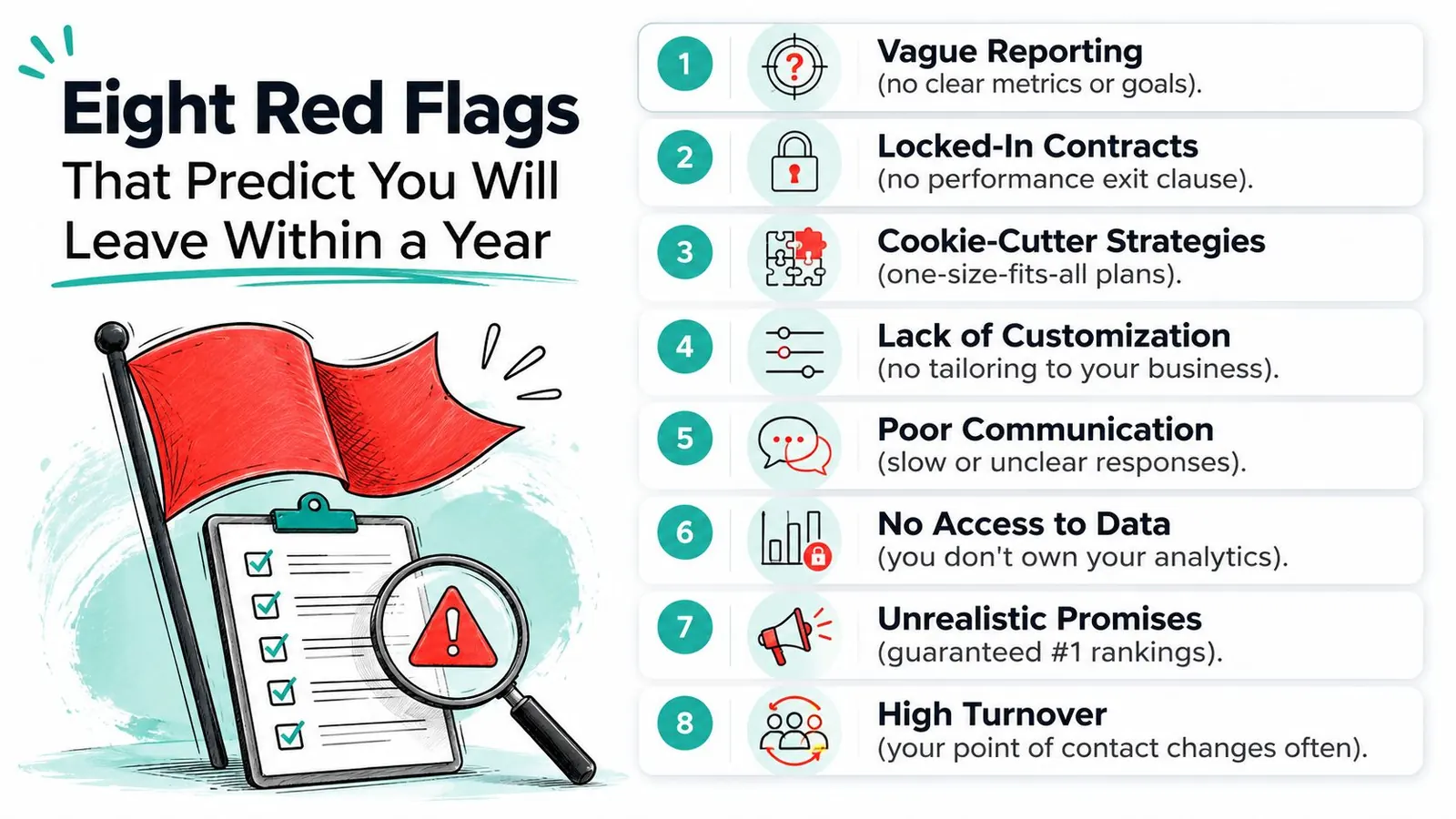
Watch for these disqualifiers
- Vague reporting: The report counts posts, clicks, or tasks without tying them to agreed business goals.
- Locked-in contracts: The agreement provides no performance review, reasonable exit path, or remedy when the stated scope is missed.
- Cookie-cutter strategies: The same channels and messaging appear in proposals for unrelated businesses.
- Lack of customization: The agency has not asked about margins, service priorities, location, intake, or the customer journey.
- Poor communication: Responses arrive late, ownership is unclear, and meetings end without decisions.
- No access to data: Analytics, advertising accounts, call records, or website assets remain outside your control.
- Unrealistic promises: Guaranteed rankings, fixed lead volumes, or certainty about results should end the conversation.
- High turnover: Your strategist or account contact changes repeatedly, so you must explain the business again.
Test these points during the sales call and proposal review. Ask who owns each deliverable, which metric will be reviewed, and what happens when results miss the agreed target.
A red flag does not always require immediate cancellation. Demand a specific correction and document the response. If the agency resists data access, clear measurement, or category-specific planning, the proposal already shows the mismatch that drives early exits.
A Decision Checklist for Dentists, Medspas, Eye Doctors, and Law Firms
A generic package becomes specialized only when the agency changes the strategy, workflow, and risk controls for your category. Replacing “healthcare” with “dental” in a PDF isn't customization.
Dentists
Ask first: How will you manage reviews, patient information, and approvals in a privacy-conscious workflow? The agency should understand that a review response can't expose sensitive details and that appointment growth depends on more than rankings. Check whether the package supports emergency intent, high-value procedures, location pages, and a clear call-handling process.
Medspas
Ask first: Who owns the rights and approvals for before-and-after content? Your proposal should address consent, image usage, treatment claims, offer language, and the difference between awareness content and consultation conversion. A feed full of attractive posts isn't a strategy if prospects can't understand eligibility, pricing context, or the next step.
Eye doctors
Ask first: Which services and patient groups are you prioritizing, and how will you measure the resulting inquiries? An optometry practice may need different messaging for routine exams, specialty care, eyewear, or urgent symptoms. The package should map service pages, local visibility, paid search, and appointment pathways to the practice's actual capacity.
Law firms
Ask first: How will the strategy comply with the advertising and professional-conduct rules in your state? The agency should identify who reviews claims, testimonials, case descriptions, disclaimers, and practice-area content. It should also distinguish a contact form submission from a qualified matter, because lead volume alone can hide poor fit.
Ask for the workflow, not the label. A “custom package” should show custom research, custom priorities, and custom approvals.
Before signing, confirm who owns the accounts, who writes and approves content, who responds to leads, and what happens when your team can't meet a requested deadline. You can also review an agency's positioning and approach through Leaping Lemur Media's about page as part of your broader vendor evaluation.
Your 90-Day Package Evaluation Framework
A quarterly review is too vague unless you define what happens inside the quarter. Use the first 90 days to establish a baseline, confirm execution, inspect data quality, and decide whether the package deserves continuation or renegotiation.
Weeks 1 and 2 establish the baseline
Record current rankings for priority services, organic traffic, inquiry sources, call activity, form completions, booked appointments, consultations, and qualified matters. The exact metrics depend on the practice, but the principle is fixed: capture the starting point before the agency changes the website, campaigns, listings, or tracking.
Confirm access to Google Analytics, Google Search Console, advertising platforms, call tracking, CRM records, and website systems. If the agency can't connect activity to a lead source, you won't be able to assess the package later.
Weeks 3 and 4 review the measurement system
By the end of the first month, ask whether the reporting is understandable and whether the goals still match the business. A dashboard should show more than traffic or ad clicks. It should help you see which channels create inquiries and whether those inquiries fit your services.
Use the first checkpoint to correct definitions. Decide what counts as a lead, qualified lead, appointment, consultation, and acquisition. Without shared definitions, the agency can report success while your front desk or intake team sees little value.
Weeks 5 through 8 audit activity and quality
Review whether the agreed campaigns launched, whether landing pages function, whether tracking records real actions, and whether content reflects your practice. Inspect the work itself. Check search intent, calls to action, brand voice, compliance, review responses, and follow-up routes.
At the day-sixty conversation, ask what the team learned and what it changed because of that learning. A credible partner should be able to identify weak assumptions, explain adjustments, and prioritize the next test. “We're still building” isn't enough if no meaningful work or measurement has occurred.
Weeks 9 through 12 check performance and economics
The final checkpoint should examine lead quality, cost per acquisition, conversion behavior, channel performance, and directional growth. SEO may require patience, while paid campaigns can provide earlier behavioral signals. That difference doesn't excuse weak tracking or absent optimization.
Keep the package when execution is consistent, measurement is trustworthy, and the business is learning what to improve. Renegotiate when the scope is active but misaligned with your bottleneck. Walk away when the agency avoids data access, can't explain the work, or keeps changing the definition of success.
For more practical guidance on marketing strategy and evaluation, browse the Leaping Lemur Media journal.
Leaping Lemur Media helps practices connect paid advertising, SEO, conversion-focused websites, and content to the way real patients and clients make decisions. If you're reviewing small business marketing packages for a dental practice, medspa, eye doctor, or law firm, visit Leaping Lemur Media to discuss a scope built around measurable priorities rather than generic tiers.